

Why is Belgian Blue Stone so strong and durable?
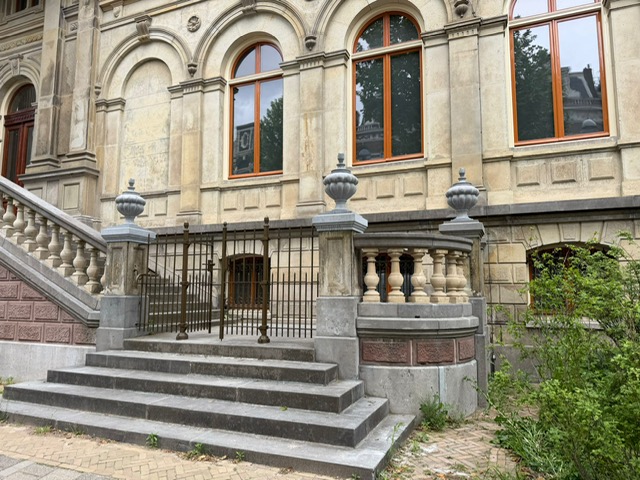 Project: ARTIS Zoo, Amsterdam · Photo: Monser Natuursteen
Compact structure: the foundation of strength and durability
The exceptional qualities of Belgian Blue Stone begin deep within the stone itself. The rock has a very fine and compact structure in which limestone particles, fossil fragments, and calcite have fused together over millions of years to form a dense whole.
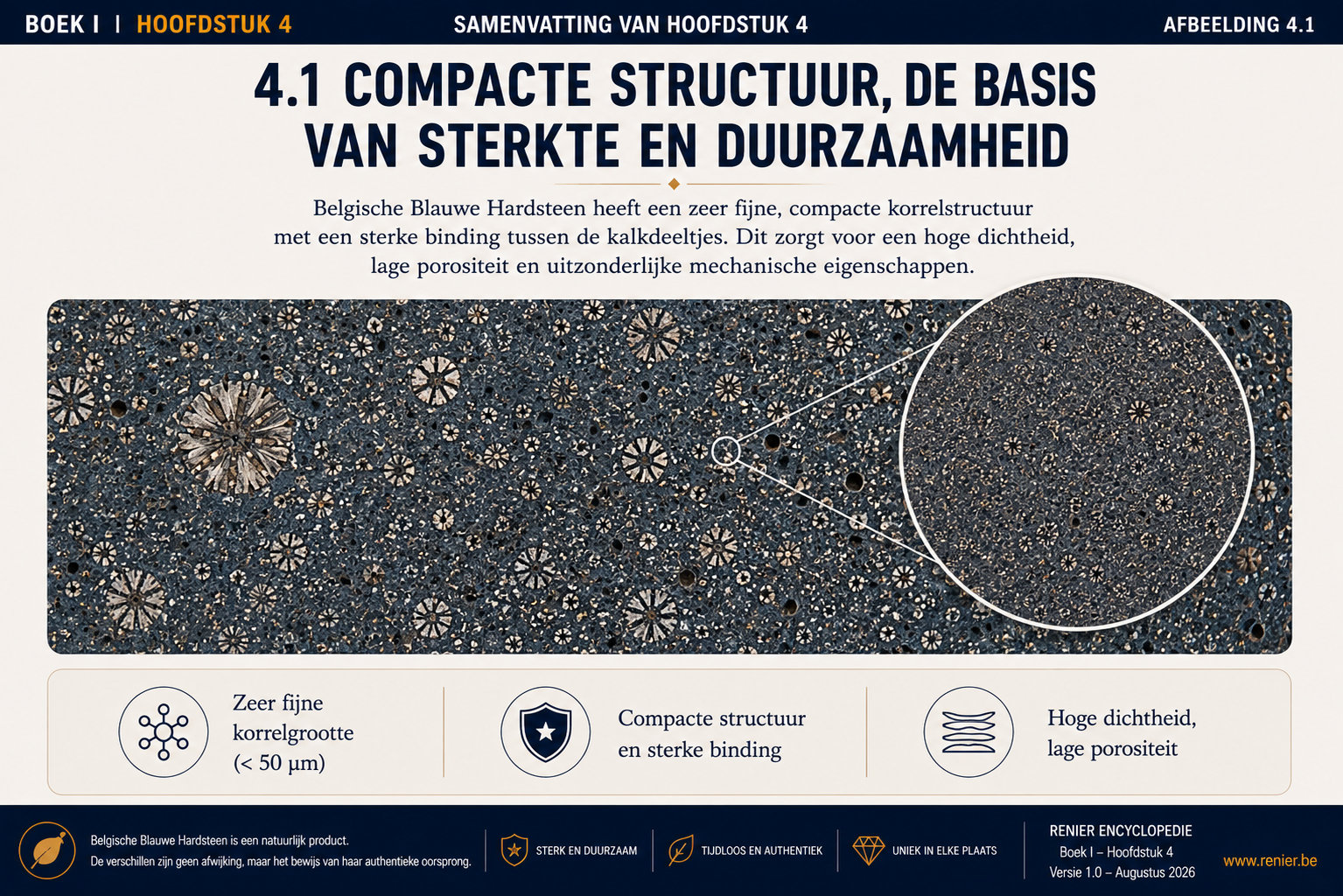
Belgian Blue Stone is not a collection of loose, unbound grains. During the rock’s formation, the original calcareous sediments were buried, compressed, and cemented together. This resulted in a particularly compact material.
That internal structure is fundamental. The less open space there is between the components, the more difficult it is for water and other substances to penetrate the rock. At the same time, the strong bond between the mineral components ensures high mechanical strength.
Compressive Strength That Makes an Impression
A natural stone that has been used for generations for sills, stairs, floors, facades, and paving must be able to withstand heavy mechanical loads.
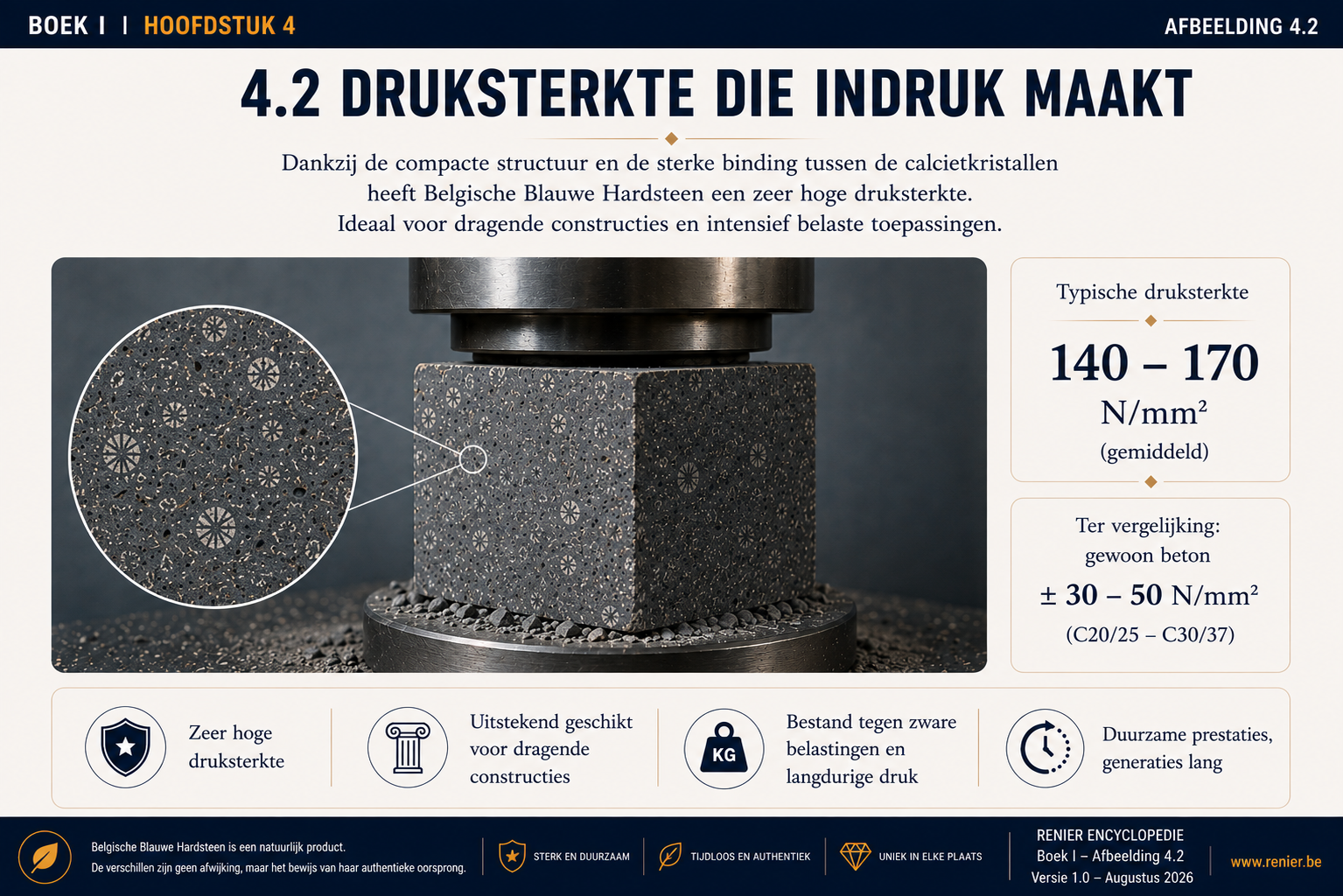
Compressive strength indicates how much pressure a material can withstand before it fails. In natural stone, this property is determined by the mineralogical composition, the internal structure, and the extent to which the various components are bonded together.
The compact structure of Belgian Blue Bluestone ensures that loads are distributed efficiently throughout the material. This explains why the stone is traditionally used in places where reliability and structural strength are important.
Compact
The dense structure minimizes weak zones in the rock.
Strong
The stone can withstand significant mechanical loads.
Proven
Centuries-old applications demonstrate its performance in practice.
Low porosity and high density
One of the main reasons for the durability of Belgian Blue Stone is the combination of high density and a very limited number of open pores.
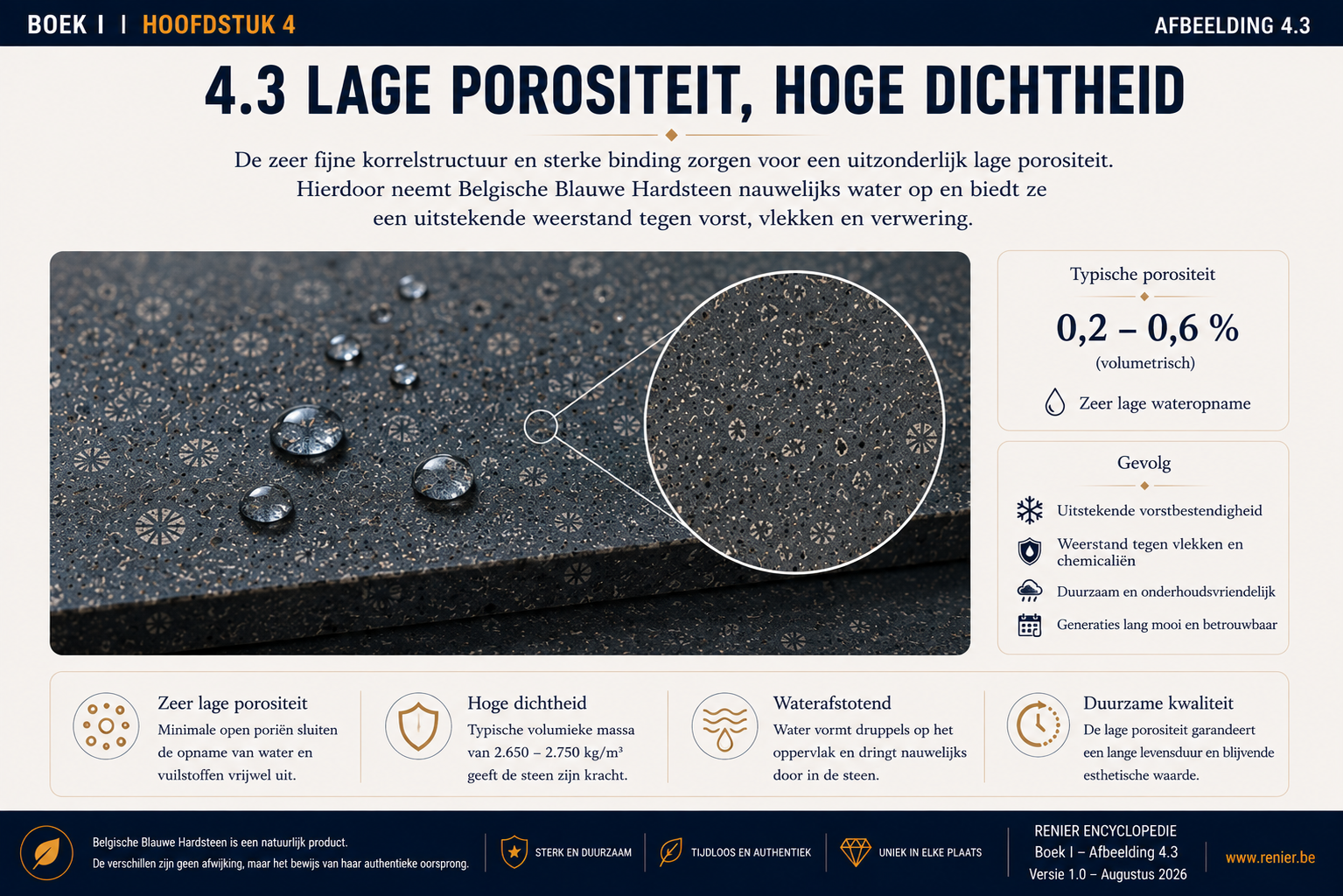
Porosity refers to the small open spaces present in a rock. Water can penetrate the material through these pores. In a dense rock, these open spaces are limited, and water absorption is also low.
This is important for outdoor applications. Water that can barely penetrate the stone is also much less likely to . The low porosity therefore forms a key link between the brick’s internal structure and its resistance to weathering.
Resistance to Frost and Thaw
Belgian Blue Stone has been used outdoors for centuries. Sills, stairs, facade stones, paving stones, and patios are constantly exposed to rain, moisture, frost, and thawing.
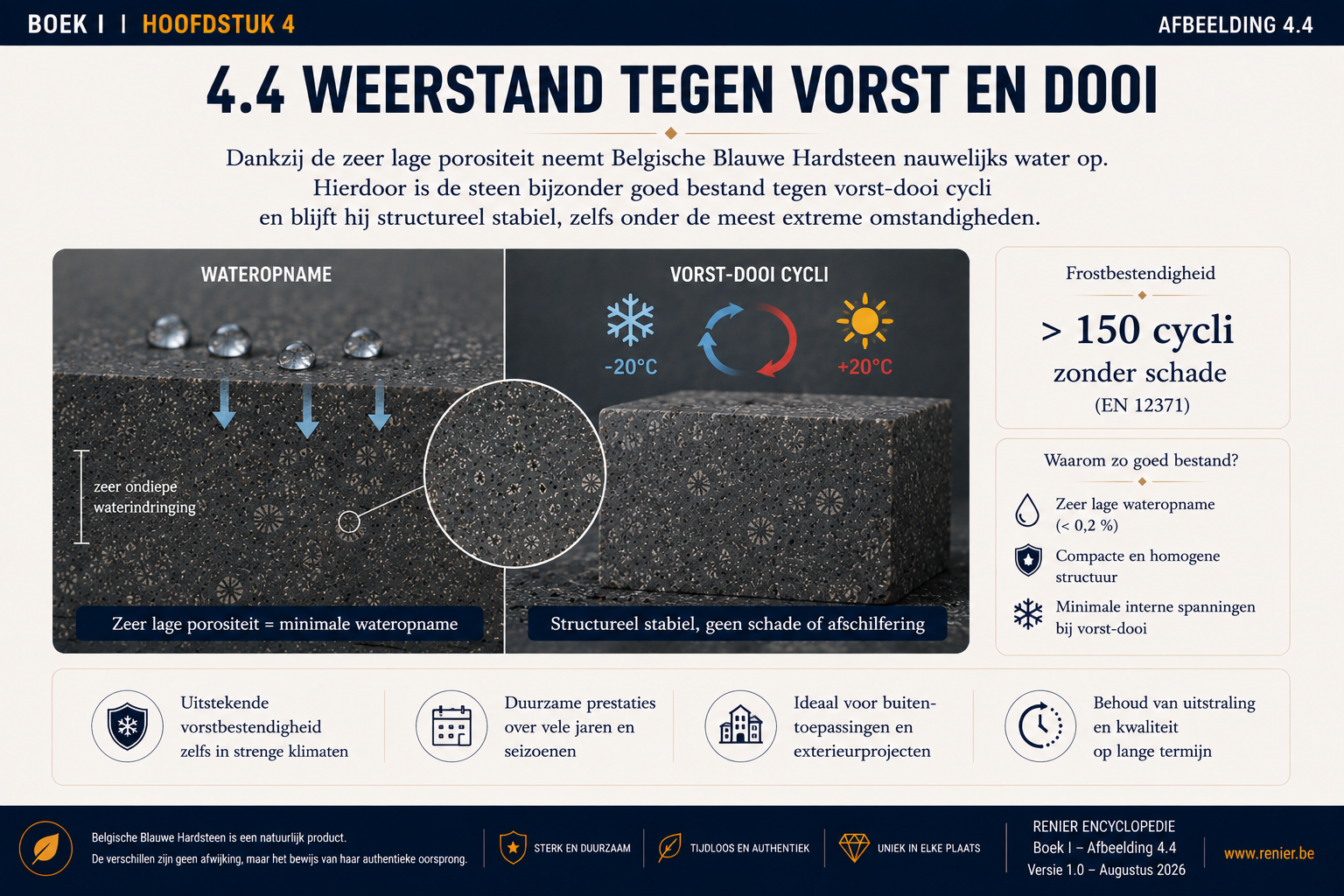
When water penetrates a porous material and then freezes, it expands. Repeated freeze-thaw cycles can cause this change in volume to generate internal stresses.
Due to its compact structure, Belgian Blue Stone absorbs relatively little water. As a result, there is less water available that can cause internal pressure when it freezes. This helps explain why the stone is particularly well-suited for outdoor applications in our climate.
Sustainability Through the Centuries
Technical figures tell only part of the story. Ultimately, the most convincing test of sustainability is time itself.
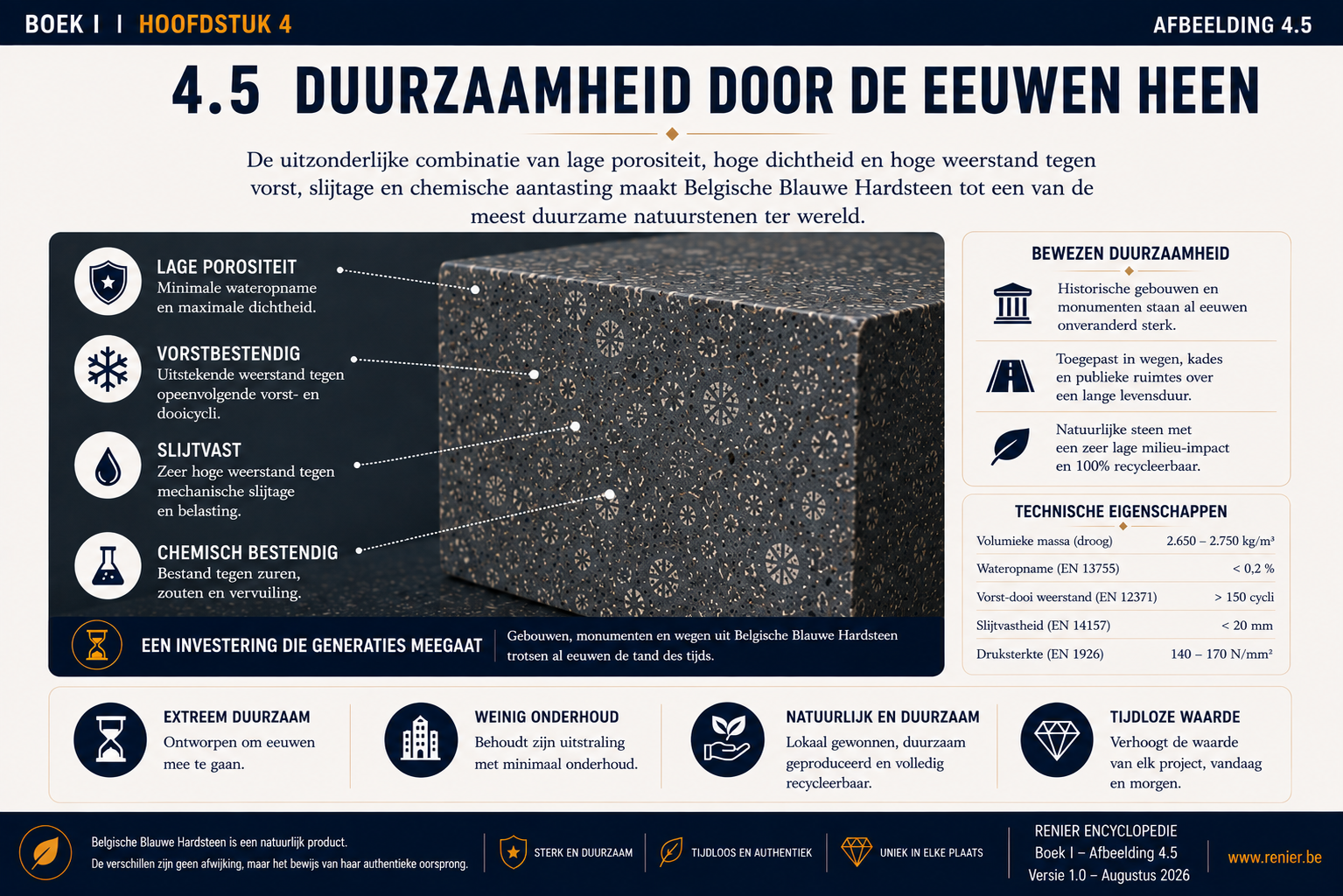
Belgian Blue Stone has been used for centuries in buildings, churches, monuments, streets, stairways, and public spaces. Many of these applications are still visible today.
This long-term use demonstrates that durability means more than just resistance to a single specific type of stress. A stone must be able to withstand mechanical stress, water, temperature fluctuations, wear and tear, and natural aging all at the same time.
That is precisely where the strength of Belgian Blue Stone lies: several favorable properties reinforce one another and, together, ensure an exceptionally long service life.
350 million years old, but still not outdated
Belgian Blue Stone is about 350 million years old. Yet its story doesn’t end when it’s extracted from the quarry and installed in a building, on a patio, or in a landscape.

It is important to distinguish between geological age and aging of the visible surface. The stone itself was formed during the Carboniferous Period. The surface that we saw today—whether sanded, polished, or finished in some other way—is, on the other hand, new.
As soon as the stone is installed, its surface begins to react to its surroundings. Light, rain, air, wear, and time cause subtle changes in color and appearance. Gradually, a natural patina develops.
That patina need not be viewed as a flaw. On the contrary, it is one of the characteristics that sets natural stone apart from many artificial materials. Over the years, the stone gains more nuance, depth, and character.
Why does Belgian Blue Stone last for generations?
There is no single characteristic that explains its long lifespan. Rather, it is the combination of its geological origin, compact structure, and technical properties that makes Belgian Blue Bluestone so durable.
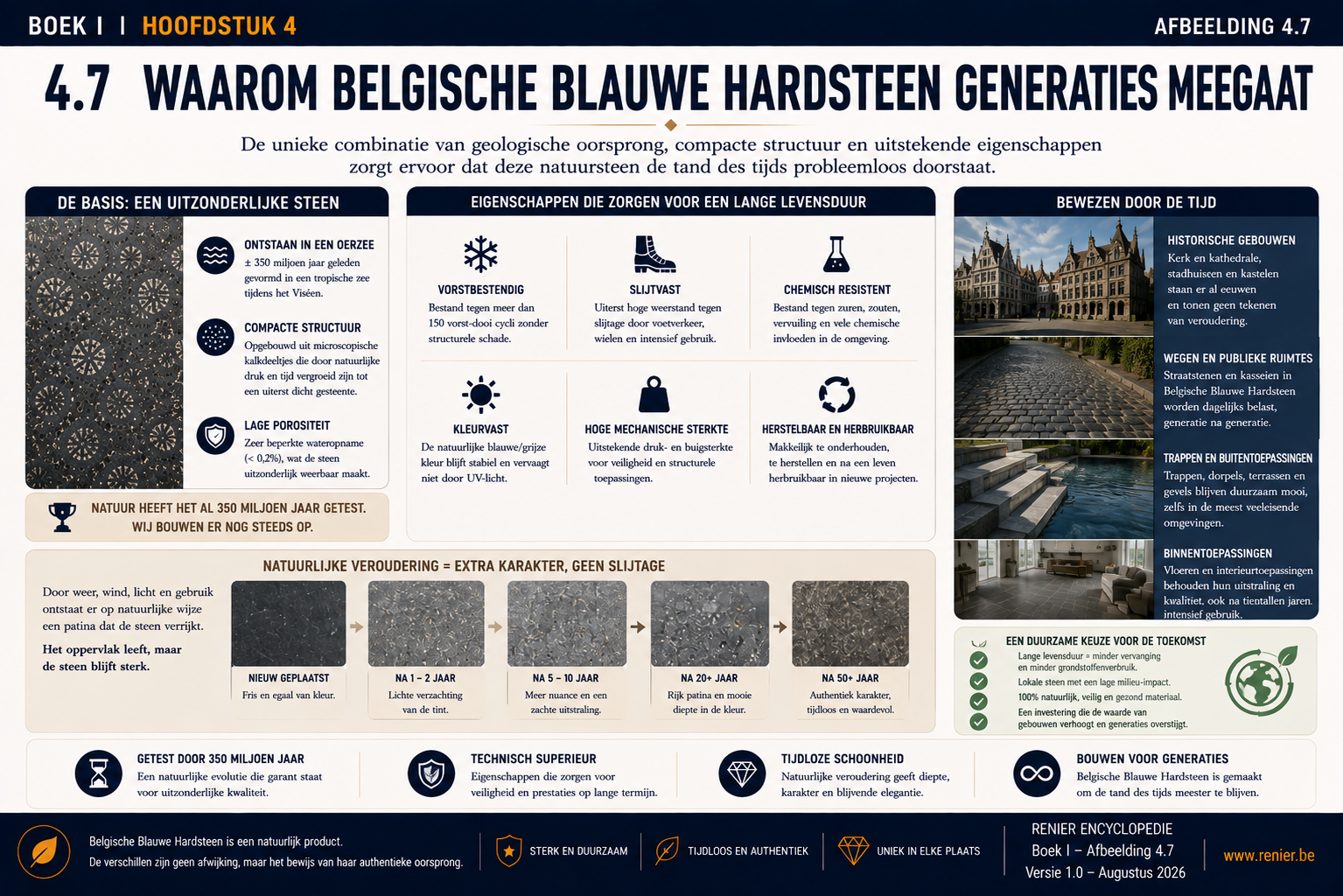
Compact and strong
The dense rock structure gives the stone high mechanical strength.
Low water absorption
The low porosity limits the effects of moisture and enhances frost resistance.
Aging Gracefully
Use and weathering can create a natural patina without detracting from the stone's character.
There is another important advantage: natural stone can often be reworked. After years of use, a surface can be cleaned, sanded, or finished in some other way. Even entire elements can be reused in certain situations.
A material that lasts a long time, ages beautifully, and can be reused doesn’t need to be replaced as often. Its long technical service life thus also becomes an important part of the sustainable value of Belgian Blue Stone.
Why is Belgian Blue Stone so strong and durable?
The durability of Belgian Blue Stone is the result of a geological process that began approximately 350 million years ago. The properties that developed in the rock at that time continue to determine its exceptional performance to this day.
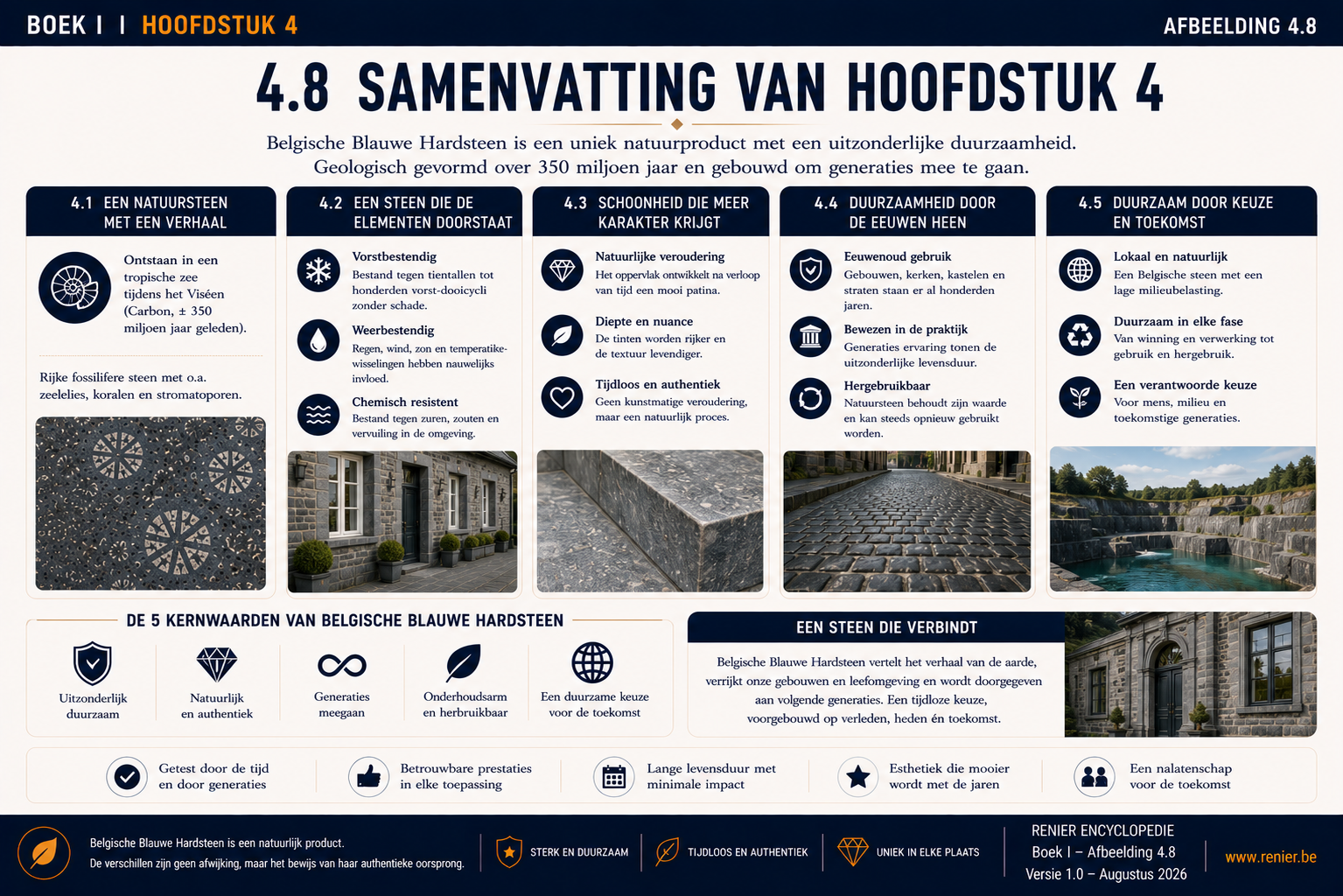
Chapter 4 at a Glance
Belgian Blue Bluestone combines an ancient geological origin with properties that remain particularly relevant today.
The fine, dense internal structure forms the basis of its mechanical strength.
Limited open pores result in low water absorption.
The stone can withstand heavy loads, weather conditions, and repeated freeze-thaw cycles.
The surface changes over time and can develop a distinctive natural patina.
Historical examples show that the stone can maintain its function for generations.
Long service life, repairability, and opportunities for reuse reduce the need for replacement.
About the Strength and Durability of Belgian Blue Stone
Why is Belgian Blue Stone so strong?
Its high strength is due to its very compact rock structure and the strong bonds between the mineral components. The calcareous sediments were compressed and cemented over millions of years into a dense rock.
Is Belgian Blue Bluestone suitable for outdoor use?
Yes. Its compact structure, low porosity, and limited water absorption contribute to its good resistance to weather conditions and freeze-thaw cycles. That is why the stone has been used for centuries for applications such as sills, stairs, paving, facades, and patios.
Why does Belgian Blue Stone absorb so little water?
The rock has a dense structure with relatively few open pores. As a result, only a limited amount of water can penetrate the rock.
Does Belgian Blue Stone become less attractive as it ages?
Not necessarily. The surface changes over time due to the effects of light, rain, air, and use. This can result in a natural patina that gives the stone more nuance, depth, and character .
How long does Belgian Blue Stone last?
The service life depends heavily on the application, installation, load, and maintenance. However, historic buildings, pavements, and other applications demonstrate that Belgian Blue Bluestone can remain functional for very long periods—and even across generations.
Can old Belgian Blue Stone be reused?
In many situations, yes. Natural stone can be cleaned, reworked, or reused as a complete element, depending on its condition, dimensions, and original application.