From Rock to Quarry
Geological movements, folding, and erosion eventually made the deep rock layers accessible for mining.
Coming soon

Alles over de oorsprong, geschiedenis, eigenschappen, ontginning, verwerking en toepassingen van Belgische Blauwe Hardsteen.
Open the reference book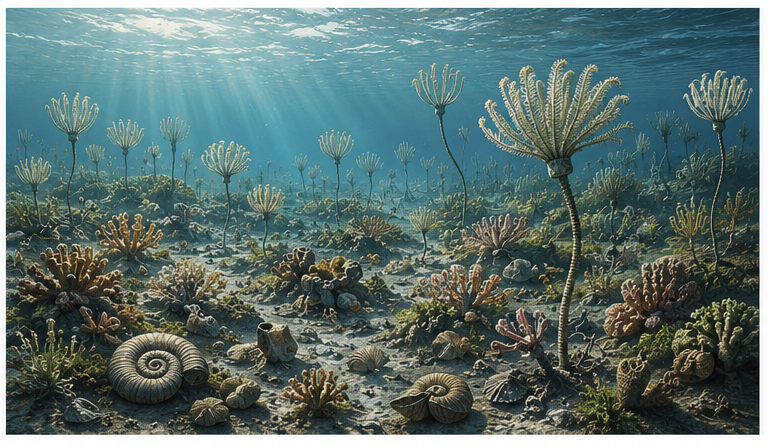
The stone, which formed approximately 350 million years ago, is currently being quarried by Renier at the La Préalle quarry in Sprimont. Here, geological history meets modern craftsmanship.
Not a story spanning decades. Not centuries. But about 350 million years.
The stone we walk on, that protects a facade or forms a staircase, came into being long before the first dinosaurs appeared. It has witnessed continents shifting, seas disappearing, and mountain ranges forming.
What is now a compact and durable natural stone began as an accumulation of calcareous remains of marine organisms on the bottom of a warm, shallow sea. Pressure, mineralization, and time gradually transformed this sediment into Belgian Blue Stone.
This digital reference work brings together geological, historical, and technical knowledge with the experience of an active quarry operator and natural stone producer. We trace the stone from its very origins to its application in contemporary architecture, heritage, interior design, and landscaping.
The reference work is being compiled step by step. Each book covers a separate aspect of the history of Belgian Blue Stone.
A journey to the warm tropical sea where calcium-rich sediments and fossils accumulated over millions of years.
Read Book IGeological movements, folding, and erosion eventually made the deep rock layers accessible for mining.
Coming soonThe chemical and mineral composition, petrography, fossils, color, and physical-mechanical properties.
Coming soonFrom historic stonemasons and manual quarrying to the mechanization of the Belgian natural stone industry.
Coming soonThe geology, history, and current quarrying of Belgian Blue Stone at Renier’s own quarry in Sprimont.
Coming soonSelection, sawing, milling, finishing, quality control, and delivery: the entire process from quarry to construction site.
Coming soonHow sanding, honing, bush-hammering, sandblasting, flame-texturing, and brushing determine the appearance and use.
Coming soonFrom thresholds, facades, and staircases to floors, pool edges, interiors, restoration, and public spaces.
Coming soonPractical and technical knowledge regarding installation, protection, maintenance, patina, repair, and restoration.
Coming soonLocal production, long service life, reuse, circularity, and the future of Belgian natural stone.
Coming soon
The story begins about 350 million years ago. Belgium did not yet exist, and the region was located thousands of kilometers further south, close to the equator.
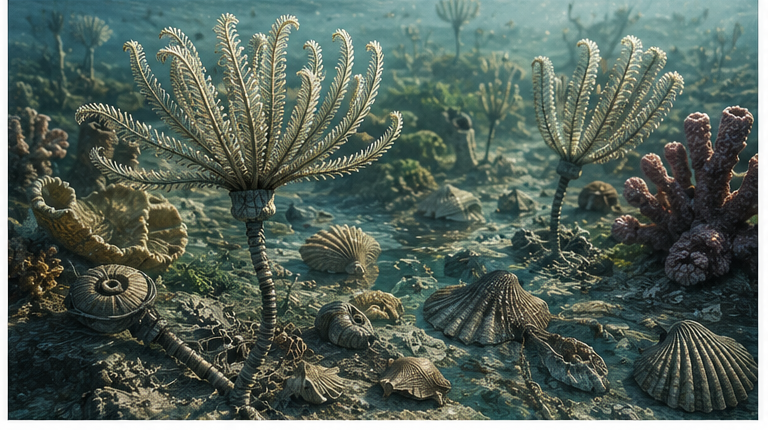
A warm, shallow sea was the habitat of sea lilies, corals, brachiopods, and countless other organisms. Their calcium-rich remains gradually formed the basis of the stone we know today as Belgian Blue Bluestone.
Sea lilies, or crinoids, resemble plants but are animals that are related to starfish and sea urchins. They lived attached to the seafloor and filtered food particles from the water.
After their death, their calcium-rich skeletons disintegrated into small slivers and fragments. These remains became an important component of Belgian Blue Stone.
The light-colored circles and star-shaped patterns in honed or polished Belgian Blue Stone are often cross-sections of fossil crinoids.
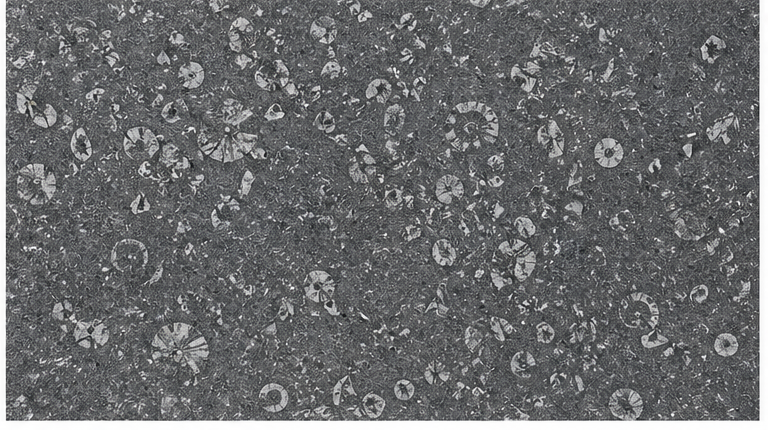
The fossils and limestone fragments are not a decorative pattern that was added later. They are part of the rock itself.
As a result, no two slabs are completely identical. Each surface reveals a different cross-section of a vanished ecosystem and bears a unique pattern of fossil remains.
It is precisely this combination of natural variation, technical quality, and geological history that gives Belgian Blue Stone its distinctive character.
Discover how a long-vanished tropical sea ultimately gave rise to one of Belgium’s most recognizable and durable natural stones.
Start het naslagwerk →