

What makes Belgian Blue Stone blue?
The characteristic blue-gray color of Belgian Blue Stone is the result of its mineral composition, fine rock structure, and natural geological characteristics. In this chapter, we’ll literally look inside the stone to understand why each slab has its own shade and character.
Belgian Blue Stone is never simply a uniform blue stone. If you look closely, you’ll discover a complex interplay of gray and blue-gray hues, faint fossil remains, calcite structures, dark lines, and natural variations.
In the previous chapters, we saw where the rock formed and which organisms provided the calcareous sediments. Now, the focus shifts from its formation to the rock itself: where does its characteristic color come from, what role does calcite play, and what does the rock look like on a microscopic scale?
Even the visible surface tells only part of the story. A different finish can make the exact same stone appear lighter, darker, more matte, or more glossy. Furthermore, after installation, the surface gradually changes over time due to wear, use, and environmental factors. This is how the patina that is so characteristic of natural stone develops.
Chapter 3 therefore links composition, microstructure, and appearance. It explains why Belgian Blue Stone remains recognizable, yet no two slabs are completely identical.
The color comes from the stone itself
The blue-gray appearance is not the result of a coat of paint or a surface treatment. It stems from the rock's natural composition and fine texture.
Belgian Blue Bluestone formed from calcareous sediment in which the remains of marine organisms, fine calcareous mud, and other components were deposited together. Through burial, compaction, and cementation, this loose sediment transformed into dense limestone.
The stone consists mainly of calcite, but there is also darker material among the very fine calcite crystals and fossil remains. The ratio and distribution of these components help determine how light or dark the surface appears.
When a surface is sawn or finished, that internal structure becomes visible. Light-colored fossil remains stand out against a darker limestone matrix, creating the typical blue-gray color and the distinctive contrast of Belgian Blue Stone.
The stone is not literally bright blue. “Blue Hardstone” refers to the typical cool blue-gray to dark-gray color range visible in the natural rock, which can appear different depending on the finish and lighting.
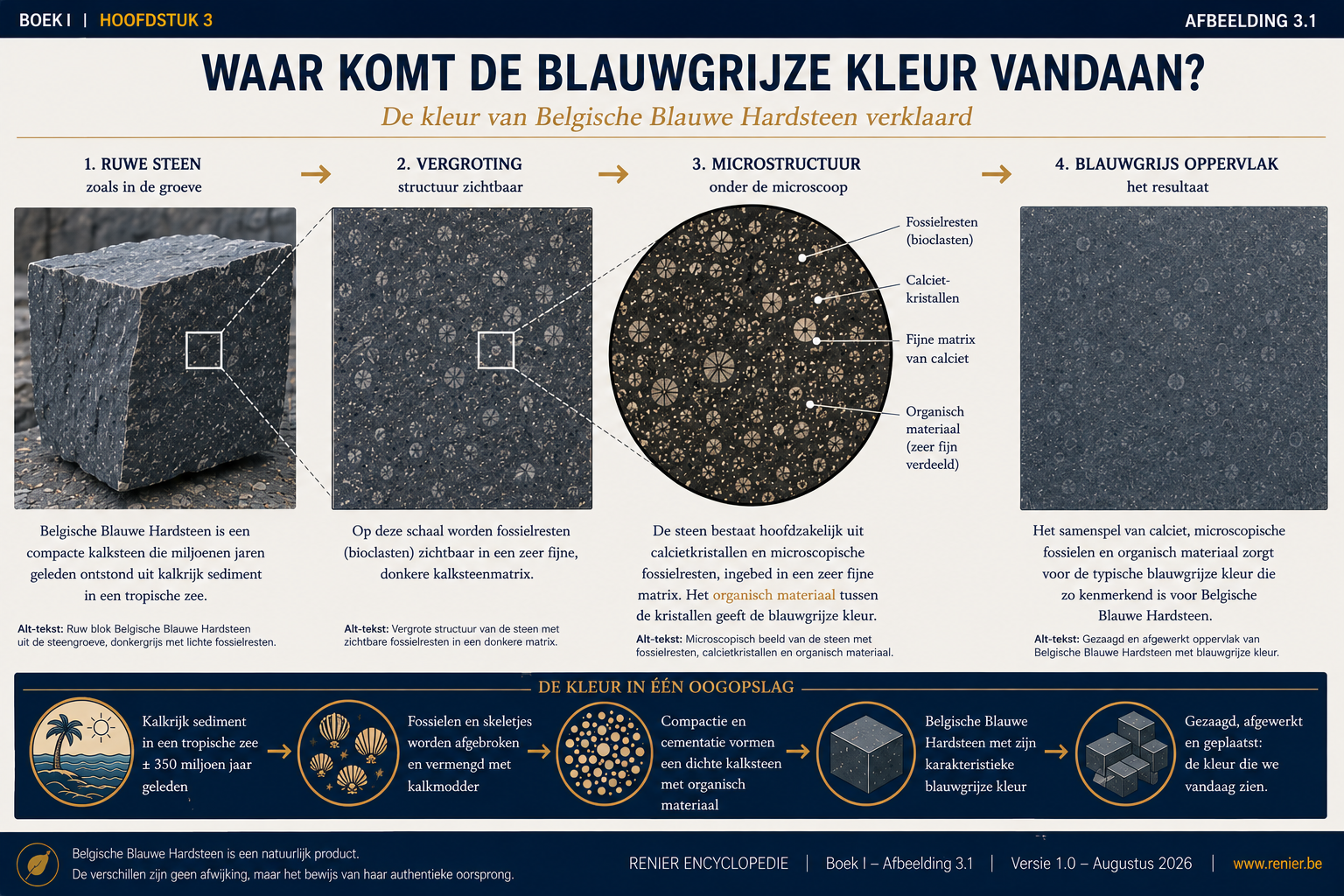
The mineral composition of the stone
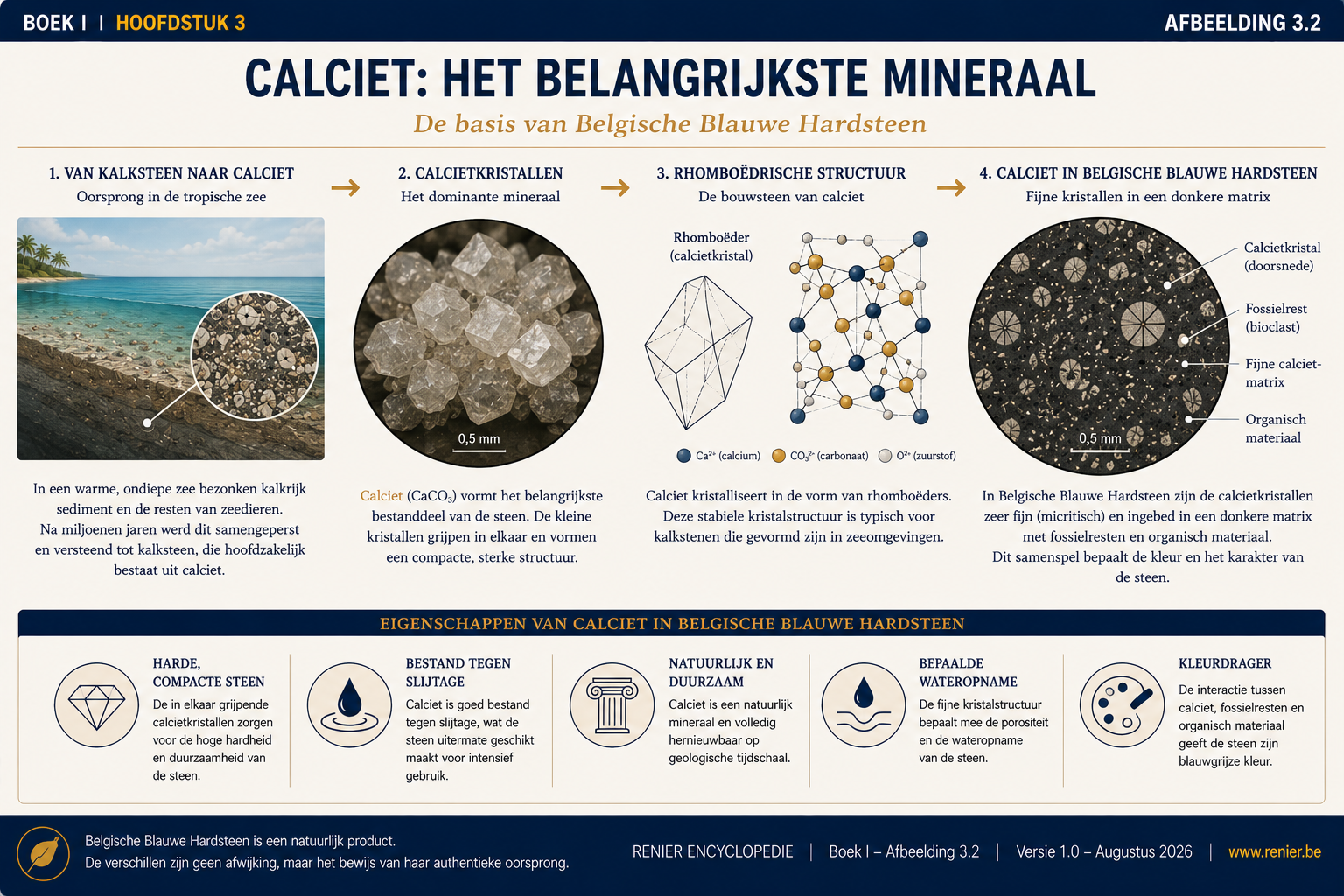
Calcite is the main mineral component of Belgian Blue Stone and directly links its geological origin to the visible stone.
Calcite is calcium carbonate (CaCO₃). In the primordial tropical sea, large quantities of calcium carbonate were produced by organisms with calcareous skeletons and through the formation of fine calcareous mud. After deposition, this material became the basis for limestone.
As the rock continued to form, calcite crystallized and cemented the sediment particles together. This bound the individual components more and more tightly together. What had once been soft limestone mud and loose skeletal remains became a single, cohesive rock.
Calcite does not appear uniformly throughout the stone. It may be part of the very fine matrix, form fossil remains, or be visible locally as a lighter vein or crystalline structure. As a result, it affects not only the composition but also the surface pattern.
A rock is not a single crystal. Belgian Blue Stone consists of countless mineral particles and fossil remains that together form a compact limestone, with calcite as the dominant mineral component.
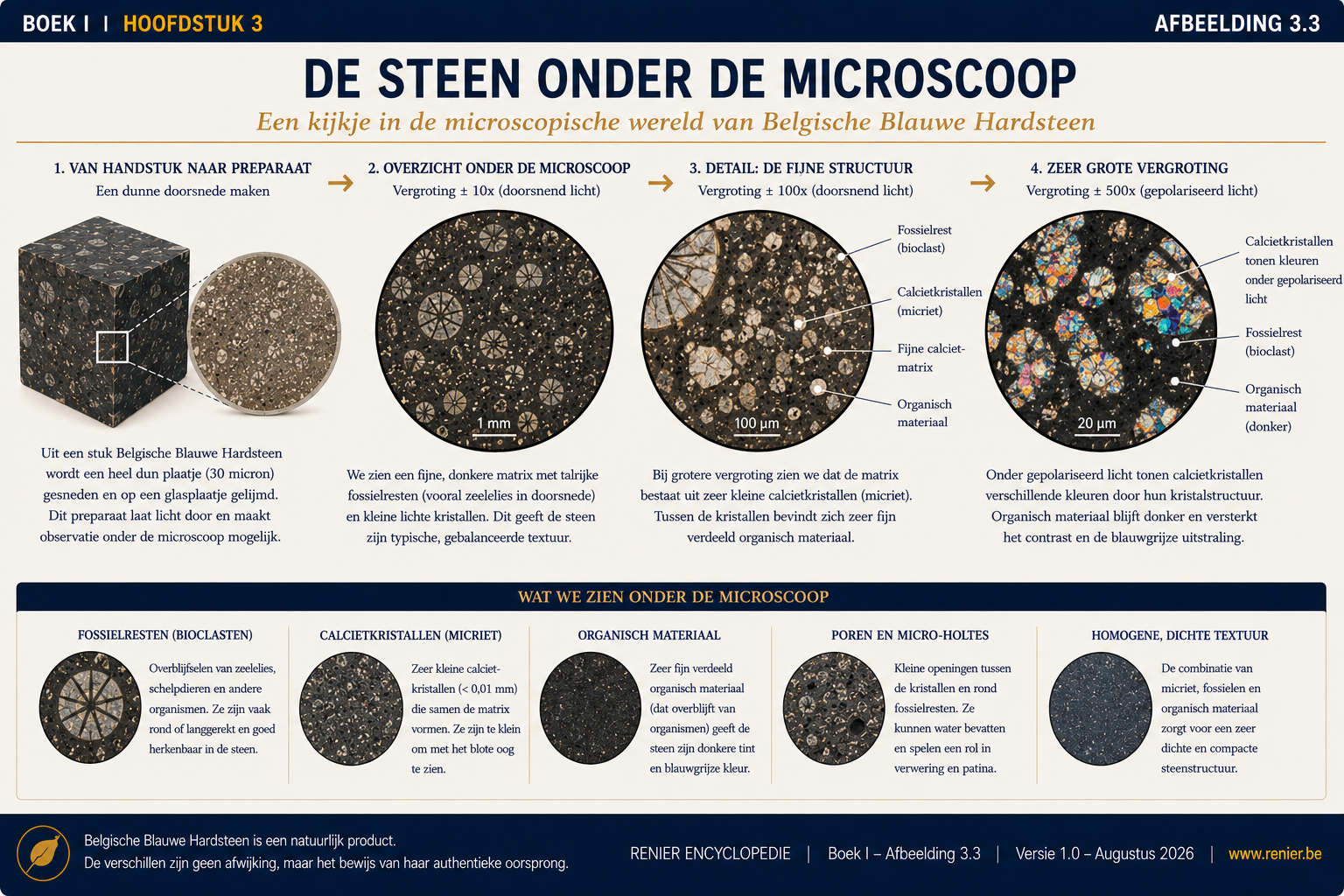
A world invisible to the naked eye
Under magnification, the seemingly homogeneous surface reveals itself to be a fine mosaic of fossil remains, calcite crystals, matrix, and small natural openings.
For microscopic examination, a very thin section of the stone can be prepared. This makes it much easier to identify individual components than on a regular sawn surface.
Fossil remains, or bioclasts, are often larger than the surrounding matrix and are therefore relatively easy to distinguish. Between them lies a very fine calcareous matrix composed of small calcite particles.
Upon closer examination, it becomes clear that, despite its compact appearance, the rock is not a completely uniform mass. There are variations in crystal size, fossil content, and very small pores or cavities. It is precisely this microstructure that helps explain why the rock has its characteristic texture.
Under polarized light, calcite crystals can also be observed in a different way. This allows for mineralogical analysis without being able to make a direct comparison with the appearance of a finished slab.
The beautiful structures that become visible under high magnification serve as a research tool. When looking at a finished plate, we primarily perceive the combined effect of millions of tiny components.
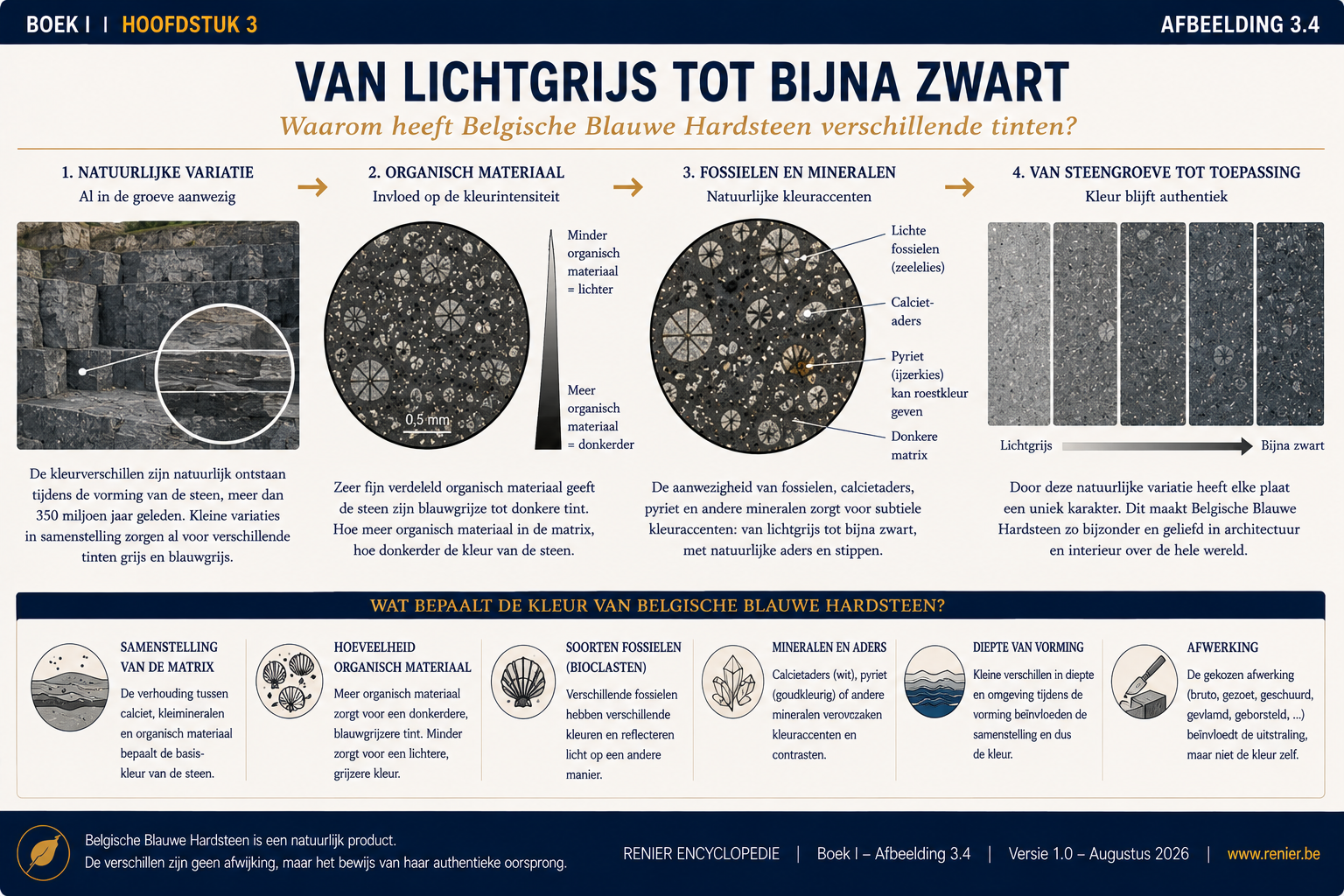
Natural color variation is a natural characteristic of the stone
Belgian Blue Bluestone has a distinctive character, but no mathematically defined color.
The composition of the original sediment varied from place to place and from layer to layer. As a result, the ratio of fine matrix, calcite, fossil remains, and darker material also varies.
These variations may be subtle, but they become apparent when multiple slabs or blocks are placed side by side. Some areas appear lighter gray, while others are noticeably darker or bluer. Light or dark areas may also appear within a single slab.
The fossils also play a visual role in this regard. Light-colored cross-sections of sea lilies and other fossil remains reflect light differently than the darker matrix. As a result, a slab with many visible fossils may appear more vibrant or have greater contrast.
Natural color variation is therefore not a manufacturing defect. It is a direct result of the fact that the stone was formed over millions of years under natural conditions.
The name "Belgian Blue Bluestone" describes a type of rock with a distinctive character, not a single, precisely reproducible color as is the case with an industrially manufactured material.
The geological signature in every slab
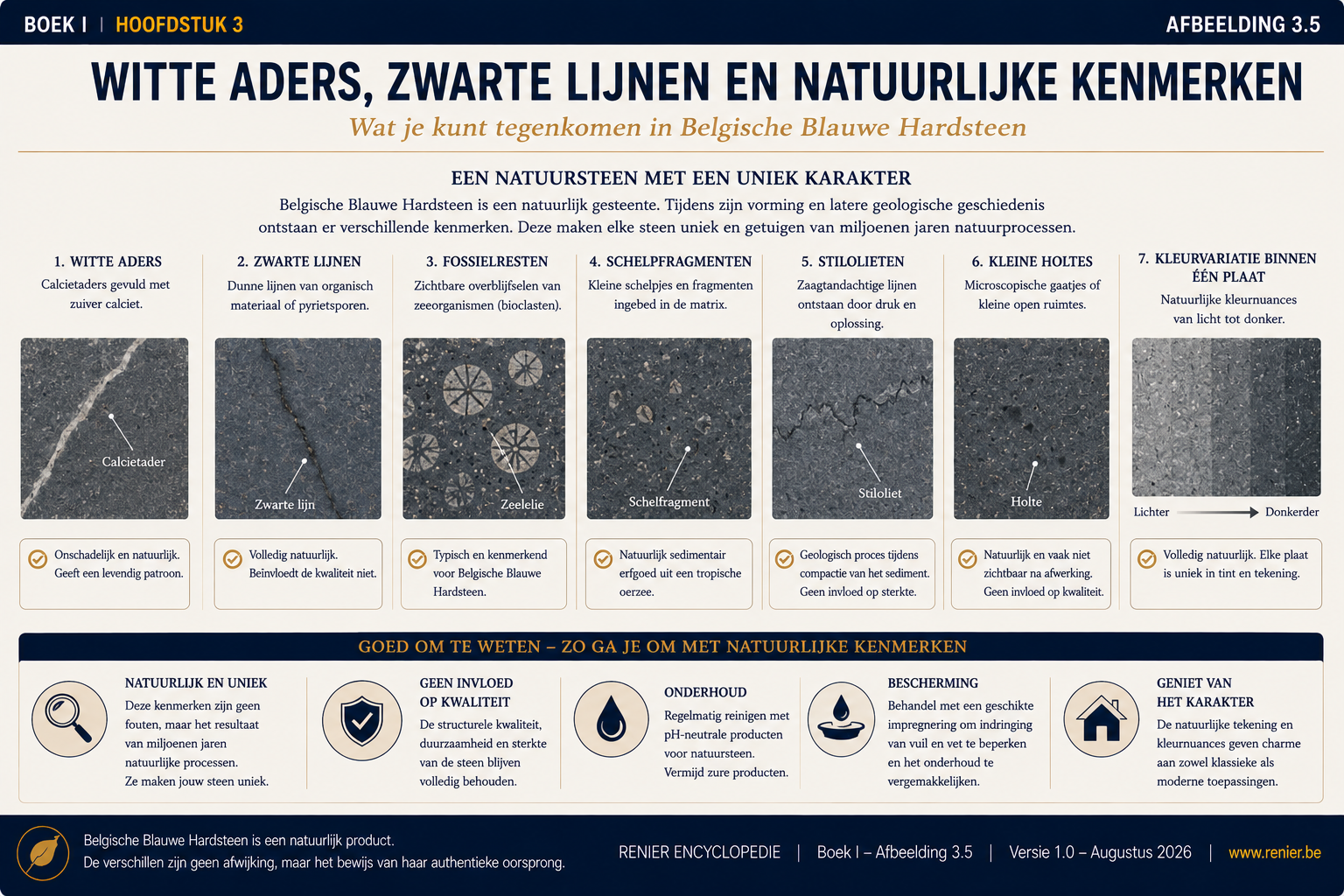
If you take a closer look at Belgian Blue Stone, you’ll see much more than just fossils and color. Veins, lines, stylolites, and other natural structures can also be part of the picture.
Lighter veins can form where calcite minerals have been deposited in a cavity or crack. They contrast sharply with the darker stone and sometimes form long, fine lines across a slab.
Dark lines can have a wide variety of appearances. Some are very fine and straight, while others are irregular or jagged. Stylolites are a typical example of natural structures associated with pressure and dissolution during the geological history of the rock.
In addition, fossil remains, shell fragments, and small natural cavities remain visible. Depending on their location within the rock, the cutting direction, and the finish, these features can be very pronounced or nearly invisible.
Not every visible feature has the same geological origin. What they do have in common is that they show the stone is a natural product and not a homogeneous industrial surface.
A visible natural characteristic is not automatically a technical defect. The assessment of a stone is always based on the type of structure, the application, and the technical quality of the material.
The same stone can look completely different
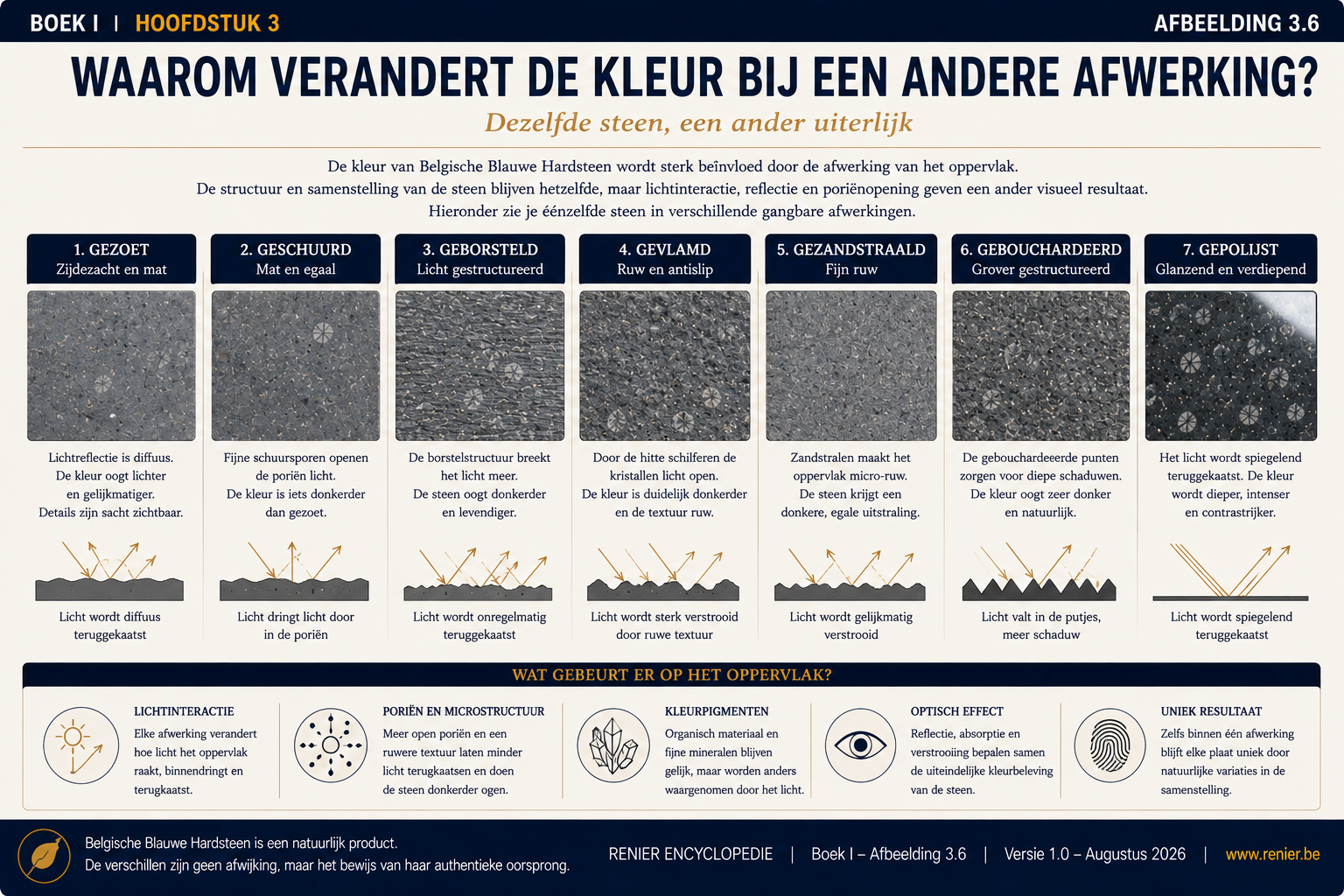
Surface treatment does not change the rock itself, but it does change how light strikes the surface, is scattered, and is reflected back to our eyes.
A relatively smooth surface reflects light differently than a rough surface. As a result, a smooth, refined finish can appear deeper and darker, while a rougher texture scatters the incoming light more widely and can make the stone appear lighter.
Fossils and natural patterns also respond visually to the finish. With a fine finish, contrasts can become sharper and deeper. A brushed, bush-hammered, flamed, or sandblasted texture, on the other hand, introduces relief, shadows, and a more tactile appearance.
That is why it is important to always evaluate samples in their desired finish. Two samples from the same rock can, at first glance, appear to be almost entirely different materials due to their surface treatment.
When a finish makes the stone appear darker or lighter, this does not mean that its mineral composition has changed. The optical effect occurs primarily on the surface.
The stone continues to interact with its surroundings
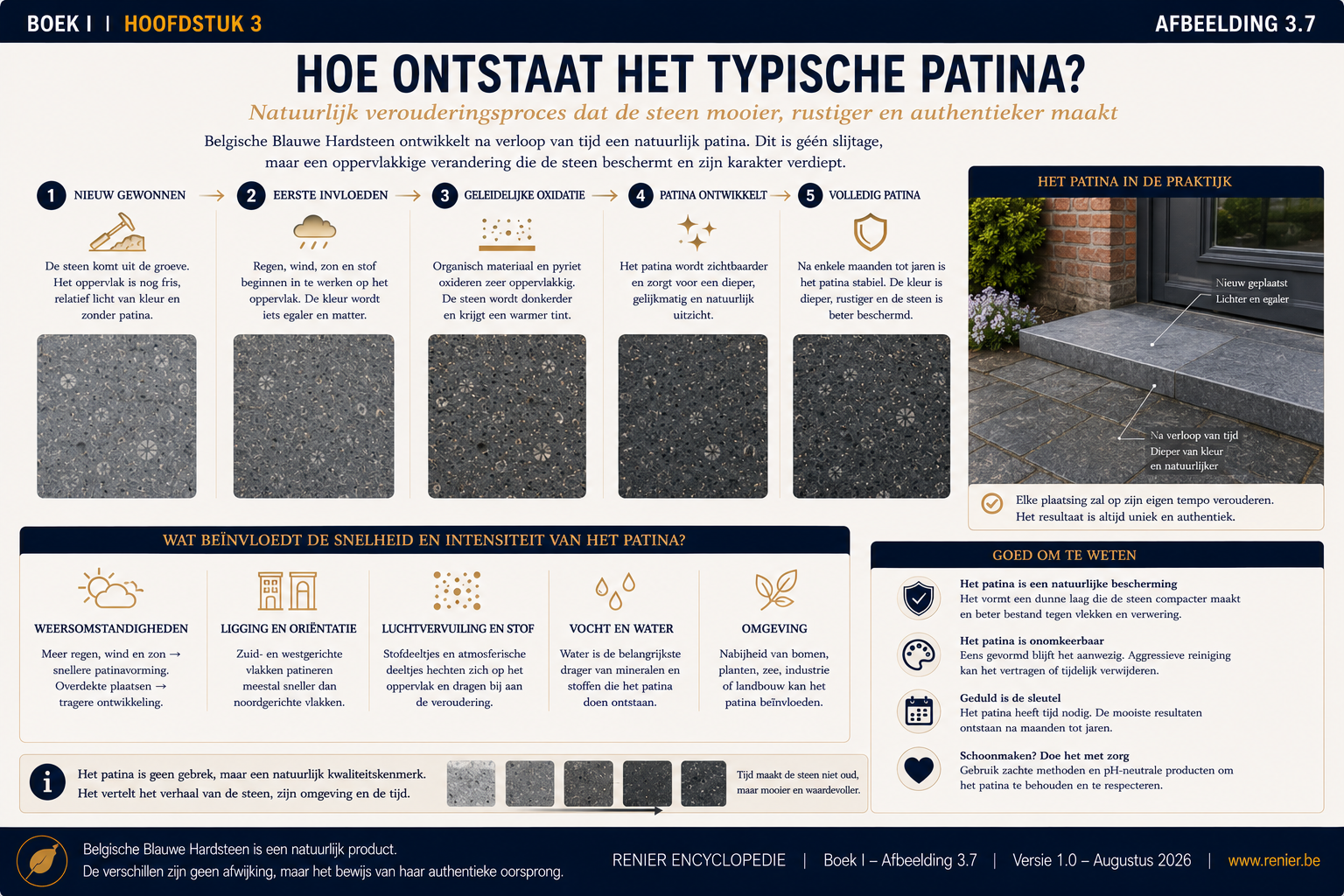
The story of natural stone doesn't end once it's installed. The surface gradually changes due to weather, use, maintenance, and the environment in which the stone is located.
A newly installed surface typically has a relatively fresh and uniform appearance. Over time, water, dust, sunlight, air, and daily use take their toll on the surface. As a result, the color may gradually appear more subdued, more even, or deeper.
When it comes to outdoor use, location and exposure play an important role. A stone that is fully exposed to rain and sun does not necessarily age in the same way as a sheltered windowsill or an indoor floor. Traffic, foot traffic, and regular use can also affect the surface in specific areas.
We call this gradual aging process “patina.” It is not a uniform coating that forms at a specific moment, but rather the visible result of time and the environment. As a result, each application develops its own character.
Proper maintenance respects that natural process. Harsh products or intensive treatments can temporarily alter the surface significantly, whereas appropriate maintenance allows the stone to evolve gradually.
An ancient threshold and a new slab may be made of the same rock but look completely different. With natural stone, time is part of the material’s story.
From Composition to Appearance
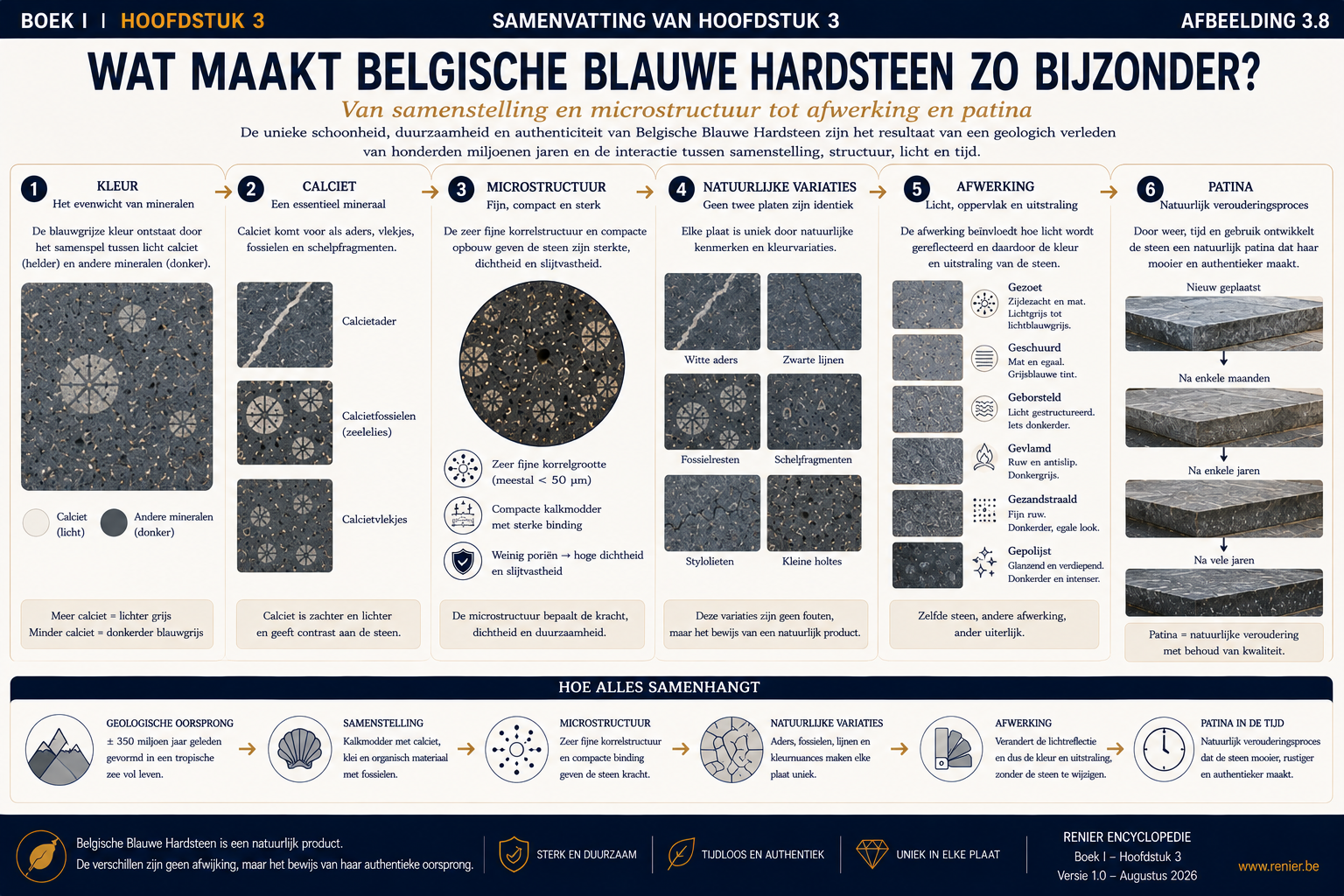
The appearance of Belgian Blue Stone is the result of a series of natural factors: composition, microstructure, fossils, variations, surface finish, and, ultimately, time.
Calcite forms the mineral basis of limestone. Fossil remains and the very fine matrix give the stone its characteristic internal structure, while darker components and their distribution contribute to its blue-gray color.
Because sedimentation and rock formation never occurred exactly the same way everywhere, there are natural variations among layers, blocks, and slabs. Veins, dark lines, fossil markings, stylolites, and color variations are therefore part of the stone’s character.
Next, the surface finish determines how we perceive that natural texture. Light interacts differently with a smooth, sanded, brushed, or rough surface. After installation, time also adds a new dimension in the form of patina.
The distinctive appearance of Belgian Blue Stone is therefore not the result of a single characteristic, but rather the interplay between geology, material structure, processing, light, and time.
Why does Belgian Blue Stone look the way it does?
- The characteristic color is a natural part of the rock and not a coating that has been applied.
- Calcite is the main mineral component of limestone.
- Fossil remains and the very fine matrix together determine the internal structure.
- The proportions and distribution of the ingredients result in natural color variations.
- Calcite veins, dark lines, stylolites, and fossils give each slab its own unique pattern.
- Surface finishes primarily alter the way light is reflected by the stone.
- After installation, the surface gradually develops a patina that allows its character to continue to evolve.
In the first three chapters, we have thus answered three fundamental questions: where did the stone come from, what kind of life provided its building blocks, and what gave it its characteristic color and structure. In the next chapter, we will examine the technical implications of this: why Belgian Blue Stone is so strong and durable.
About the Color and Appearance of Belgian Blue Bluestone
Why is Belgian Blue Bluestone called "blue" when it looks gray?
The name refers to the rock’s characteristic cool blue-gray color. Depending on the type of stone, the finish, the lighting, and the condition of the surface, that shade may appear lighter, darker, or more distinctly blue-gray.
Why are some records darker than others?
Belgian Blue Bluestone is a natural product. The proportion and distribution of fine matrix, calcite, fossil remains, and darker components vary naturally, which means that shades may differ between individual slabs.
Are white veins in Belgian Blue Bluestone normal?
Light-colored calcite structures and veins may be natural features of the rock. They formed over the course of geological history and may be more or less visible depending on the cutting direction and finish.
Why does polished Belgian Blue Stone darken?
A finer, smoother finish changes the way light is reflected off the surface. As a result, the same stone can appear optically deeper and darker without any change in its mineral composition.
Does Belgian Blue Stone change color after installation?
The surface may develop a natural patina over time. Weather, use, maintenance, and the environment all influence how quickly and in what way the color appearance and surface character evolve.