

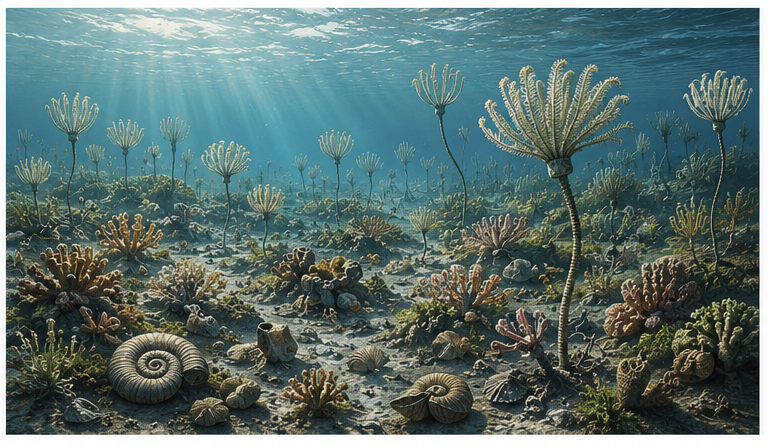
Reconstruction of the tropical sea in which Belgian Blue Stone was formed Book I
A journey to the warm, shallow sea where the foundation of Belgian Blue Stone was formed.
The Bible of Belgian Blue Stone

The Formation of the Stone

From a living tropical seabed to a compact, fossil-rich natural stone.

The story of Belgian Blue Stone begins about 350 million years ago. The area that would later become Belgium was then located near the equator and was covered by a warm, relatively shallow sea.

In Book I, we explore how the location of the continents, the climate, marine life, and millions of years of sedimentation together laid the foundation for the stone that is quarried in Belgium today.

  • Book I
  • 4 chapters
  • Geology and Origin
  • Reading time for the entire book: approximately 45 minutes
View the chapters
The Origins To understand the stone, we must first understand the vanished world in which it came into being.

Back when Belgium didn't exist yet

There were no Ardennes, no North Sea, and no Atlantic Ocean as we know them today.

The tectonic plates were positioned differently, and the area that is now Belgium was much closer to the equator. A vast marine landscape was populated by sea lilies, corals, brachiopods, bryozoans, and countless other organisms.

After their deaths, their calcium-rich skeletal remains ended up on the seafloor. They mixed with carbonate mud and other sediments. New layers buried the material and gradually increased the pressure.

Through compaction, cementation, and other processes of diagenesis, the loose sediment eventually transformed into compact limestone. The fossil origin remained visible in the rock’s structure.

From the Sea to Natural Stone

Four steps in a process spanning millions of years

The formation of Belgian Blue Stone was not a single event, but a long process in which biological activity, sedimentation, and geological change followed one another.

1. A tropical sea Present-day Belgium is located close to the equator under a warm, shallow sea.
2. Life and Lime Marine organisms build their skeletons and hard parts from calcium carbonate.
3. Sedimentation Calcareous sediments and carbonate mud accumulate layer by layer on the seafloor.
4. Diagenesis Pressure, cementation, and mineralization gradually transform the sediment into compact limestone.
Contents of Book I

Four chapters on the beginning

Each chapter highlights a separate part of the geological story. Chapter 1 provides a broad introduction; the following chapters explore Belgium’s role, marine life, and the eventual formation of limestone.

01
Chapter 1

Back when Belgium was still at the bottom of a tropical sea

A Journey to the Lower Carboniferous: a world without dinosaurs, with different continents and a warm, shallow sea where Belgium is today.
02
Chapter 2

Which organisms built the stone?

Discover which marine organisms provided the calcium-rich building blocks for Belgian Blue Stone some 350 million years ago, and why their fossils are still visible in every slab today.

03
CHAPTER 3

What makes Belgian Blue Stone blue?

Discover how calcite, fossil remains, microstructure, and natural variations determine the typical blue-gray color, and how the finish and patina influence the final appearance.

04
CHAPTER 4

Why is Belgian Blue Stone so strong and durable?

From its compact rock structure and low porosity to its compressive strength, wear resistance, frost resistance, and durability: discover why this natural stone has been used as a building material for centuries.

The Main Characters

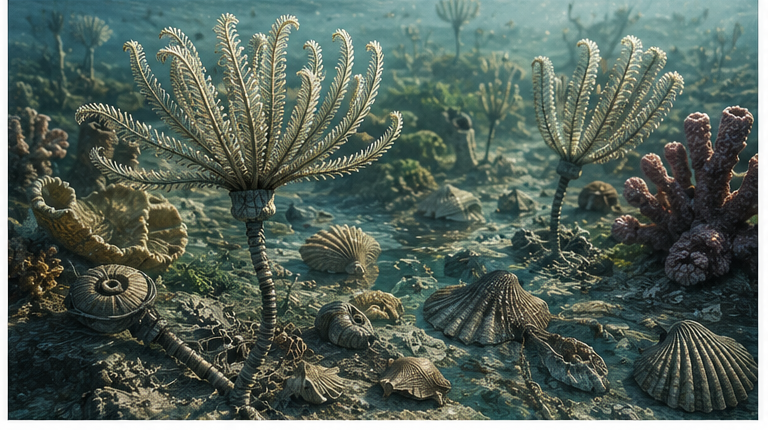
Sea lilies helped build the stone

Sea lilies, or crinoids, belong to the phylum Echinodermata and are related to starfish and sea urchins. Although their shape is reminiscent of a plant, they are animals.

Their calcareous stems consisted of stacked disc-shaped segments. After their death, these stems fell apart. Large quantities of these fragments ended up in the sediment and form a characteristic component of Belgian Blue Stone.

Did you know that?

The small, light-colored circles and star-shaped figures in polished Belgian Blue Stone are often cross-sections of fossil crinoid fragments.

Reconstruction of sea lilies or crinoids in a tropical sea
In-Depth Scientific Analysis

A compact, fossil-rich limestone

Belgian Blue Stone is a sedimentary carbonate rock. The stone consists mainly of calcite and contains a large number of fossil fragments, particularly the remains of crinoids.

In petrographic terms, these variants can be described as crinoid limestone, in which fossil grains are embedded in a fine limestone matrix or calcite cement.

Not every Belgian quarrying area belongs exactly to the same stratigraphic layer. For this reason, we will discuss the specific formations, age, and local differences later, separately for each quarry and rock type.

Feature General Description
Rock type Sedimentary limestone
Major Mineral Calcite, calcium carbonate
Important Fossil Crinoids or sea lilies
Depositional environment Warm, relatively shallow sea
Period of Origin Lower Carboniferous, with local variations depending on the mining zone
Formation Process Sedimentation, burial, compaction, cementation, and diagenesis

The journey begins at the bottom of a tropical sea

Read about what the area that is now Belgium looked like about 350 million years ago, and why this particular environment laid the foundation for Belgian Blue Stone.

Read Chapter 1