

Belgian natural stone literally embodies Belgian heritage: Petit Granit (blue stone) can be found in cathedrals, at Antwerp Central Station, and in hundreds of monuments that still stand there after centuries. The stone also appears beyond the country’s borders, such as in the historic vases at ARTIS in Amsterdam. Renier still quarries this same stone today in two of its own quarries and supplies it for restoration and new construction. Why have master builders chosen this stone for centuries, and what does that mean for your project?
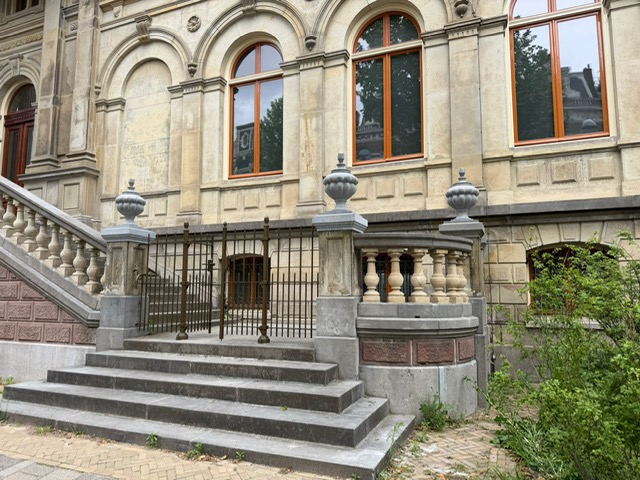
Belgian blue stone combines three properties that were decisive for monumental construction: very low water absorption (resistant to our freeze-thaw climate), high compressive strength (it supports facades, columns, and staircases without fatigue), and local availability from quarries in Wallonia. The fact that centuries-old monuments still stand in their original condition is the best proof of durability a building material can offer.
The best-known examples can be found in train stations, churches and cathedrals, city halls, and mansions throughout Belgium, with Antwerp Central Station serving as an icon. But Belgian stone was also appreciated internationally: at ARTIS in Amsterdam, there are historic vases made of Belgian blue stone. For centuries, Petit Granit was an export product of the Low Countries, and some of the quarries that supplied it are still active today, including our own quarries in Sprimont and Vinalmont.
Belgian blue stone develops a gray patina when exposed to the elements, while Vinalmont Meuse limestone develops an almost white patina. This natural weathering protects the stone and gives monuments their character. This patina must be taken into account during restoration work: new pieces of the same stone type will blend in over the years, so that the restoration becomes imperceptible. That is precisely why restorers seek stone from the original quarry or an equivalent Belgian quarry.
Because Renier still quarries stone from its own Belgian quarries today, we can supply stone for restoration projects that is geologically consistent with the original, with certificates and documentation of origin for the specifications. For new construction, this means building today with a material that has proven its durability over centuries. Architects send their specifications or details to our Technical Department; for custom solutions such as sills, our in-house workshop produces moldings and stair treads according to the plans.

Which Belgian natural stone has been used in historic buildings? In particular, Petit Granit—the Belgian blue stone—which can be found in cathedrals and Antwerp Central Station, among other places—and Belgian limestones such as Meuse limestone. The stone also appears internationally, such as in the vases at ARTIS Amsterdam.
How long does Belgian blue stone last? Centuries-old monuments preserved in their original condition are proof: when installed properly, stone will last for generations.
Can I get the same stone as the original for the restoration? Renier still quarries stone today from its own Belgian quarries and supplies stone that is geologically consistent with historical materials, complete with documentation of origin for the specifications.
Why does old blue bluestone turn gray? That's patina: natural weathering that is characteristic of the stone and helps protect it. During restoration, new stone of the same type gradually takes on the same color.