

How is the stone layer constructed?
From individual rock outcrops to flat surfaces, natural fractures, and subtle variations within a single layer. In this chapter, we’ll examine how Belgian Blue Stone is actually composed beneath the landscape.
From the discovery site to the stone quarry
In the previous chapter, we saw where Belgian Blue bluestone is found and why the correct geological layers are accessible at the surface only in certain places.
Now let's take a closer look. A limestone formation does not consist of a single homogeneous mass. It is made up of separate layers or stone banks, which were deposited over long consecutive periods.
Their thickness, continuity, flat surfaces, natural joints, fractures, and internal variations tell us a great deal about both the stone’s formation and the way in which it can be quarried and processed today.
- What is a stone bench?
- The sequence of limestone layers
- Thickness and Continuity of the Banks
- Flat surfaces and direction of sedimentation
- Natural joints and fractures
- Variations within the same stone quarry
- What does a quarry wall tell us?
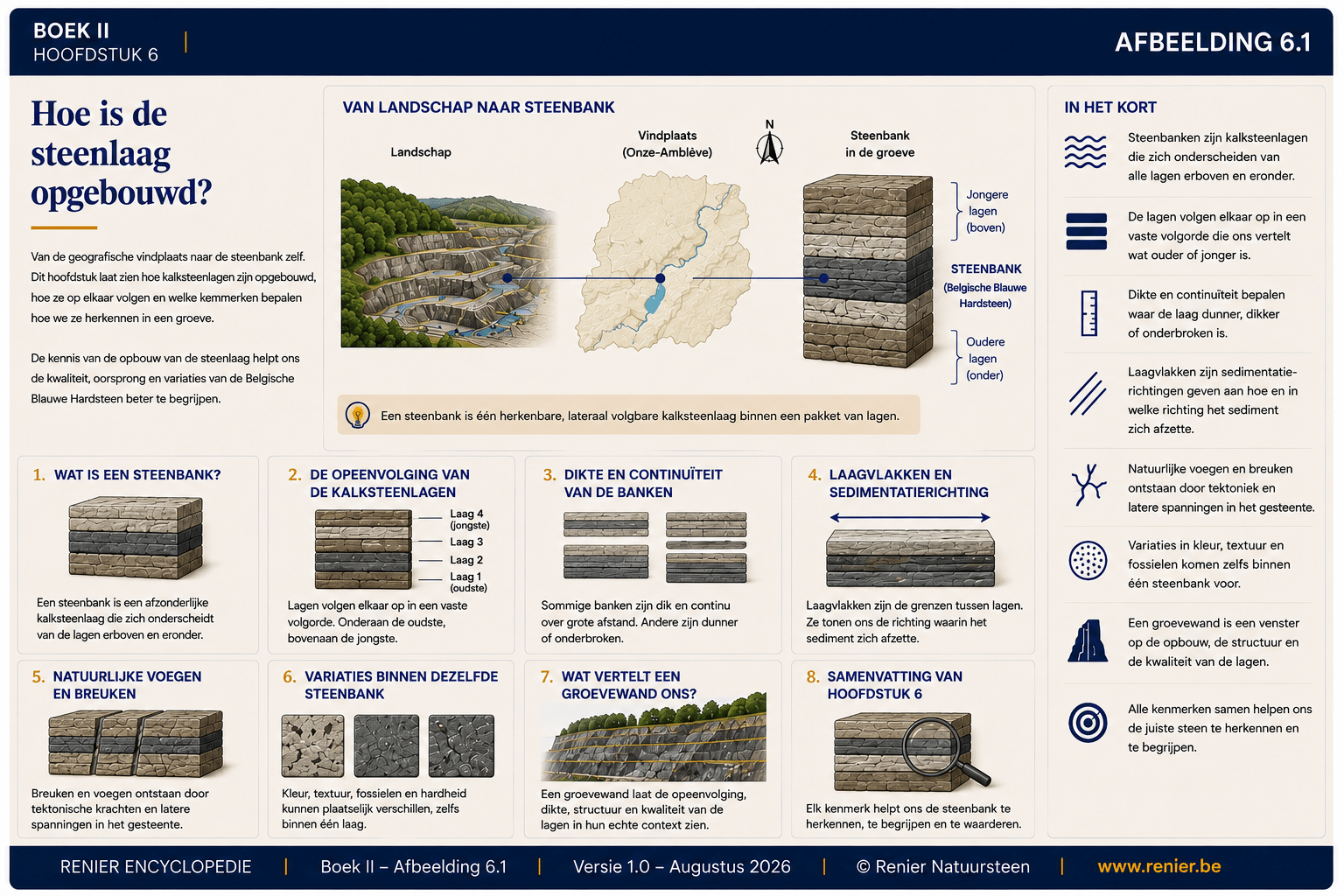
What is a stone bench?
When we look at a quarry wall, we see that the rock consists of several more or less parallel layers. We call such a distinct, recognizable layer of limestone a stone bench.
A limestone bed was formed during a specific period of sedimentation. Calcareous silt, remains of organisms, and other material accumulated layer by layer on the seafloor. After compaction and fossilization, this gave rise to the limestone banks that we see today in the quarry.
A rock layer can be traced over a considerable distance, but it is not necessarily exactly the same thickness everywhere or completely identical in composition.
The sequence of limestone layers
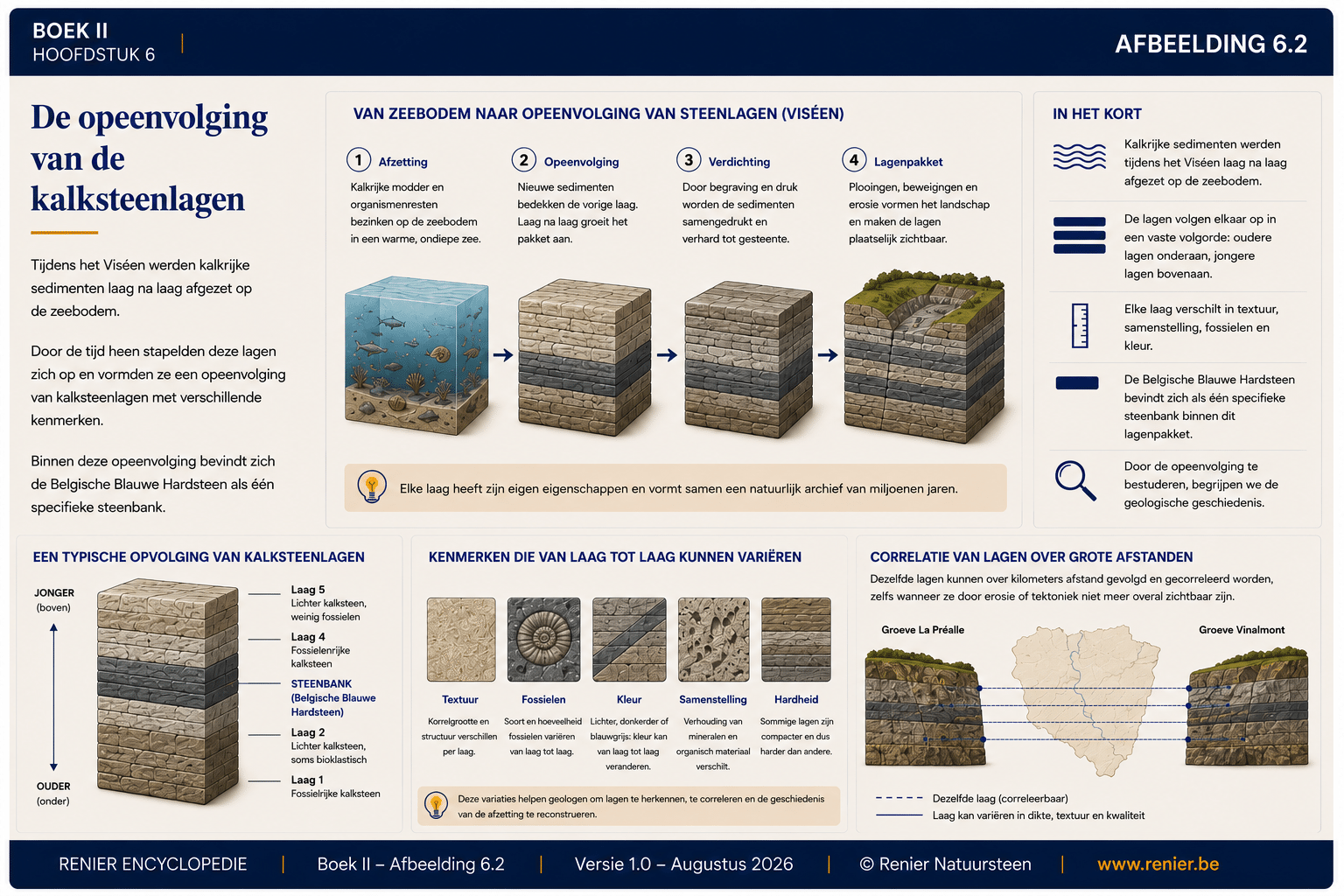
Rock layers are not arranged randomly, one above the other. Their order reflects the successive phases in which sediment was deposited on the ancient seafloor.
According to the principle of superposition, in an undisturbed stratigraphic sequence, the lower layers are older than the layers above them. Each new deposit was laid on top of the sediment that was already present.
This creates a sequence that geologists can, as it were, interpret. Differences between the banks may indicate changes in water depth, current, the amount of organic material, or other conditions during sedimentation.
Thickness and Continuity of the Banks
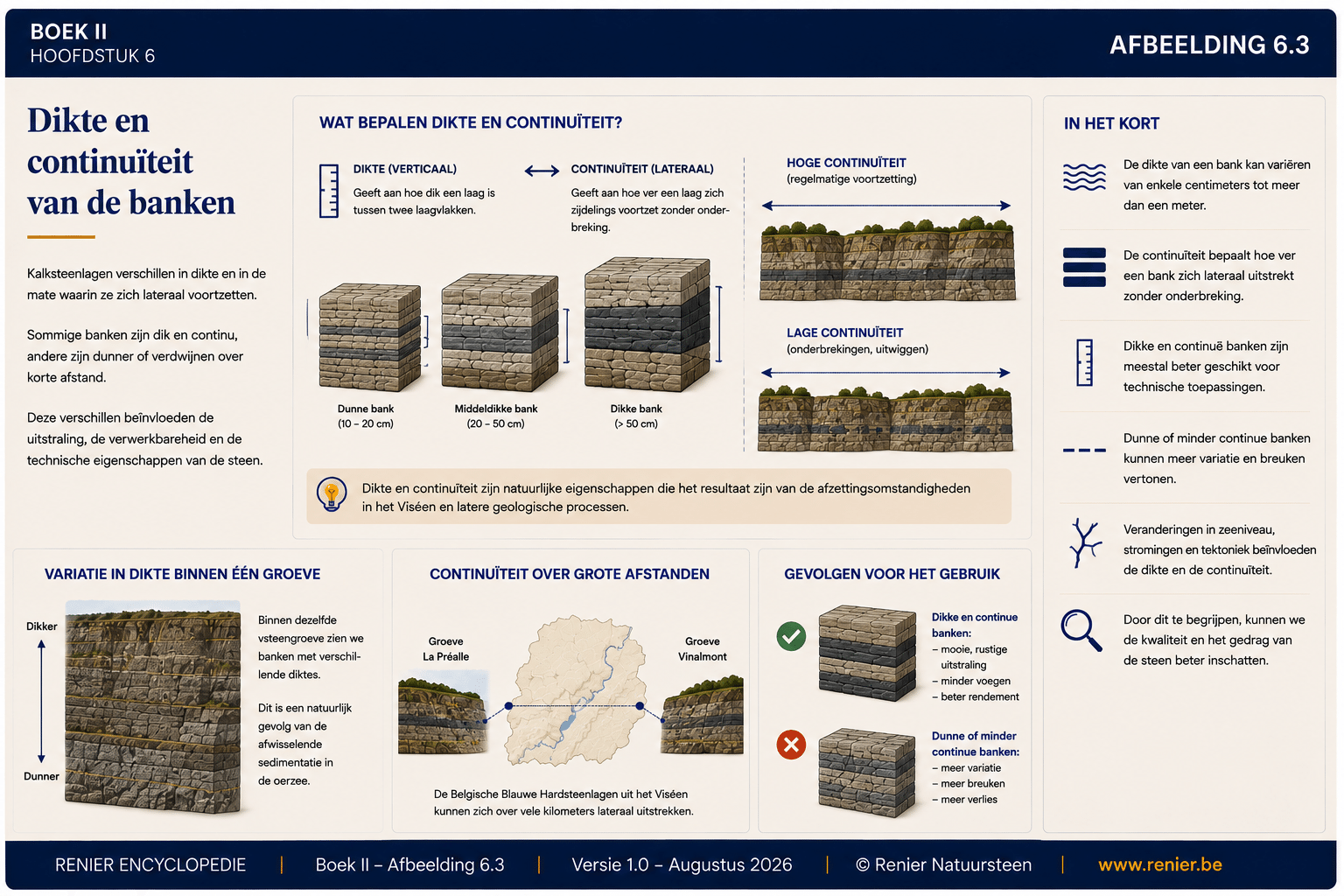
Not every stone bed is the same thickness. Some beds are relatively thin, while others are much thicker. The thickness can also vary gradually within a single bed.
In addition, the lateral continuity. A rock bench can extend over a long distance, become thinner, be locally interrupted, or eventually break away completely.
These differences are related to the conditions under which the sediment was originally deposited. The seafloor was not a completely flat and uniform surface, and the supply of sediment also changed over time.
Flat surfaces and direction of sedimentation
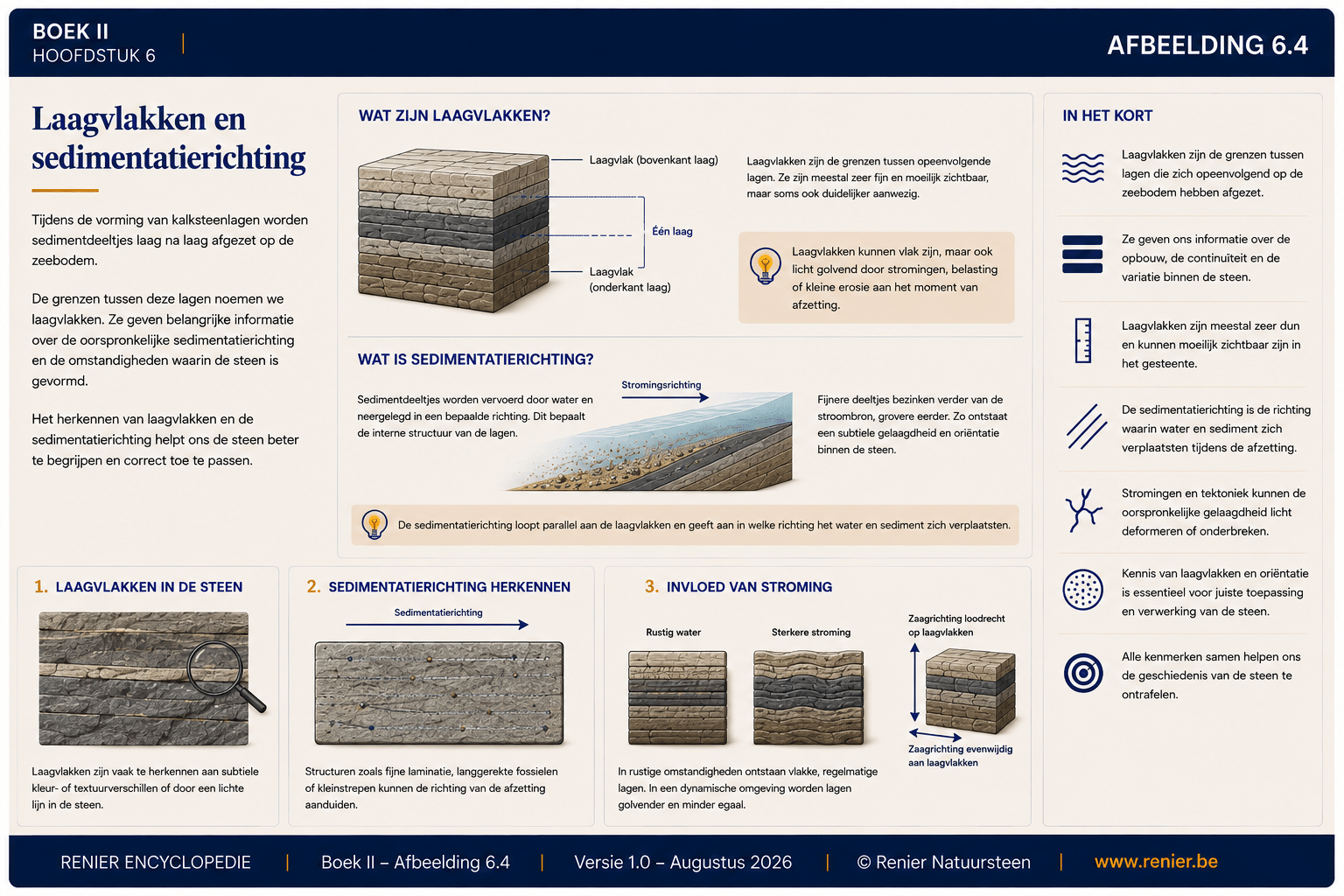
The boundary between two consecutive layers of rock is called a low-pressure area. These layers are the result of changes or interruptions during sedimentation.
Bedding planes reveal the original layering of the rock. They help us distinguish individual beds from one another and provide information about the way in which the sediment was deposited.
Currents in the primordial ocean may also have left traces. The direction in which sediment was transported and deposited can therefore sometimes still be discerned in the internal structure of the rock.
Natural joints and fractures
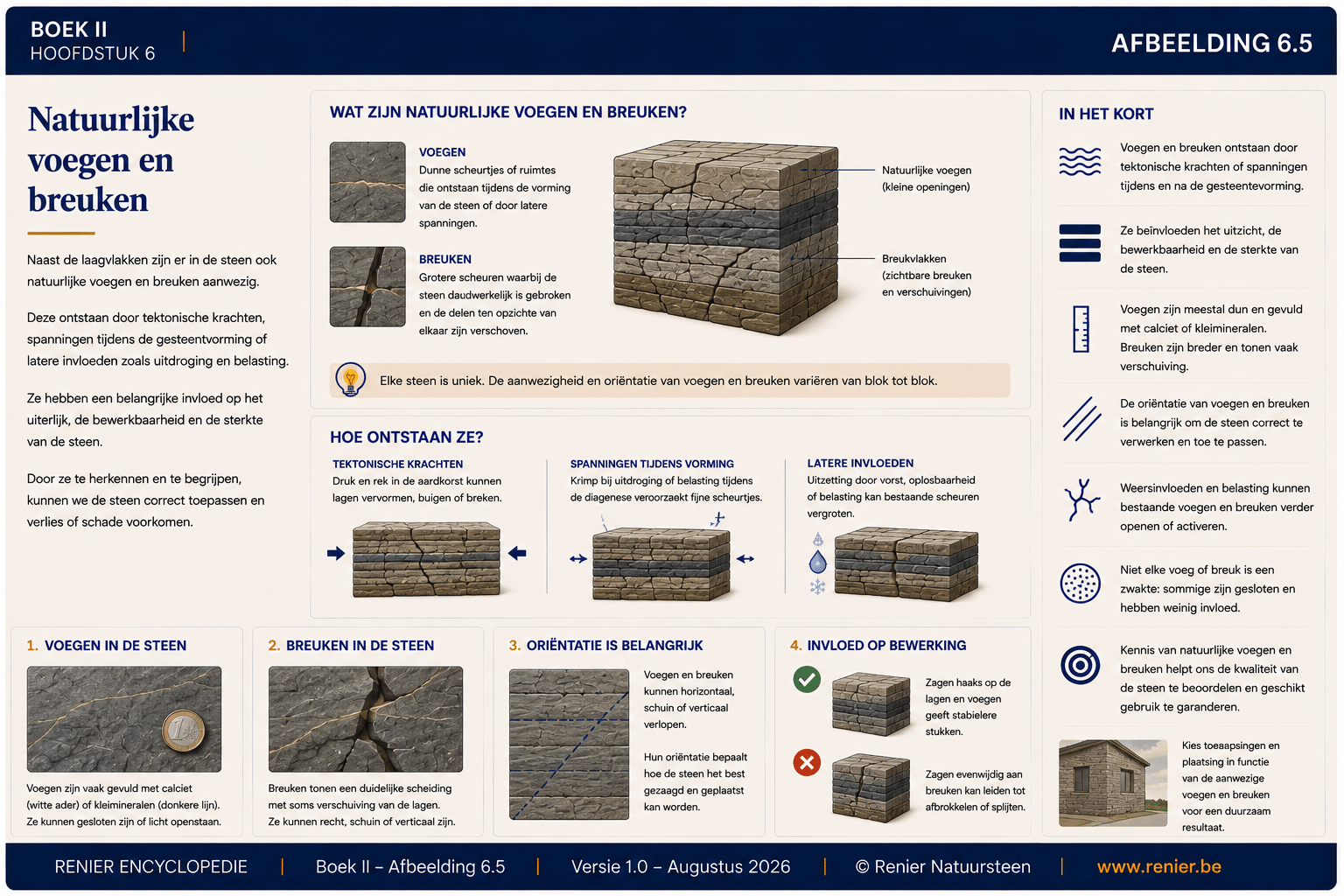
After the limestone had formed, the rock did not remain untouched. Subsequent geological forces caused the layers of rock to come under stress.
As a result, natural join and fractions formed. A joint is a natural separation or opening in the rock where little or no displacement has occurred. In the case of a fracture, rock masses may have shifted relative to one another.
These structures are important for quarrying. They help determine how large intact blocks can be extracted from a quarry and where natural breaks in the rock are located.
Variations within the same stone quarry
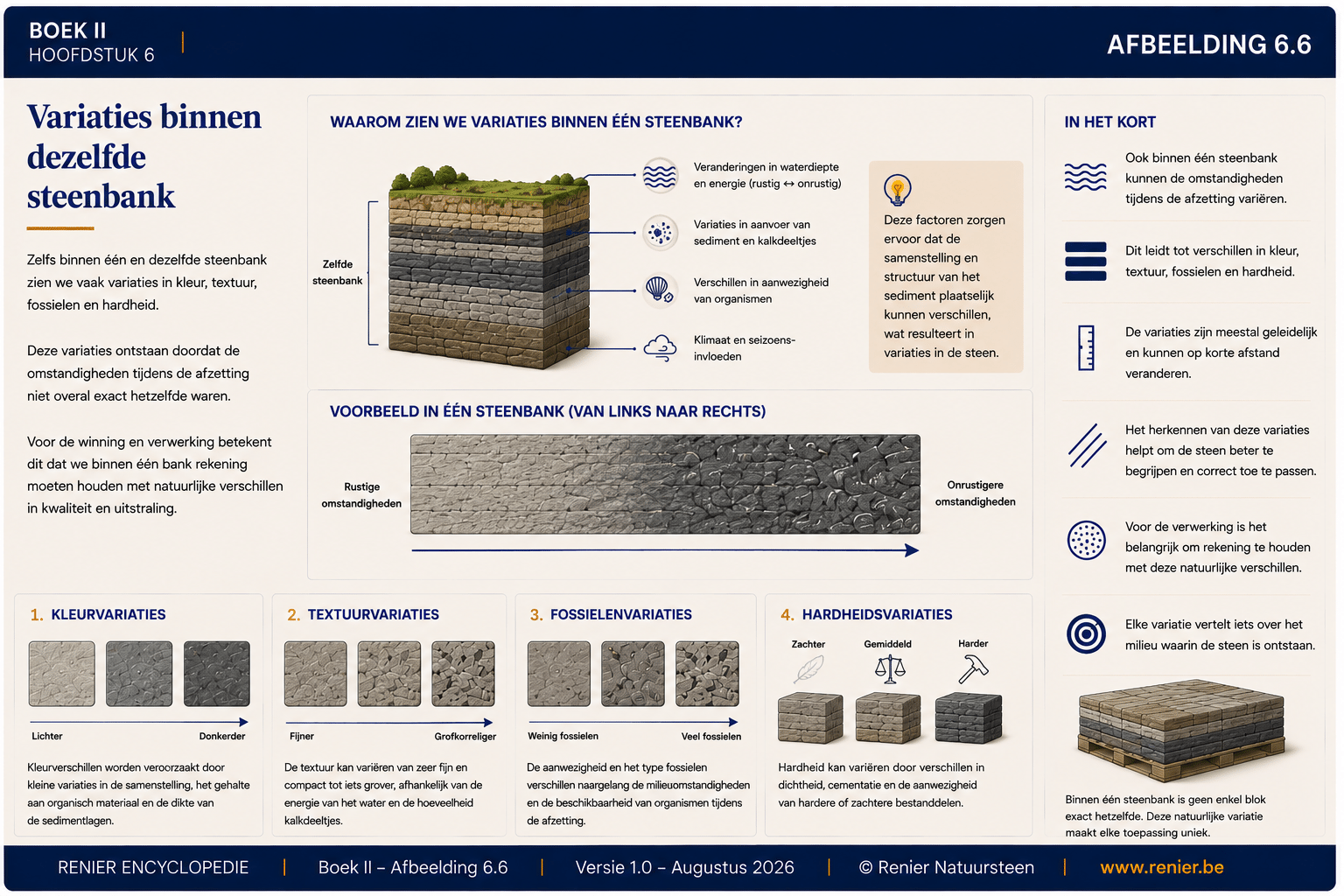
Even within a single quarry, natural stone is never completely uniform. Local variations may occur in color, texture, fossil content, and other visible characteristics.
That is a direct result of the natural formation process. The conditions on the seafloor were not exactly the same in every square meter. Currents, organisms, and the composition of the sediment could vary locally.
These differences are therefore not artificial variations, but are part of the natural character of Belgian Blue Stone.
What does a quarry wall tell us?
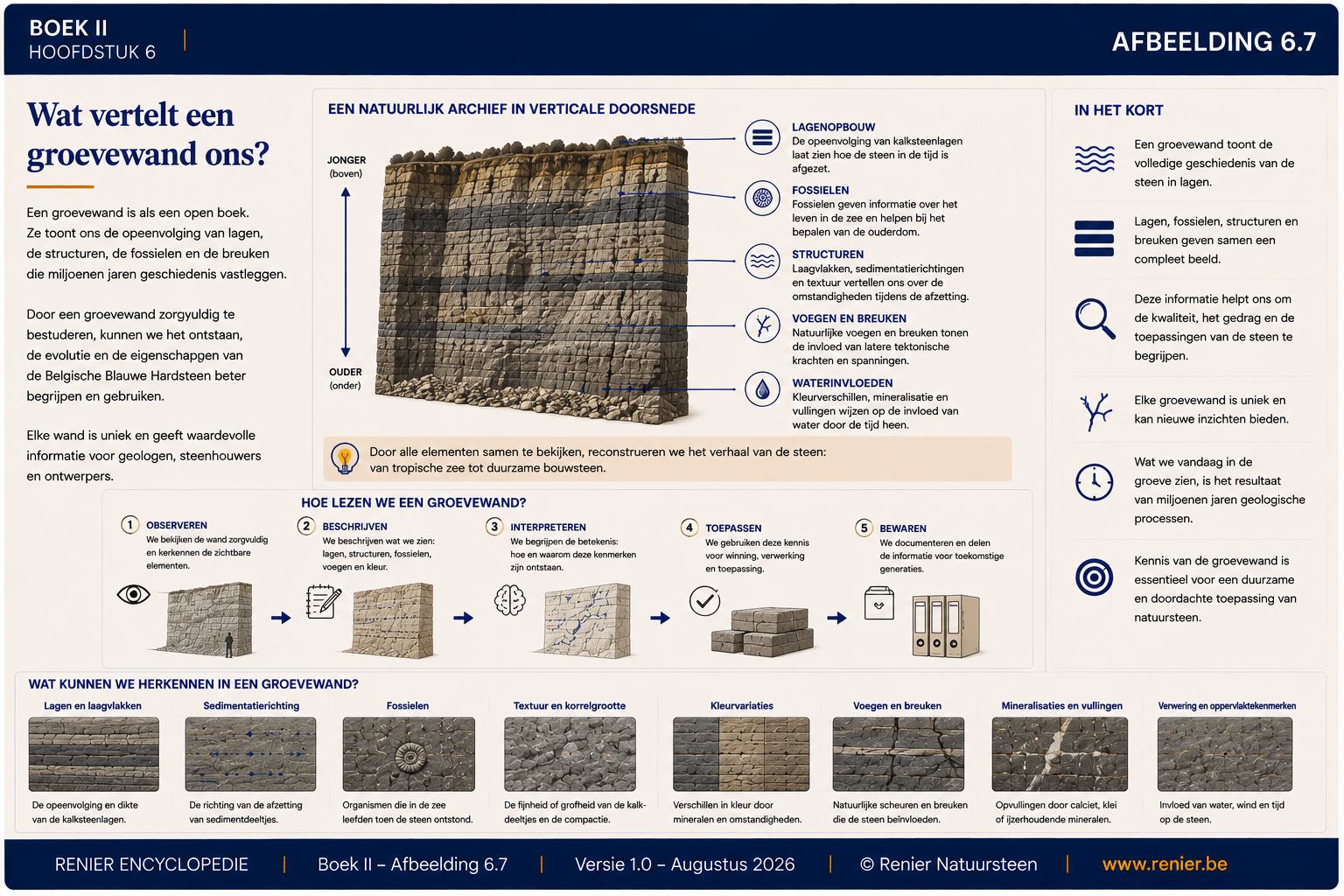
In a quarry, the subsurface is literally exposed. This creates a cross-section through the rock strata in which millions of years of geological history are revealed.
A quarry face reveals the sequence and thickness of the beds, flat surfaces, natural joints, and fractures. Differences in color, texture, fossils, and weathering can also be directly observed.
To a geologist, a wall like this is therefore much more than a mining front. It is a geological archive in which both the formation and the subsequent history of the rock can be discerned.
How is the stone layer constructed?
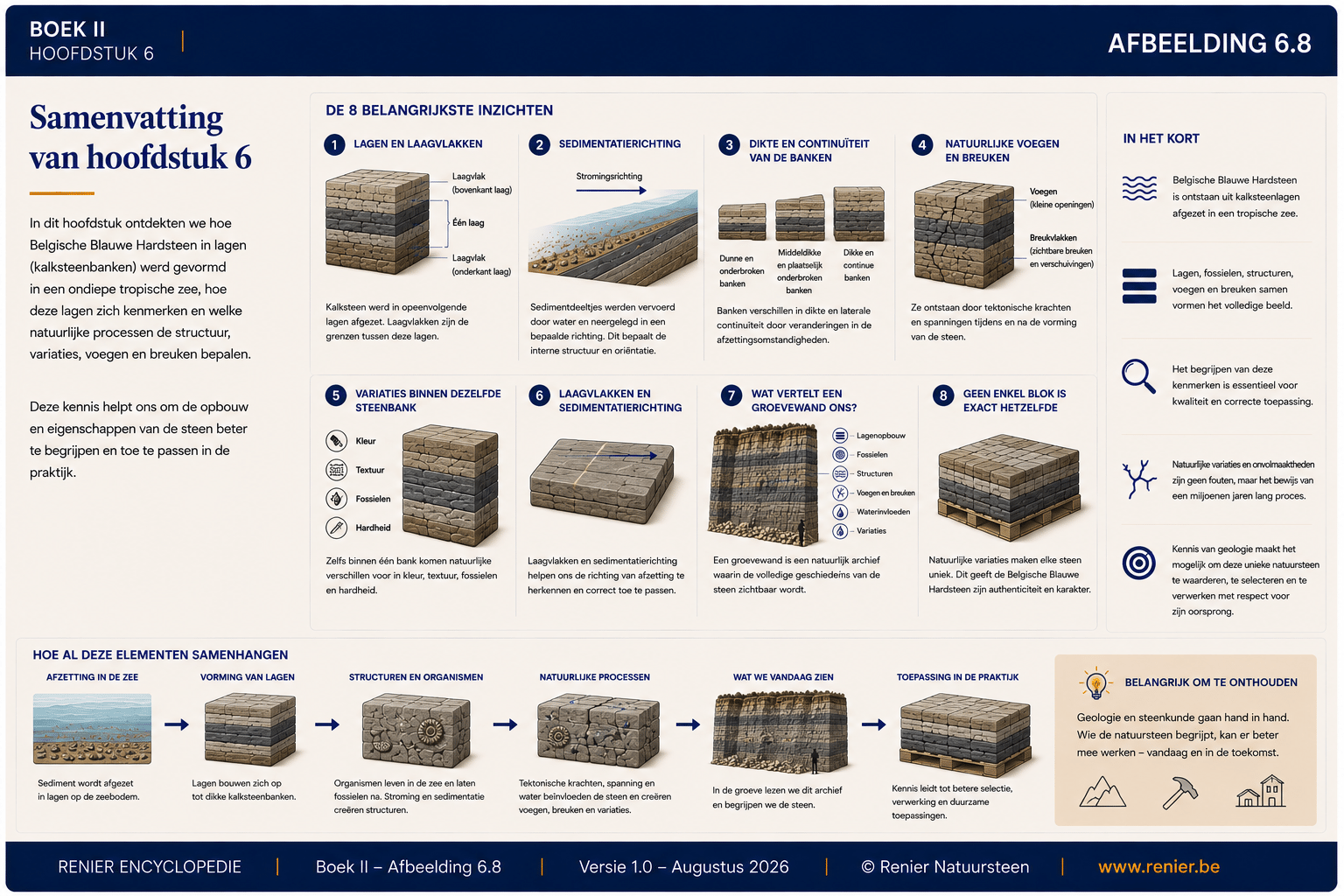
Belgian Blue Bluestone is part of a much larger set of limestone layers. Within that set, individual stone beds can be distinguished, each with its own location, thickness, and natural characteristics.
The stone bench determines what we can win
The geological structure is not only interesting for understanding the formation of Belgian Blue Stone; it also has a direct impact on day-to-day operations in the quarry.
The thickness of a quarry, the presence of joints and fractures, the continuity of the layer, and natural variations all help determine which blocks can be quarried and how the stone can then be selected and processed.
Anyone who sees a finished piece of Belgian Blue Stone is therefore looking at the result of a process that began hundreds of millions of years ago—layer by layer, bed by bed.