

Where can we find Belgian Blue Stone?
Belgian Blue Stone was formed about 350 million years ago in a tropical sea. But where are those ancient limestone layers located today, and why can we only quarry the stone in certain places in Belgium?
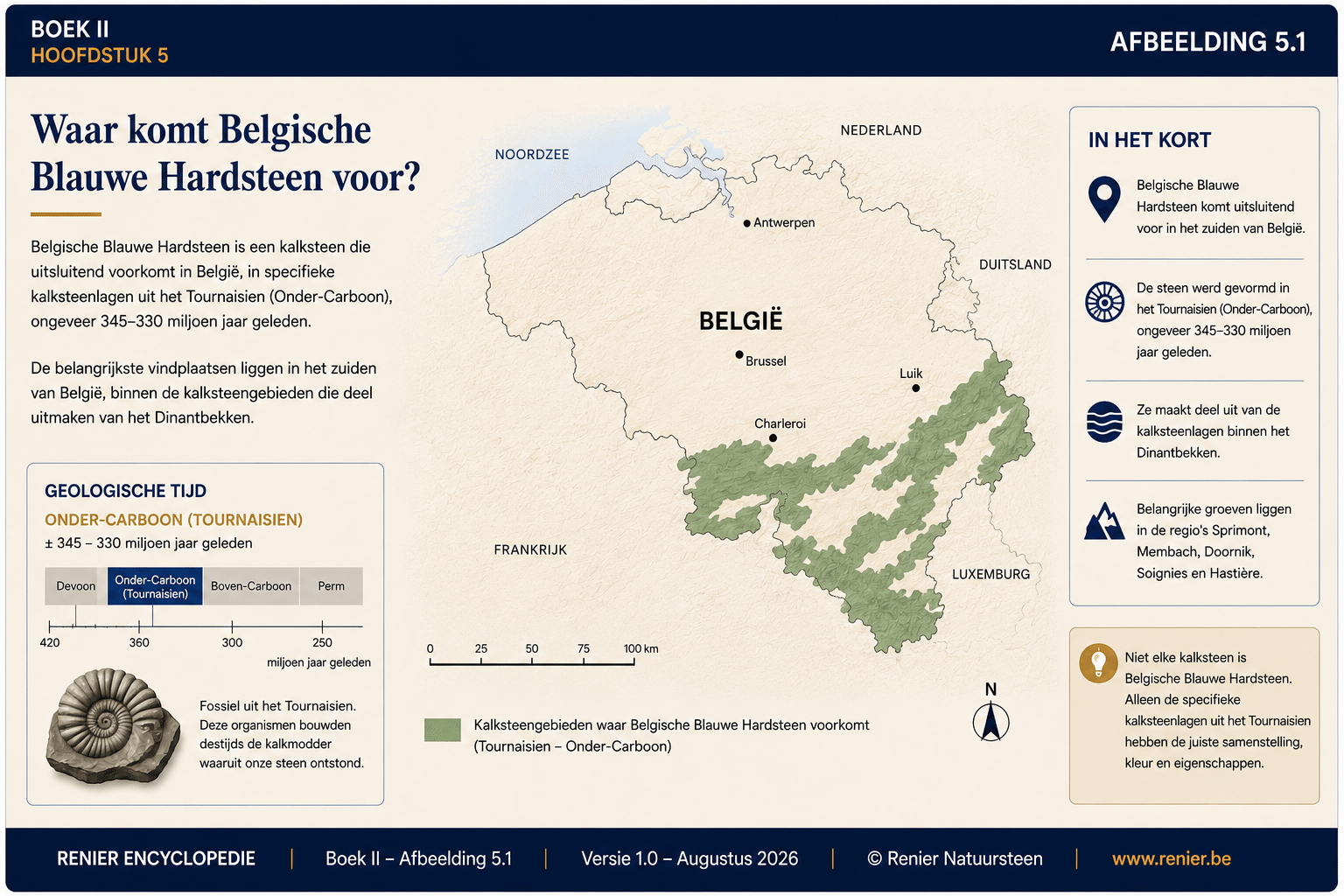
After Book I, we know how Belgian Blue Stone came to be, which organisms provided its building blocks, and why the rock acquired its characteristic color and exceptional properties. The next question is as logical as it is fundamental: where is that stone located today?
The calcareous mud that was deposited on the seafloor during the Tournaisian did not form a layer that is present throughout Belgium today. Sedimentation occurred in specific marine environments and resulted in various limestone formations.
After that, the landscape underwent dramatic changes. Layers of rock were buried, compressed, folded, and tilted. Mountains were formed and then eroded away again. Rivers carved out valleys, and erosion brought old rock layers back close to the surface in some places.
That is why Belgian Blue Stone can be found today only where three conditions are met: the correct geological layer must have formed at some point, it must have been preserved, and it must have ended up in an accessible location as a result of subsequent geological processes.
A Belgian stone of very local origin
Belgian Blue Stone is closely linked to the geological history of southern Belgium.
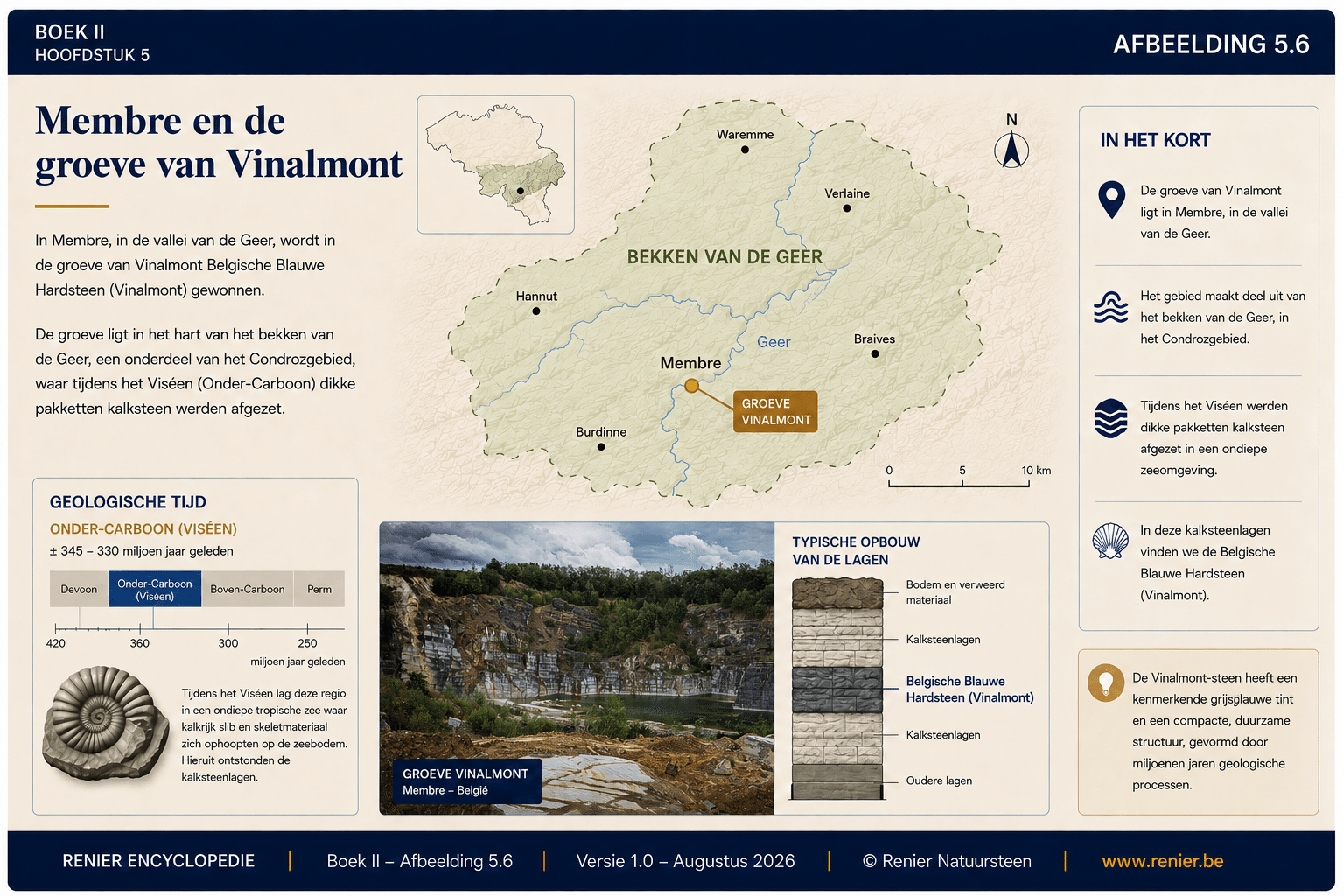
The rock belongs to limestone formations that were formed predominantly during the Tournaisian stage of the Lower Carboniferous—with Vinalmont being the well-known exception from the slightly younger Visean. This means that, for the most important sites, we must look for rock layers that were deposited approximately 359 to 347 million years ago in a suitable marine environment.
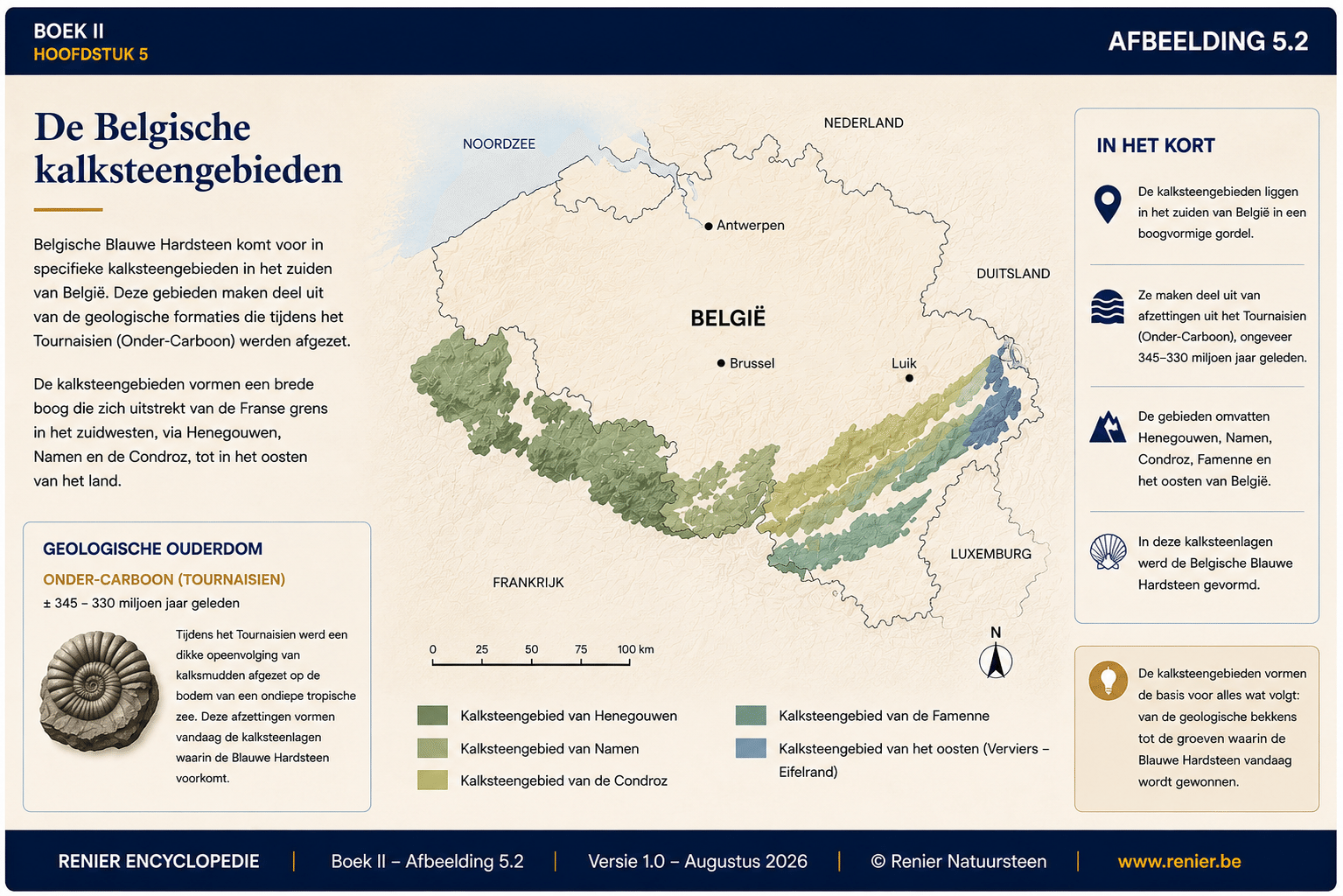
These layers are found primarily in a broad zone stretching across the southern part of Belgium. They extend from Hainaut and Namur through the Condroz and the Famenne to the eastern part of the country.
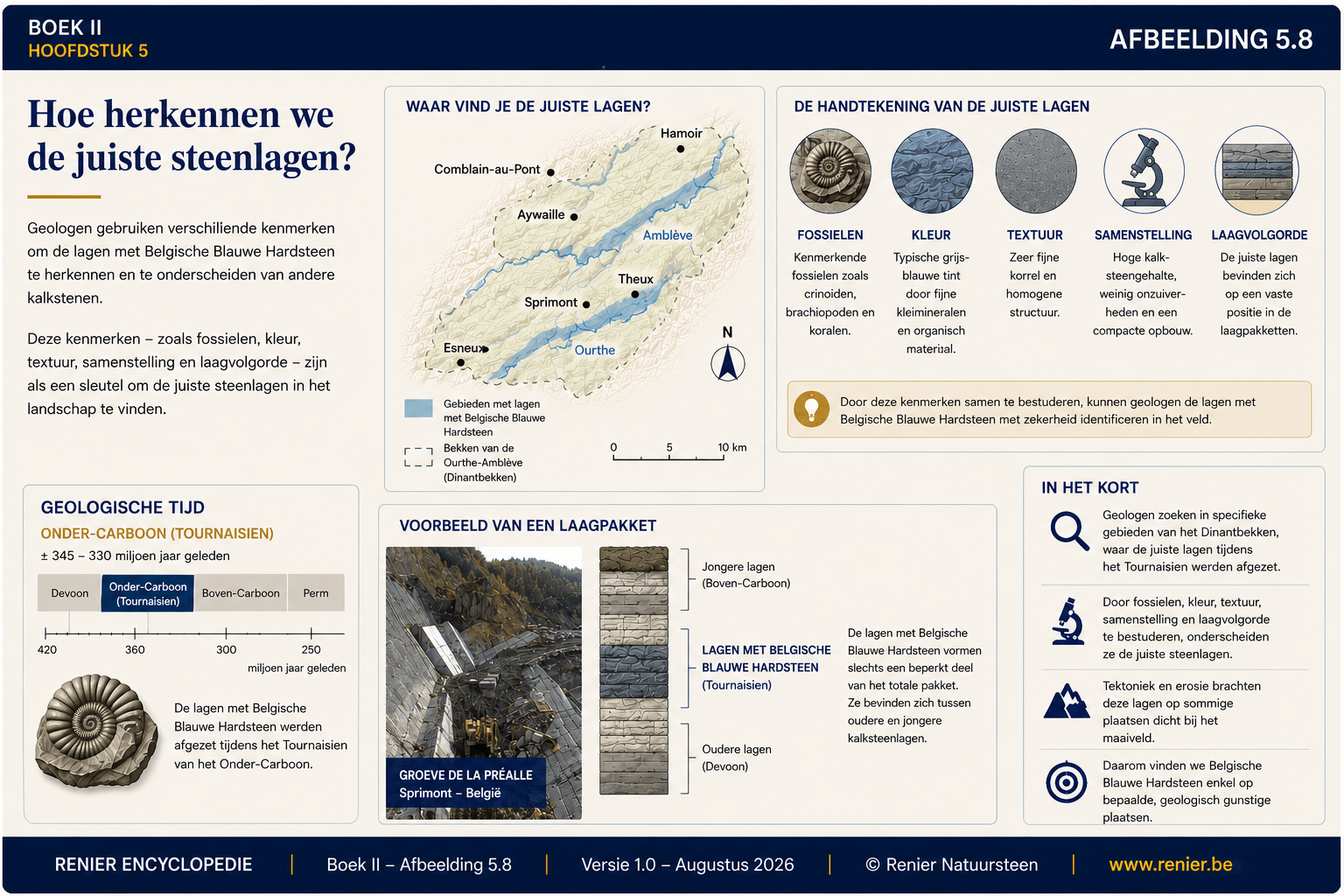
But even within these limestone regions, not every layer is composed of Belgian Blue Stone. The stone occurs only in certain rock formations with the right composition, structure, and geological history.
A limestone belt running through southern Belgium
The sites where Belgian Blue Stone is found are part of a much larger geological landscape of limestone formations.
During the Paleozoic Era, large parts of what is now southern Belgium were submerged under the sea. Over the course of various periods, enormous quantities of calcareous sediment were deposited.
This resulted in the formation of a broad belt of limestone formations that today runs from west to east through Wallonia. Within that belt, we can distinguish, among others, areas in Hainaut, Namur, the Condroz, the Famenne, and eastern Belgium.
The composition and age of these limestones vary. Some formed earlier or later, while others formed in a different sedimentary environment. This explains why different Belgian limestones can have different appearances and properties.
The presence of limestone does not automatically mean that Belgian Blue Stone is present. The geological age, composition, and conditions of deposition must all match.
Today, the ancient seafloor is a complex geological landscape
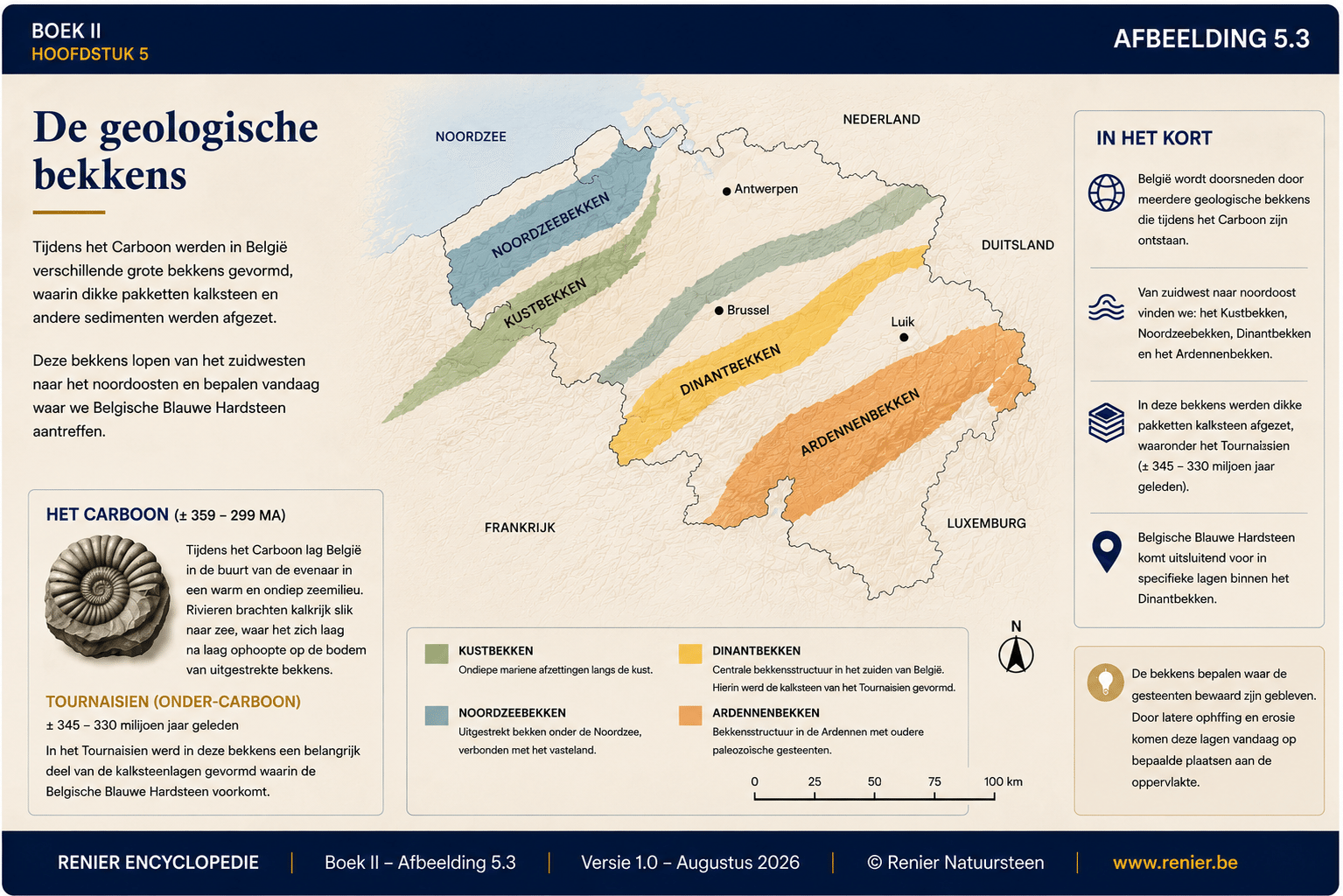
Geologists look not only at regions, but also at the large structures in which the rock layers have been preserved: the geological basins.
A basin is an area where sediments could be deposited and preserved over long periods of time. As the seafloor subsided, new sediment was continuously added, resulting in thick rock sequences.
Later, these layers were folded and displaced during tectonic events. As a result, today we no longer see a simple horizontal sequence of rock layers, but rather a complex pattern of folds, faults, and varying directions of dip.
The Dinant Basin is particularly important for Belgian Blue Stone. Parts of this basin contain the Tournaisian strata, in which the rock was predominantly formed, with the Vinalmont site being a well-known exception from the Visean.
An important aspect of the geological narrative
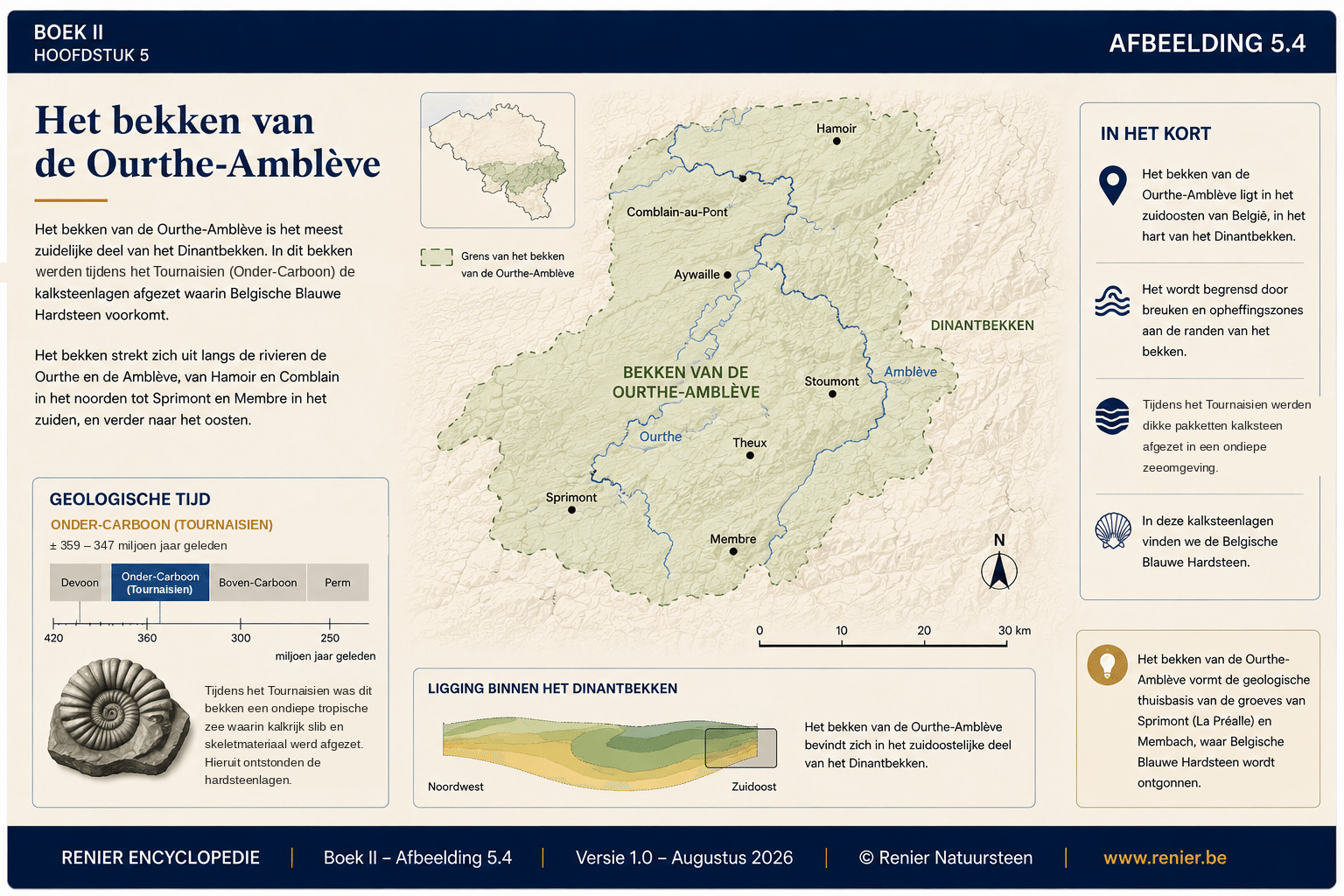
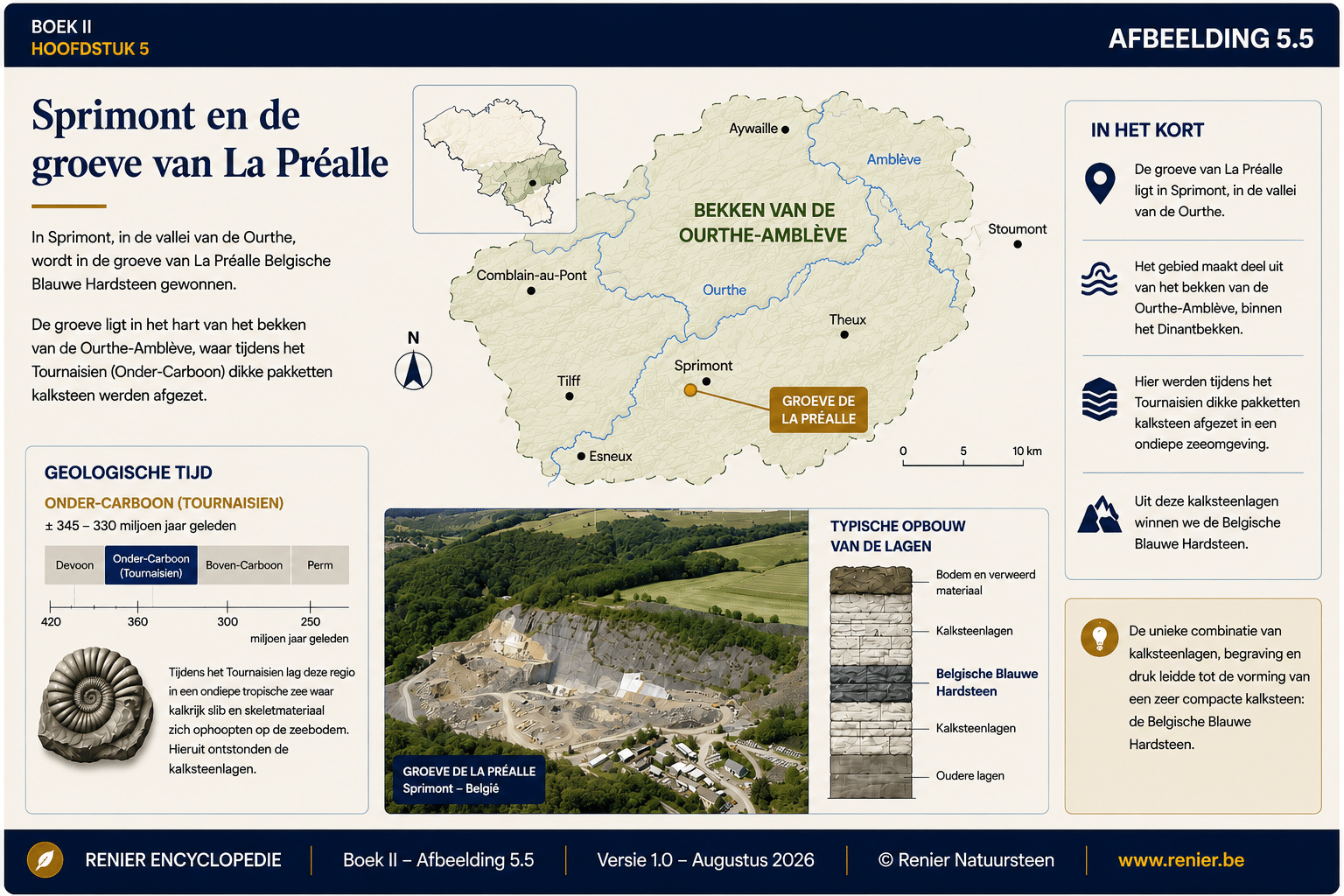
When we zoom in further on the Dinant Basin, we find ourselves in the region of the Ourthe and the Amblève.
The current landscape here is characterized by river valleys, forested slopes, and limestone massifs. Beneath that landscape lie folded rock layers that are hundreds of millions of years older than the valleys we see today.
In parts of this region, limestone layers from the Tournaisian come close enough to the surface to be visible in natural outcrops and quarries.
Sprimont is part of this geological context. It is also home to the La Préalle quarry, where Belgian blue stone is mined.
The Ourthe and the Amblève are much younger than the rocks through which they flow. Through erosion, they have locally exposed these ancient layers once again.
Where Geology Comes to Life
In a quarry, the abstract narrative of maps, time scales, and geological cross-sections becomes literally visible.
In Sprimont, the appropriate limestone layers lie close enough to the current earth's surface to be mined. The La Préalle quarry provides access to this ancient rock formation.
In the quarry wall, we do not see a uniform mass of stone, but rather a succession of different layers. Some are suitable for use as high-quality Belgian Blue Stone, while others have a different composition or structure.
Identifying and selecting the right quarries is therefore an essential part of understanding natural stone. The quality of the final material begins long before a block is cut from the quarry.
The layers are rarely horizontal anymore
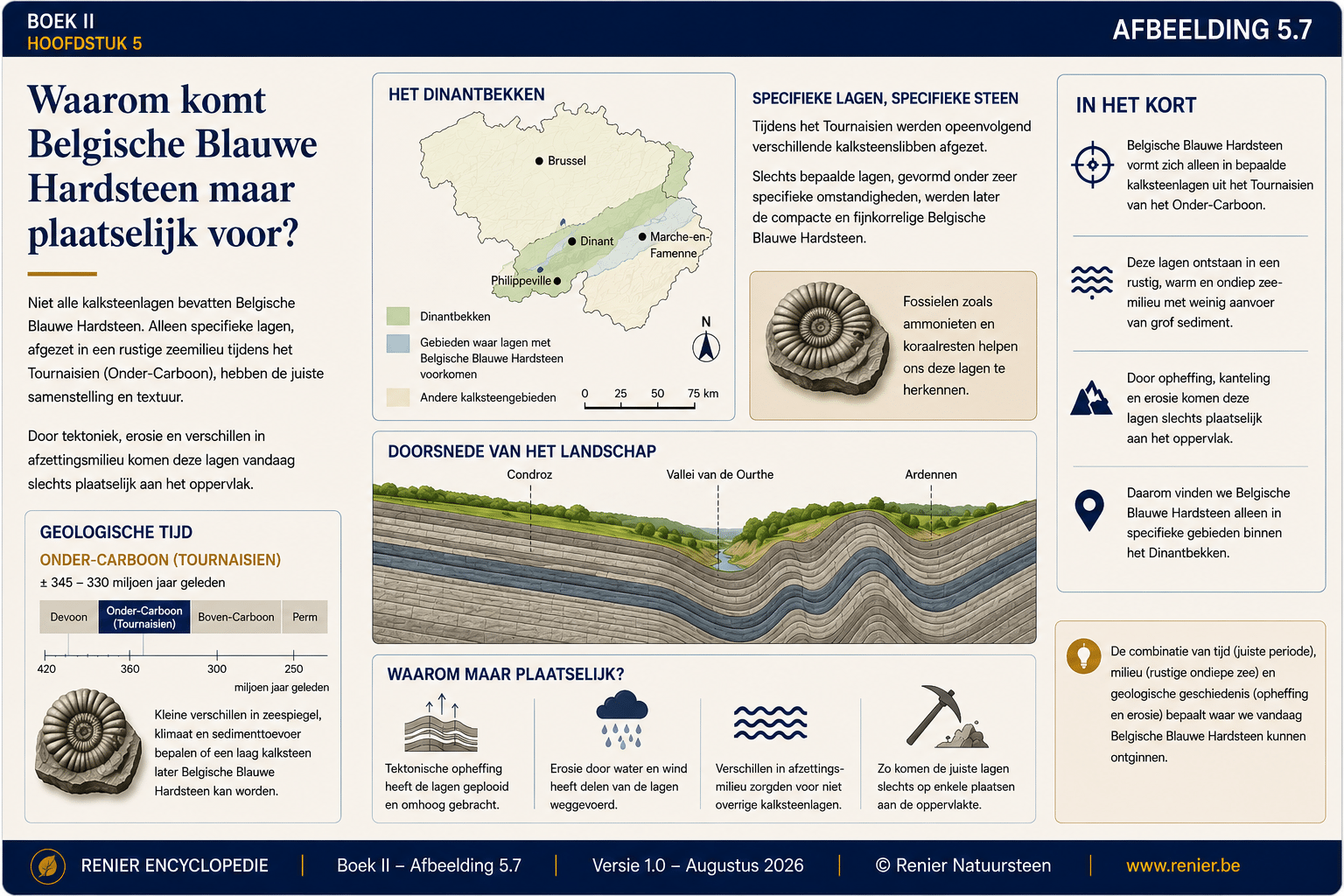
The limestone was originally deposited almost horizontally on the seafloor. Today, we find these same layers folded, tilted, and locally buried deep underground.
After the deposition, new sediments were continuously deposited on top of the limestone layers. As a result, the oldest layers became increasingly buried, and the pressure increased.
During subsequent mountain-building processes, enormous rock layers were compressed. The original horizontal layers were folded, tilted, and locally cut through by faults.
Erosion then began to wear away the landscape once again. Rivers carved out valleys and, in some places, removed rocks that were millions of years younger. As a result, some of the old limestone layers once again came close to or reached the surface.
What we see on the surface is merely the cross-section of a three-dimensional stack of folded rock layers.
The right rock requires the right geological history
The fact that Belgian Blue Stone occurs only in certain areas is no coincidence. Various conditions had to align perfectly for hundreds of millions of years in succession.
The Right Time
The limestone must have been deposited during the Tournaisian.
The Right Environment
A calcareous, calm, and relatively shallow sea was needed.
The Correct Position
Tectonics and erosion eventually had to make the layer accessible .
Even within a single geological basin, small differences in sea depth, currents, sediment supply, and biological activity can cause two layers to have different compositions.
After that, the suitable layers had to withstand millions of years of burial, pressure, folding, and erosion without disappearing entirely. Some remained hidden deep beneath younger rocks, while others were completely removed by erosion.
The current sites are therefore the result of an exceptional sequence of circumstances. A quarry is not simply established wherever stone is needed; it is created where geological conditions allow.
From the tropical seafloor to the quarry
The places where we find Belgian Blue Stone today were not shaped by a single event, but by a geological story spanning hundreds of millions of years.
First, during the Tournaisian, calcareous sediments had to be deposited in the appropriate marine environment. Next, these sediments had to be buried and solidify into limestone.
After that, tectonic forces deformed the rock layers. What had once lain flat on the seafloor was folded and tilted.
Finally, erosion removed large amounts of overlying rock. Rivers carved out valleys and brought certain ancient layers back close to the surface.
Only where all these factors come together can we find the suitable quarries today that can be mined for Belgian Blue Stone.
Why exactly is the stone there?
The current sites are the end result of an exceptionally long geological process.
About the Sources of Belgian Blue Stone
Is Belgian Blue Stone found throughout Belgium?
No. The rock occurs only in specific limestone layers with the correct geological age, composition, and formation history.
How old are the layers of Belgian Blue Stone?
The relevant limestone layers were formed primarily during the Tournaisian stage of the Lower Carboniferous, approximately 359 to 347 million years ago. Only in Vinalmont does the rock date from the slightly younger Visean.
Why is there so much limestone in southern Belgium?
Large parts of what is now southern Belgium were submerged under the sea during various geological periods. There, thick layers of calcareous sediment were deposited, which later hardened into limestone.
What does the Dinant Basin have to do with Belgian blue stone?
Within the Dinant Basin, there are limestone formations from the Tournaisian stage that contain specific layers of Belgian Blue Bluestone.
Why aren't the stone layers horizontal anymore?
The layers were originally deposited nearly horizontally on the seabed. Subsequent tectonic forces have folded them, tipped them, and, in some places, displaced them along faults.
Why can Belgian Blue Stone be quarried in Sprimont?
In the Sprimont region, suitable layers of Tournaisian limestone are close enough to the surface—due to their geological position and subsequent erosion— to be quarried in sites such as La Préalle.
Is every layer of limestone in a quarry suitable for use as Belgian Blue Stone?
No. Within a rock sequence, layers differ from one another in composition, structure, fossil content, and other properties. Only the suitable beds are selected.