

Ceramic tiles with a blue stone look feature a print of natural stone; genuine Belgian blue stone is the material itself—solid, with unique fossils and veining in every tile. Ceramic is more uniform and thinner, while natural stone ages beautifully and can be repaired locally if damaged. The right choice depends on what’s important to you: perfect consistency or authentic character.

| Criterion | Stone-look ceramic tile | Belgian blue stone |
|---|---|---|
| Materials | Fired tile with a natural stone print | Solid natural stone from the quarry |
| Appearance | Uniform; pattern repeats | Every tile is unique: fossils, veining, subtle variations |
| Aging | The print layer remains the same until it wears out or becomes damaged | Develops a natural patina and can be sanded down |
| In the event of damage | Replacing a Tile | Spot repairs or resanding are possible |
| Formats | Manufacturer's Standard Sizes | Standard and fully custom-made in our own workshop |
| Authenticity | Imitation | The original, used in Belgian construction for generations |
Blue stone is not a style but a material: solid, durable, and timeless. The stone from our own quarry is processed in our own workshops into floor tiles, thresholds, and custom work, in any desired finish. And because the material is solid, it doesn't wear out over time: it ages alongside the home.
In addition to ceramic imitations, there are also cheaper types of natural stone on the market that are passed off as Belgian blue stone. How to How to Recognize Genuine Belgian Blue Stone and what the difference is between Chinese blue stone, as you can read in the Knowledge Center.
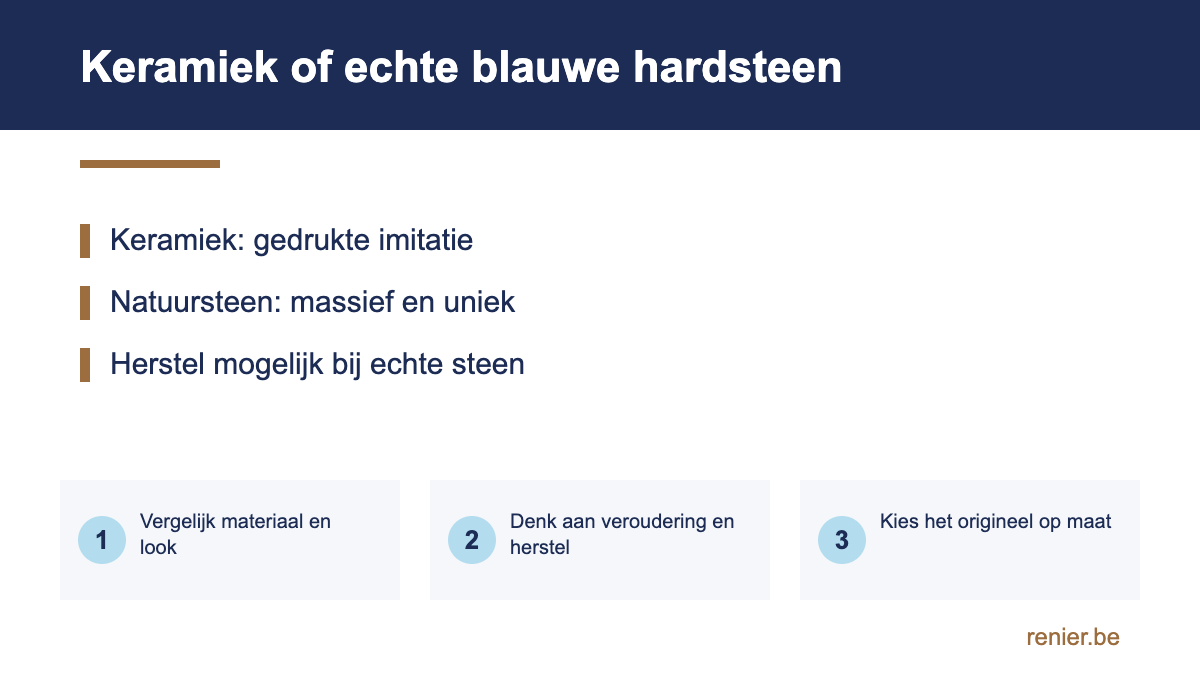
Tile prices vary by brand and size, but the price difference is smaller than people often think. Always consider the big picture—including the tile itself, installation, and lifespan—and calculate the cost of your project using the configurator or by requesting a quote.
Up close, though: ceramic tiles feature a printed repetition of the same pattern, while natural stone has unique fossils and veining in every tile. To learn how to recognize genuine Belgian blue stone, read our article on its origins.
A damaged ceramic tile exposes the core beneath the printed layer and must be replaced. Blue stone is solid: scratches or wear can be sanded down and repaired in specific areas.
No. Renier is a natural stone specialist with its own quarries and workshops, and it deliberately chooses authentic materials.
No. You clean a blue stone floor with pH-neutral natural stone soap and protect it with an impregnating agent. In practice, this is not much different from maintaining ceramic tiles.
How to Recognize Genuine Belgian Blue Stone
Blue stone or granite for the outdoors?
Arduin or blue stone: is there a difference?