

Which organisms built the stone?
Discover which marine organisms provided the calcium-rich building blocks for Belgian Blue Stone some 350 million years ago, and why their fossils are still visible in every slab today.
Every light-colored circle, streak, and shell-like formation in Belgian Blue Stone is a tangible trace of life in a tropical sea that disappeared hundreds of millions of years ago.
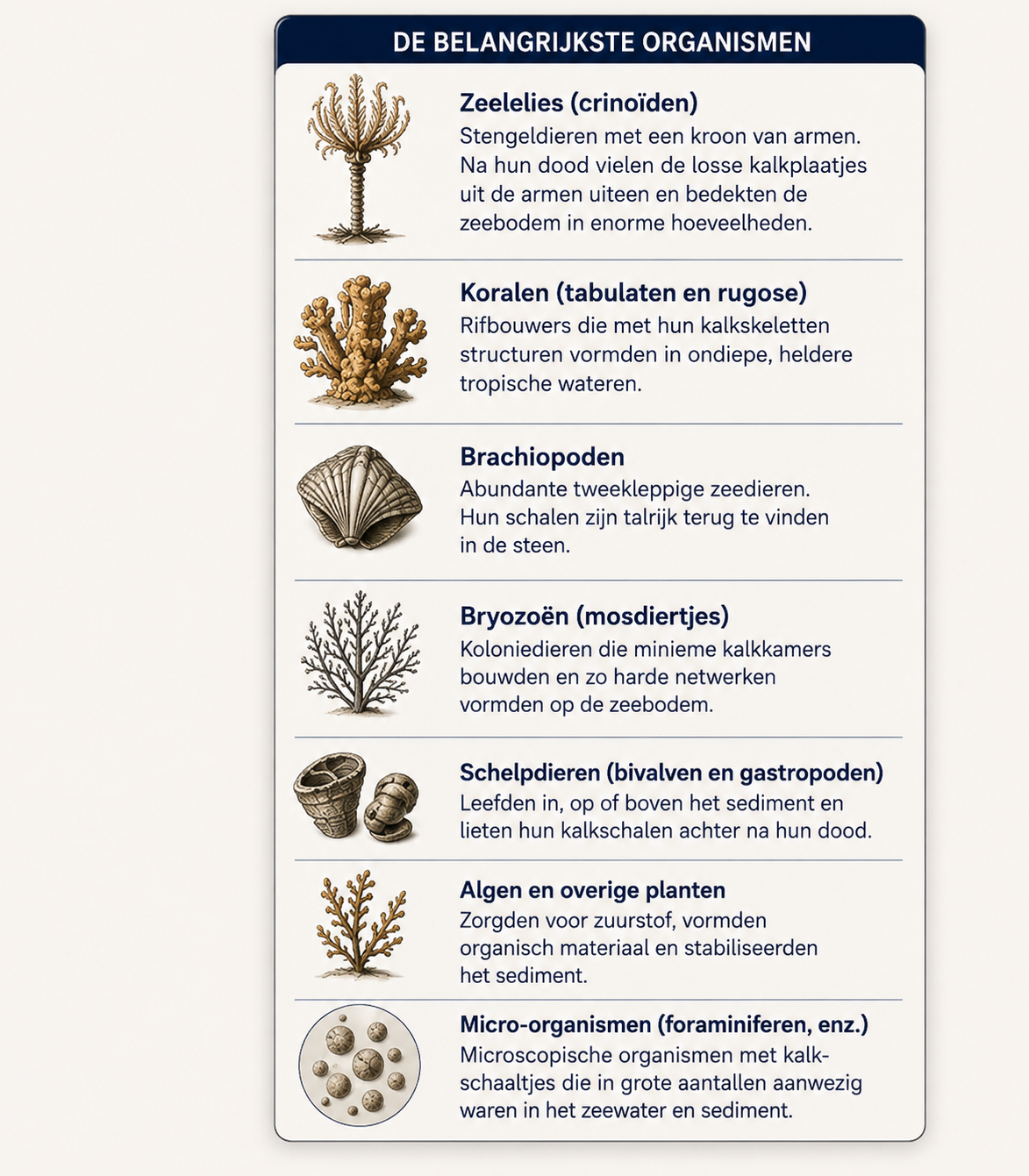
Chapter 1 described where and when Belgian Blue Stone was formed. In this second chapter, we focus on the organisms that provided the calcium-rich building blocks of the stone. Sea lilies, corals, brachiopods, bryozoans, shellfish, and microscopic organisms together formed an extraordinarily rich marine ecosystem.
After their deaths, their calcareous skeletons and hard parts disintegrated. They settled on the seafloor, were covered by fine calcareous mud, and were eventually preserved as fossils in the rock. As a result, Belgian Blue Stone is much more than a building material: it is a natural archive of a vanished world.
We’re not only examining which organisms are present in the rock, but also why crinoids in particular are so dominant, how a living animal becomes a fossil, why the preservation was exceptionally good, and why no two slabs ever have exactly the same pattern.
An ecosystem that turned to stone
Belgian Blue Bluestone did not originate from a single type of organism, but from the combined activity of an entire marine ecosystem.
During the Viséen, countless organisms lived in the warm, shallow sea. Some floated in the water, while others lived on the seafloor or were attached to hard surfaces. Their bodies varied greatly, but many species shared one characteristic: they formed hard structures made of calcium carbonate.
Sea lilies produced large quantities of calcareous plates. Corals built colonies and reef-like structures. Bryozoans formed finely branched networks of calcareous chambers. Brachiopods and bivalves provided sturdy shells, while calcareous algae and microscopic organisms contributed to the fine calcareous matrix.
Constant growth and death created an endless supply of calcareous material. Layer by layer, the seafloor was built up from fossil fragments, calcareous skeletons, and fine calcareous mud. The ecosystem literally provided the building blocks for what would later become natural stone.
The fossils are not accidental inclusions in Belgian Blue Stone. They form an important part of the rock itself.
Crinoids: The Symbol of the Stone
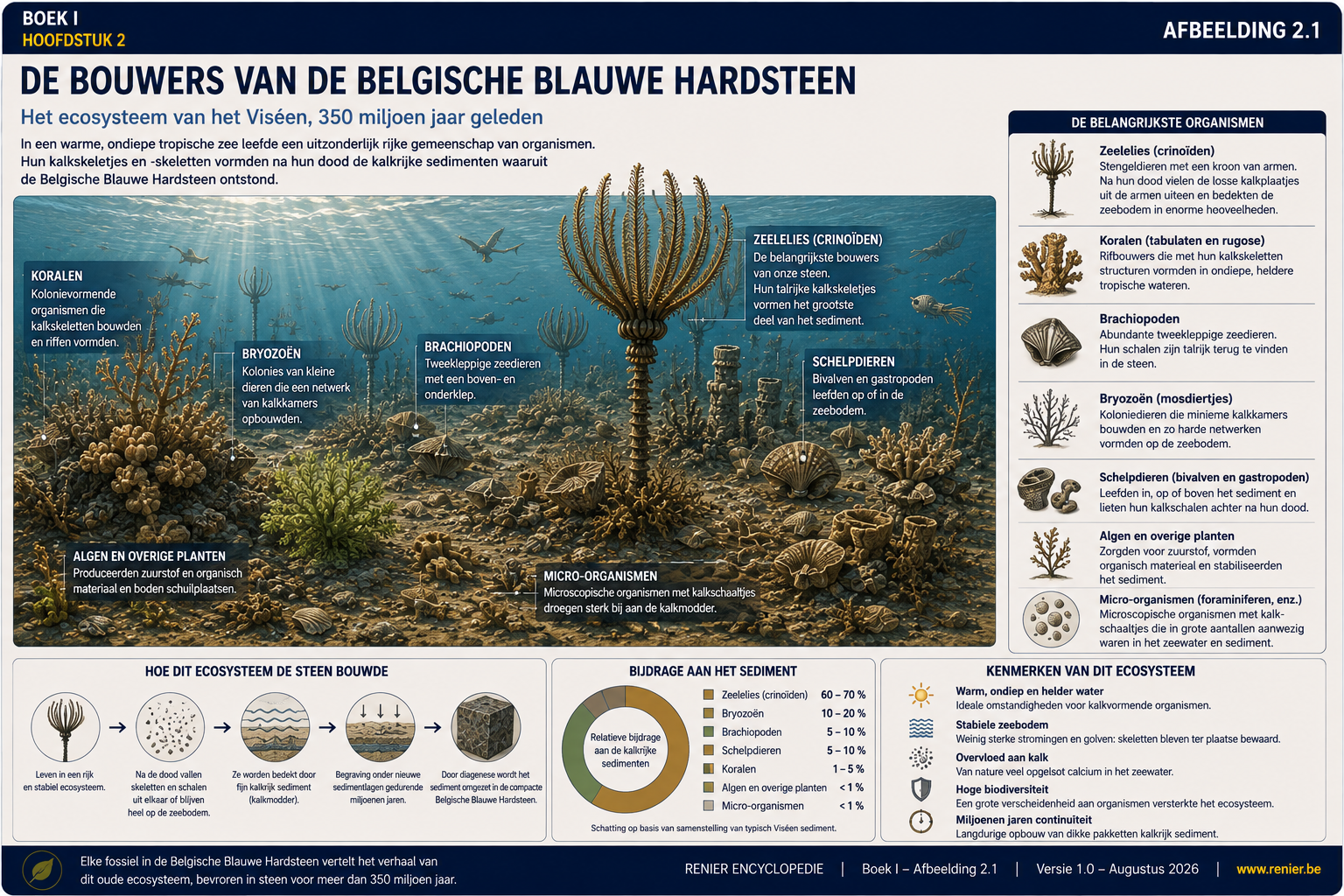
Sea lilies were not plants, but animals related to starfish and sea urchins.
Crinoids lived attached to the seafloor by a stalk. At the top, they had a calyx with branched arms that they used to filter food particles from the water. Their skeleton consisted of many individual calcite plates and stacked discs in the stalk.
After the animal’s death, the soft tissues quickly disintegrated. The hard skeleton also lost its structural integrity. As a result, a single crinoid could contribute hundreds to thousands of small calcareous fragments to the sediment. When enormous populations did this over long periods of time, layers formed that were exceptionally rich in crinoid remains.
In sawn or honed Belgian Blue Stone, the stamen segments appear as light circles, small rings, or short rods. Other cross-sections reveal star-shaped structures, parts of the calyx, or fragments of the petals. The direction of the cut determines which pattern is visible.
Their skeletal parts were made of relatively sturdy calcite. As a result, they often remained more recognizable than the softer or more fragile remains of other organisms.
An exceptionally rich biodiversity
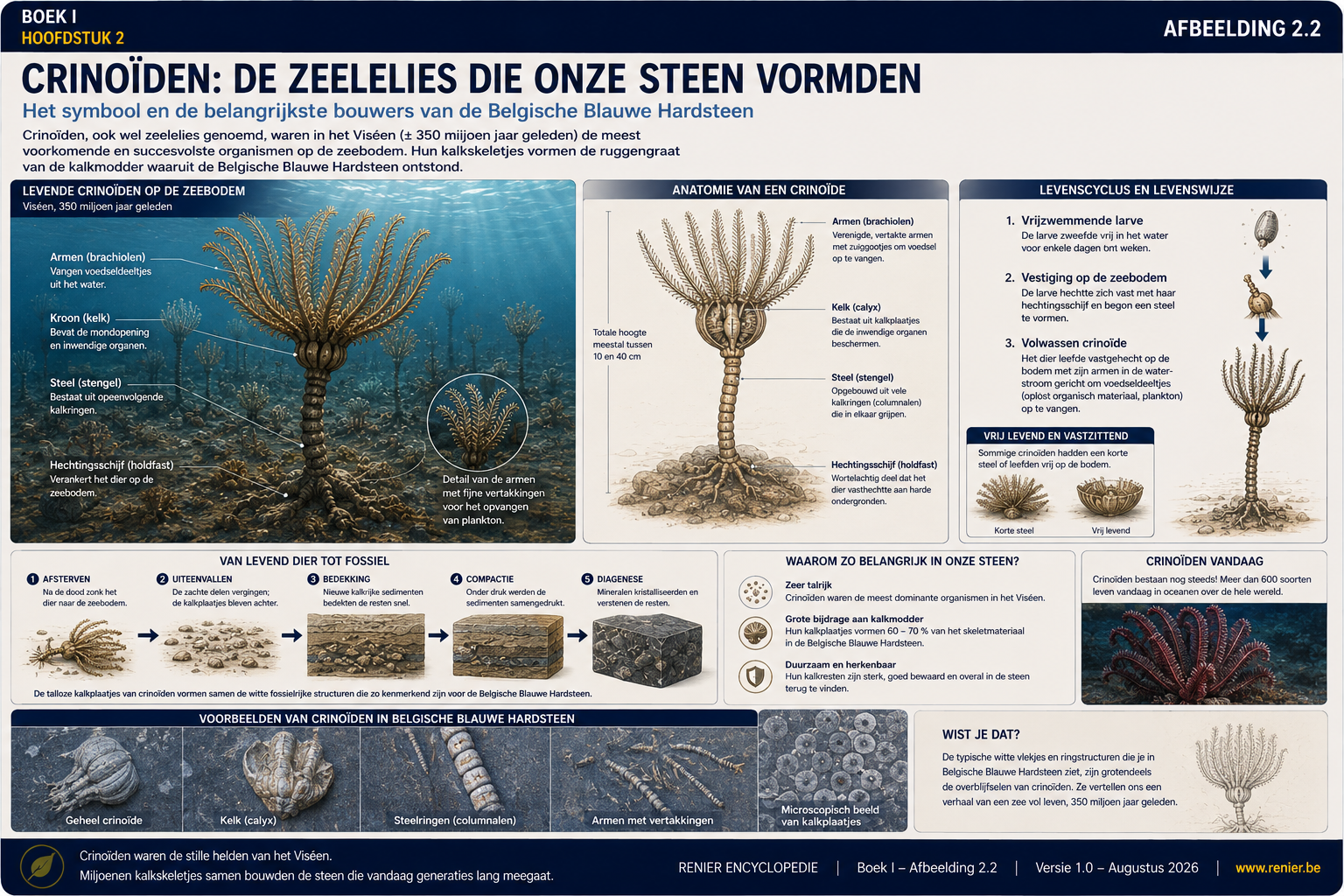
The sea lilies were dominant, but they shared their habitat with a wide variety of other organisms.
Brachiopods resembled shells at first glance, but constituted a separate group of animals. They lived on or partially within the seafloor and filtered food from the water. Their two valves were usually of unequal shape and produced distinct fossils after death.
Bryozoans consisted of colonies of very small animals. Together, they built finely branched or crust-like calcareous structures. Corals formed colonies or individual calcareous skeletons and created a complex three-dimensional habitat in certain areas.
Bivalves, snails, algae, sponges, and microscopic organisms rounded out the ecosystem. Not every group contributed equally to the resulting rock, but together they determined the diversity of the fossils and the texture of the limestone.
Various groups, including crinoids, brachiopods, bryozoans, corals, and mollusks, still exist today. However, their modern relatives live in different ecosystems and under different conditions.
How Life Was Preserved in Stone
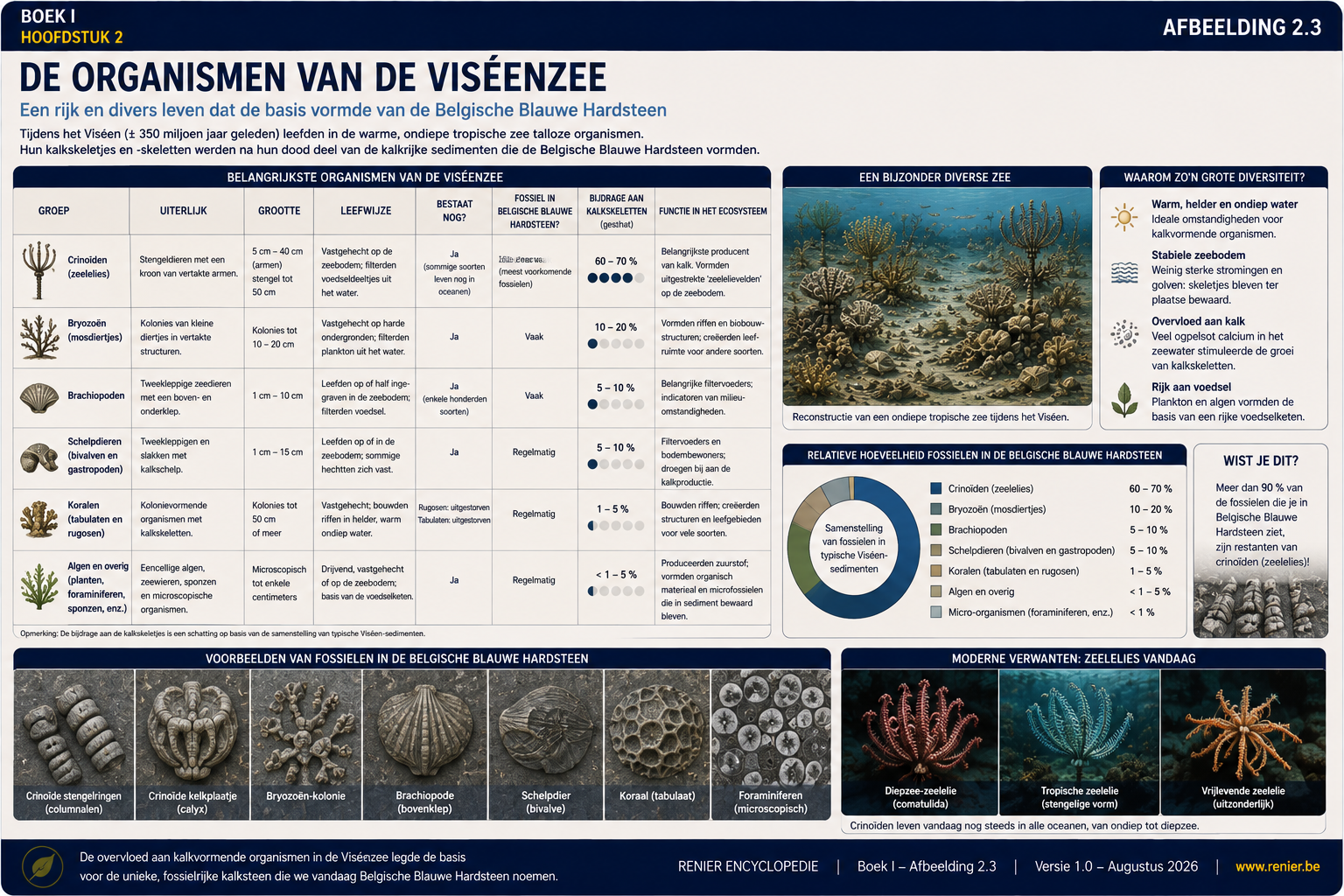
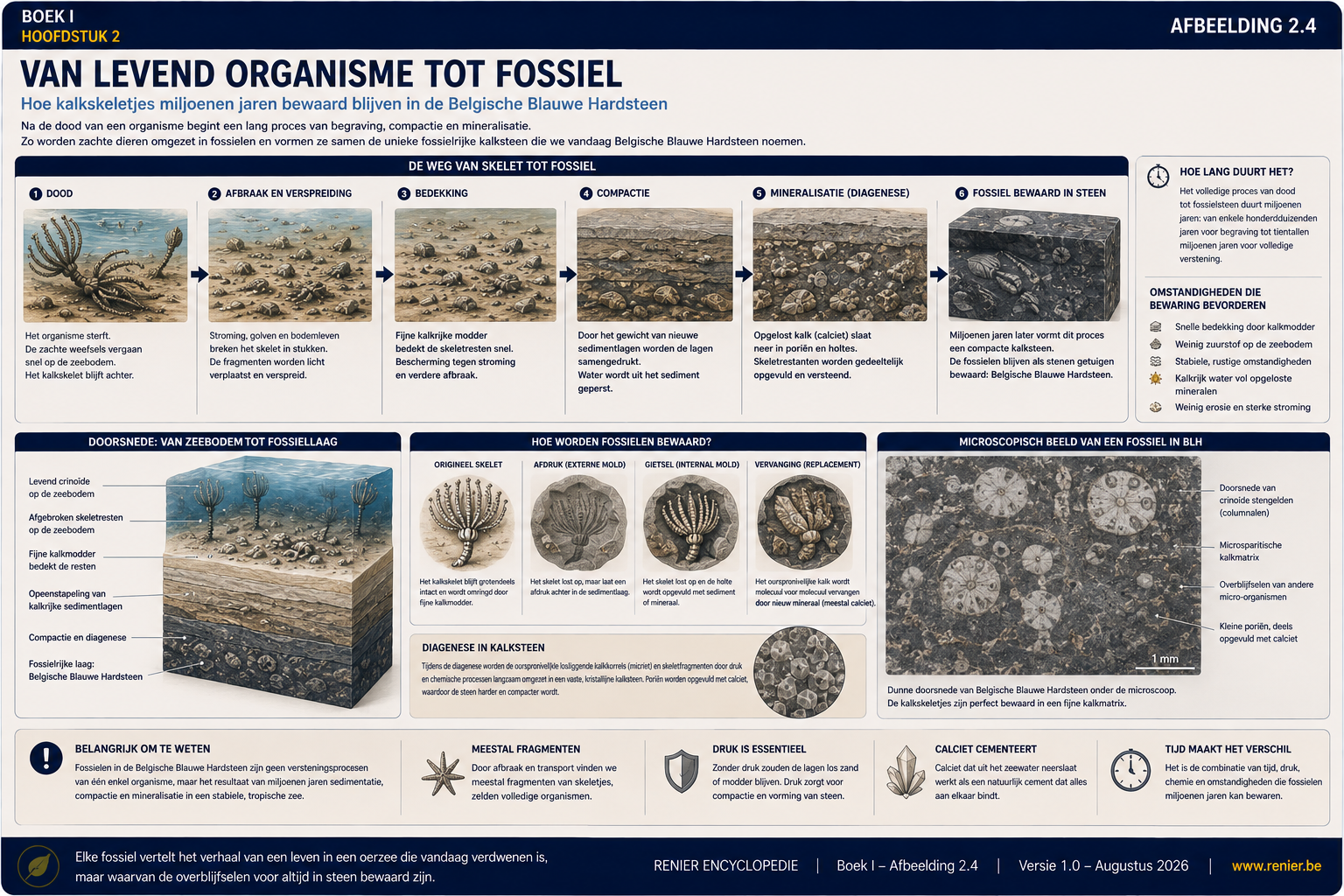
Fossilization is not a single moment, but a sequence of biological, sedimentary, and chemical processes.
After death, the soft tissues usually disappeared quickly. Calcareous skeletons, shells, and hard fragments remained. Currents, waves, and bottom-dwelling animals could move, break, or scatter these remains before they were finally buried.
Fine limestone mud covered the remains. New layers of sediment accumulated, protecting the buried fragments from further damage. Under the weight of the overlying layers, the sediment was compressed and lost water.
Dissolved minerals precipitated in pores and around fossils. Some skeletal parts remained largely intact, while others were partially dissolved, replaced, or preserved as impressions. The result is a rock in which different forms of fossil preservation occur side by side.
In Belgian Blue Stone, we usually find isolated skeletal fragments and cross-sections. Fully preserved organisms are rarer because skeletons often disintegrated after death.
Exceptional circumstances for custody
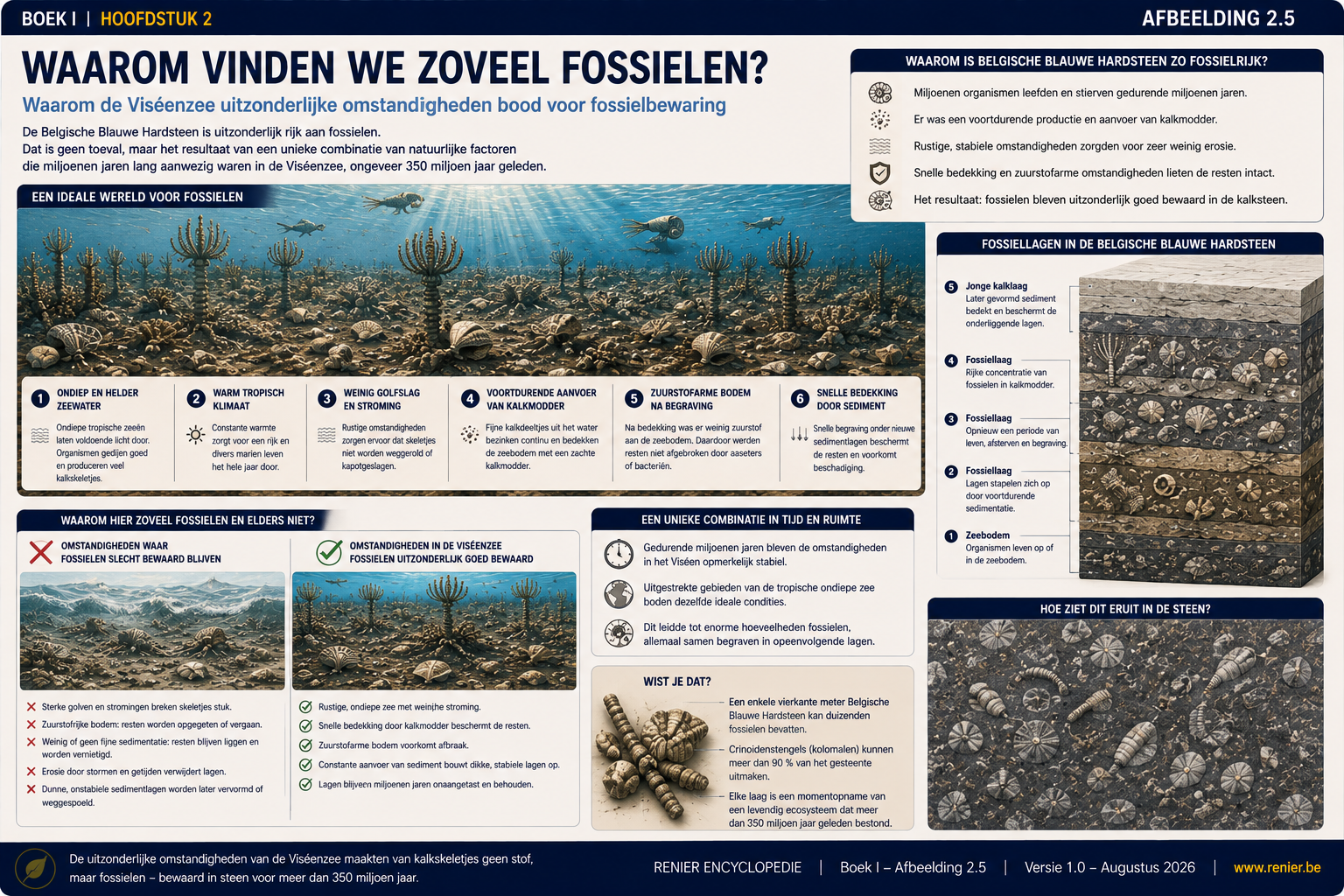
The abundance of fossils is the result of a rare combination of abundant life, continuous calcium carbonate production, and favorable preservation conditions.
For a very long time, vast numbers of organisms lived in the same shallow sea. Each generation contributed new calcareous skeletons and fragments. This created a continuous supply of fossil material.
The seafloor was relatively calm for much of the time. Strong currents and intense erosion would have shattered or carried away the remains. Instead, fine calcareous mud was able to accumulate and quickly cover the skeletal fragments.
After burial, the oxygen supply decreased. As a result, decomposition by soil animals and microorganisms was limited. New layers protected the older sediments, while the seafloor remained stable enough to deposit thick layers of fossil-rich limestone.
Not all fossils are perfectly or completely preserved. It is precisely the large number of fragments that shows how productive the ecosystem was and how often the cycle of life, death, burial, and preservation repeated itself.
A fossil-rich rock does not represent a single moment in time, but rather a succession of countless organisms and sedimentary layers that accumulated over a very long period of time.
A Hidden World Within the Stone
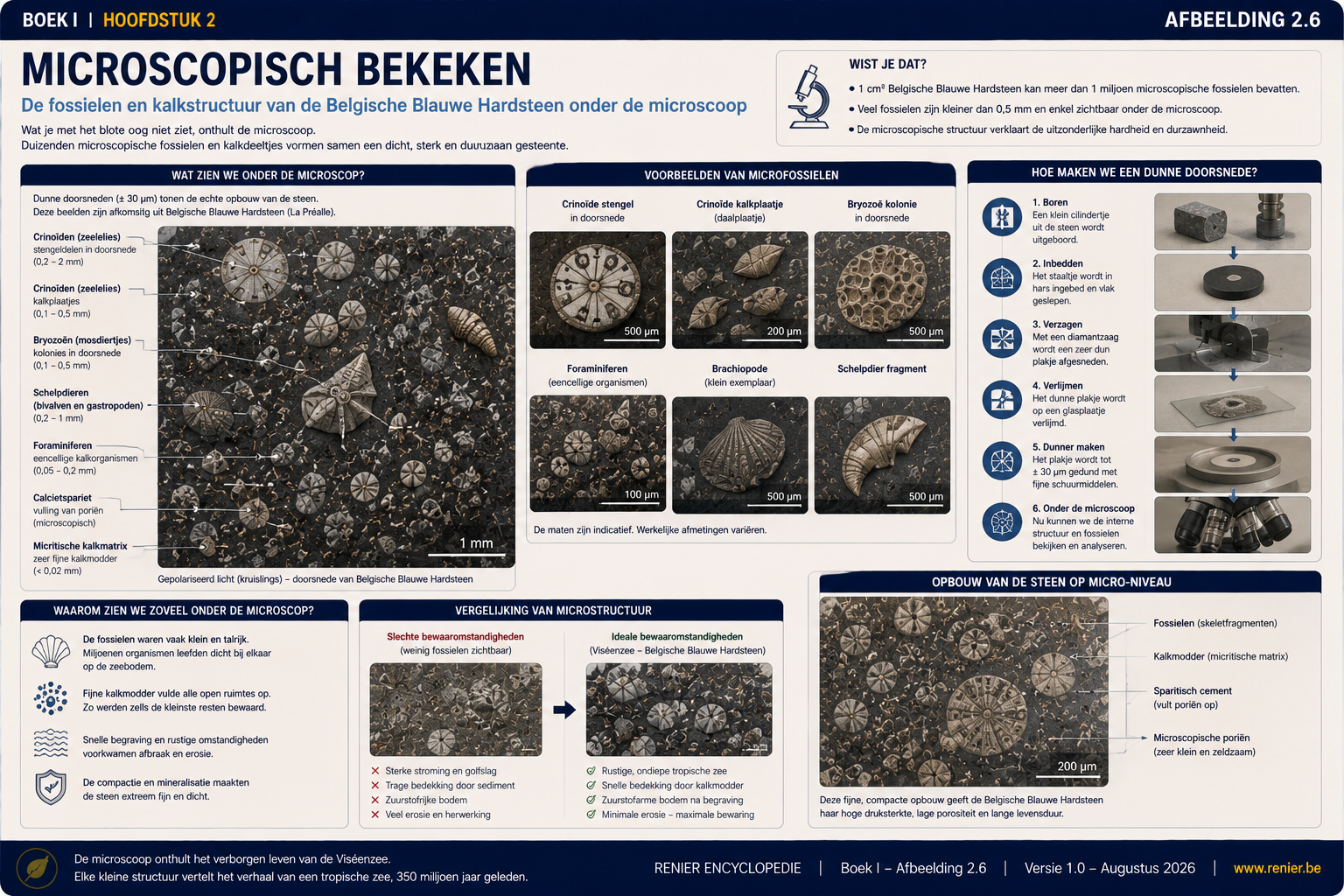
What appears to the naked eye to be a single, compact surface turns out, under a microscope, to be a complex mosaic of fossils, calcareous mud, crystals, and pores.
For microscopic examination, a very thin slice of rock is prepared. Light can pass through this thin cross-section, revealing minerals, fossil fragments, and internal structures.
The dark, fine-grained sediment consists largely of micritic limestone: extremely small limestone particles derived from calcareous mud and microscopic material. Interspersed among them are larger fossil fragments of crinoids, brachiopods, bryozoans, mollusks, and microorganisms.
Calcite cement fills some of the spaces between the grains. This binds the loose particles together, creating a dense structure with relatively few open pores. This microscopic structure helps explain why the stone is compact, durable, and easy to polish.
The properties of the rock are not determined by a single element, but by the ratio of fossils, fine matrix, calcite cement, crystal size, and pores.
The stone's natural signature
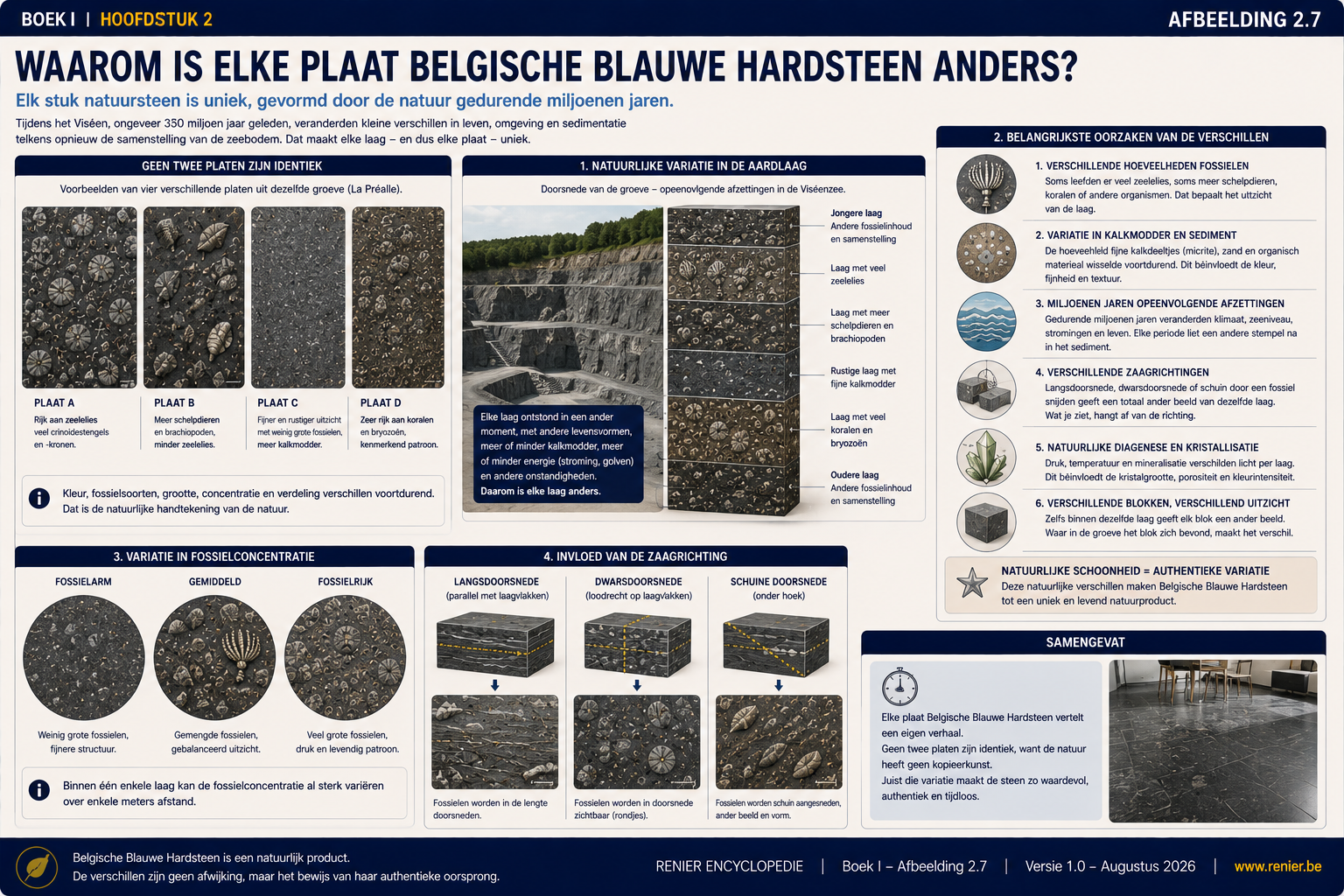
No two slabs of Belgian Blue Stone have exactly the same distribution of fossils, pattern, or shade.
Life on the seafloor was constantly changing. At times, crinoids were particularly abundant, while in other places or at other times, brachiopods, bryozoans, corals, or mollusks were more prevalent. As a result, each sediment layer had its own unique composition.
The amount of fine calcareous mud, the energy of the water, and the rate of sedimentation also varied. These differences influenced the fossil concentration, grain size, and the ratio of dark matrix to lighter fossils.
The position of the block in the quarry and the direction of the cut then determine how these structures are revealed. A fossil cut lengthwise reveals a different pattern than the same fossil cut crosswise.
The finish either enhances or softens the visibility of the fossils. Contrasts often stand out clearly on a honed or polished surface, while a rougher finish can produce a more subtle and uniform appearance.
The natural variations show that the stone was not pressed, cast, or replicated. They serve as proof of its authentic geological origin.
A fossil record of a vanished sea
The fossils directly link the lives of the people of Visée to the natural stone used today in architecture, interior design, and landscaping.
Belgian Blue Stone was formed from material originating from a rich marine ecosystem. Crinoids provided a particularly large number of calcareous fragments, but corals, bryozoans, brachiopods, shellfish, algae, and microorganisms also contributed.
After their deaths, their hard remains were scattered, covered, and buried. Thanks to a combination of calm conditions, fine limestone mud, rapid burial, and prolonged sedimentation, enormous quantities of fossils were preserved.
Under the microscope, the stone appears to be a fine network of fossil fragments, a micritic limestone matrix, calcite cement, and small pores. The natural variation in these components explains why each slab has its own unique character.
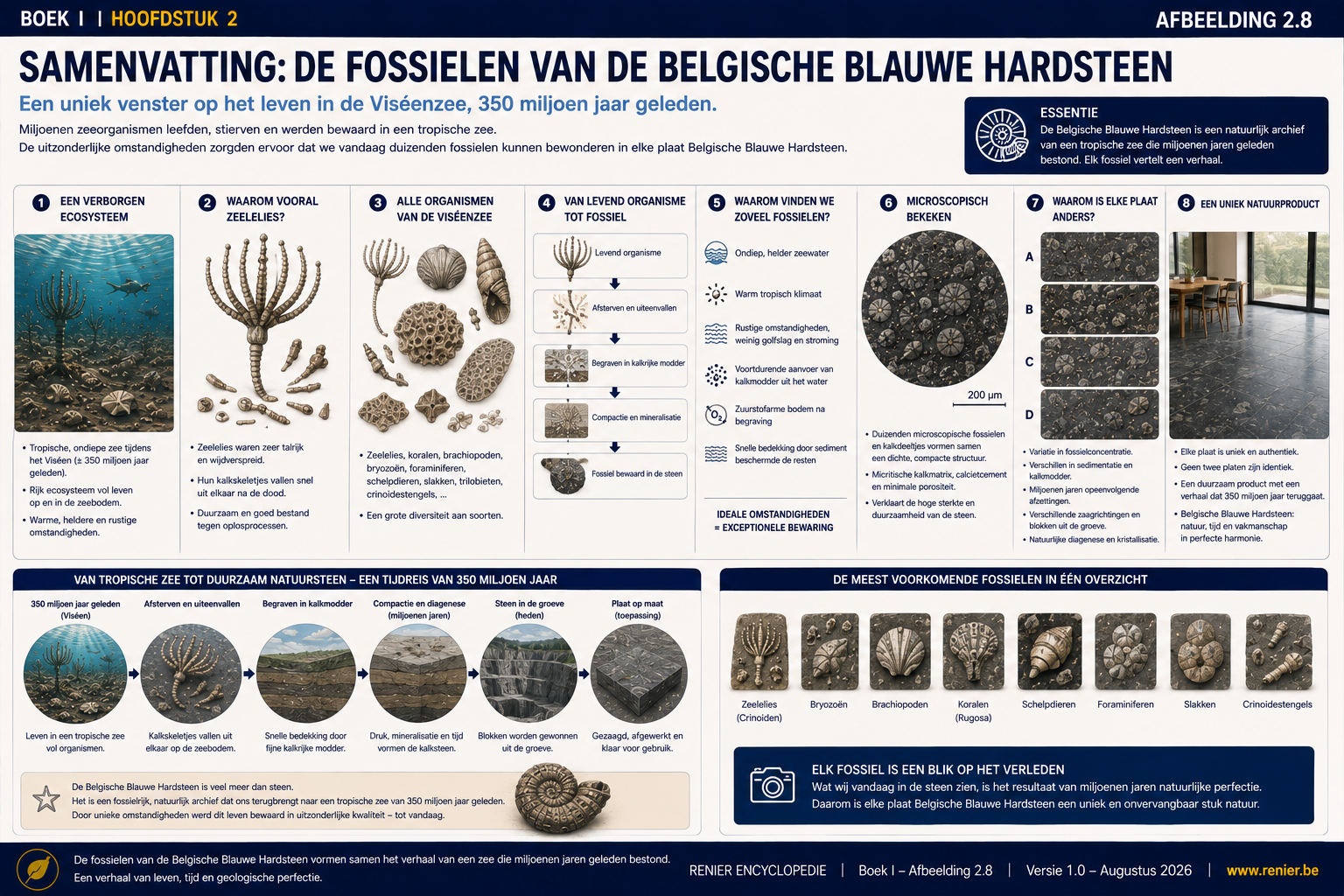
What We Learn from Fossils
- The rock was formed by an entirely tropical marine ecosystem.
- Crinoids were particularly abundant and yielded many identifiable skeletal fragments.
- Bryozoans, brachiopods, corals, shellfish, algae, and microorganisms also contributed.
- Fossils were formed through death, coverage, burial, and mineralization.
- Calm conditions and fine limestone mud contributed to exceptionally good preservation.
- At the microscopic level, the stone consists of fossils, a fine limestone matrix, calcite cement, and small pores.
- Natural variations in grain, fossils, and cutting direction make each slab unique.
Every piece of Belgian Blue Stone thus carries a piece of this vanished sea within it. The fossils not only give the stone its distinctive appearance, but also make it a tangible link between nature, geological time, and human craftsmanship.
About Fossils in Belgian Blue Stone
What fossils are found in Belgian Blue Stone?
The most recognizable fossils are the remains of crinoids, or sea lilies. Other fossils found here include brachiopods, bryozoans, corals, shellfish, algae, and various microorganisms.
Are the white circles in the rock fossils?
Many of the light-colored circles and ring-shaped structures are cross-sections of crinoid stalks. The exact shape depends on how the fossil is cut by the saw blade.
Why are some rock layers richer in fossils than others?
The quantity and types of fossils varied by sediment layer. The block’s location, the direction of the cut, and the surface finish also influence how many fossils are visible.
Are fossils a weak spot in the rock?
Fossils are part of the natural structure of limestone. Their presence is not, in itself, a defect. The technical quality is determined by the rock as a whole, including the matrix, cementation, pores, and any natural discontinuities.
Why do fossils look different depending on how they're finished?
A smooth finish often enhances the contrast between fossils and the dark matrix. With a rougher finish, the surface is more strongly defined by texture, and fossils may be less clearly visible.