

Back when Belgium was still at the bottom of a tropical sea
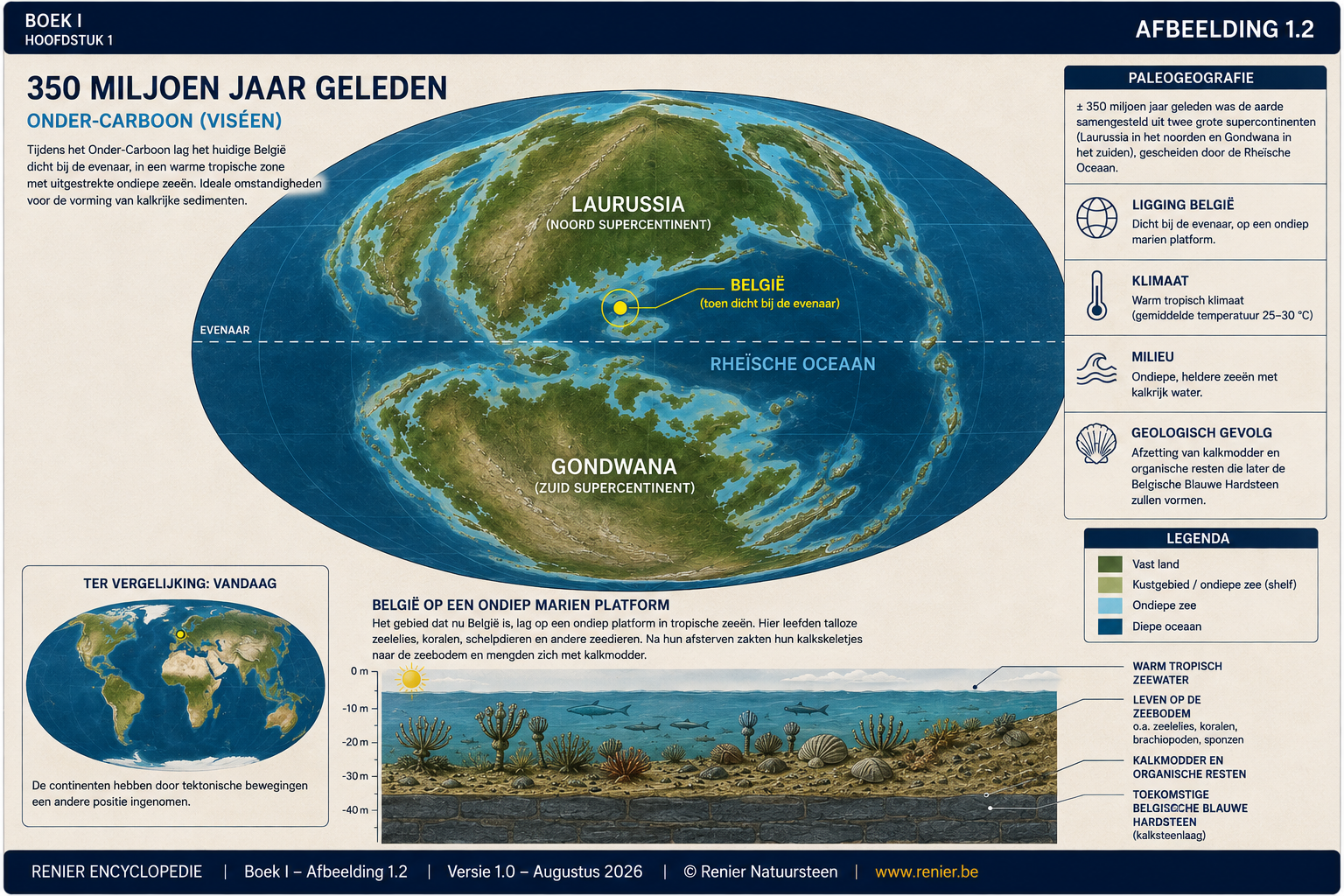
A journey back to about 350 million years ago, when what is now Belgium was located near the equator and a warm, shallow sea laid the foundation for Belgian Blue Stone.
Anyone looking at a door sill, floor tile, or facade stone made of Belgian Blue Stone today is, in reality, looking at the fossilized remains of a long-vanished tropical sea.
The story begins about 350 million years ago, during the Lower Carboniferous. The Earth looked completely different back then. Europe did not yet exist in its current form, the Atlantic Ocean had not yet opened up, and the continents were in different locations.
The area that would later become Belgium was also located thousands of kilometers further south. It lay close to the equator and was largely covered by a warm, shallow sea. The seafloor was home to sea lilies, corals, brachiopods, bryozoans, shellfish, and countless other organisms with calcareous skeletons.
After their death, these remains became part of the sediment. Layer by layer, limestone fragments, fossils, and fine limestone mud were deposited on the seafloor. Under the influence of burial, pressure, and chemical processes, a compact, fossil-rich limestone eventually formed: Belgian Blue Stone.
Belgium was close to the equator
Our region was not located at its current latitude, but in a warm tropical area on the edge of Laurussia.
Due to the movement of the tectonic plates, the position of the continents was constantly changing. The rock formation from which Belgian Blue Stone originated was formed when our region was located much further south than it is today.
Its location near the equator explains its tropical climate and warm sea. Under such conditions, calcareous organisms were able to thrive. Their skeletons and hard parts consisted largely of calcium carbonate, the same material that would later become a major component of limestone.
Belgian Blue Stone is older than the dinosaurs, older than the Alps, and older than the Atlantic Ocean.
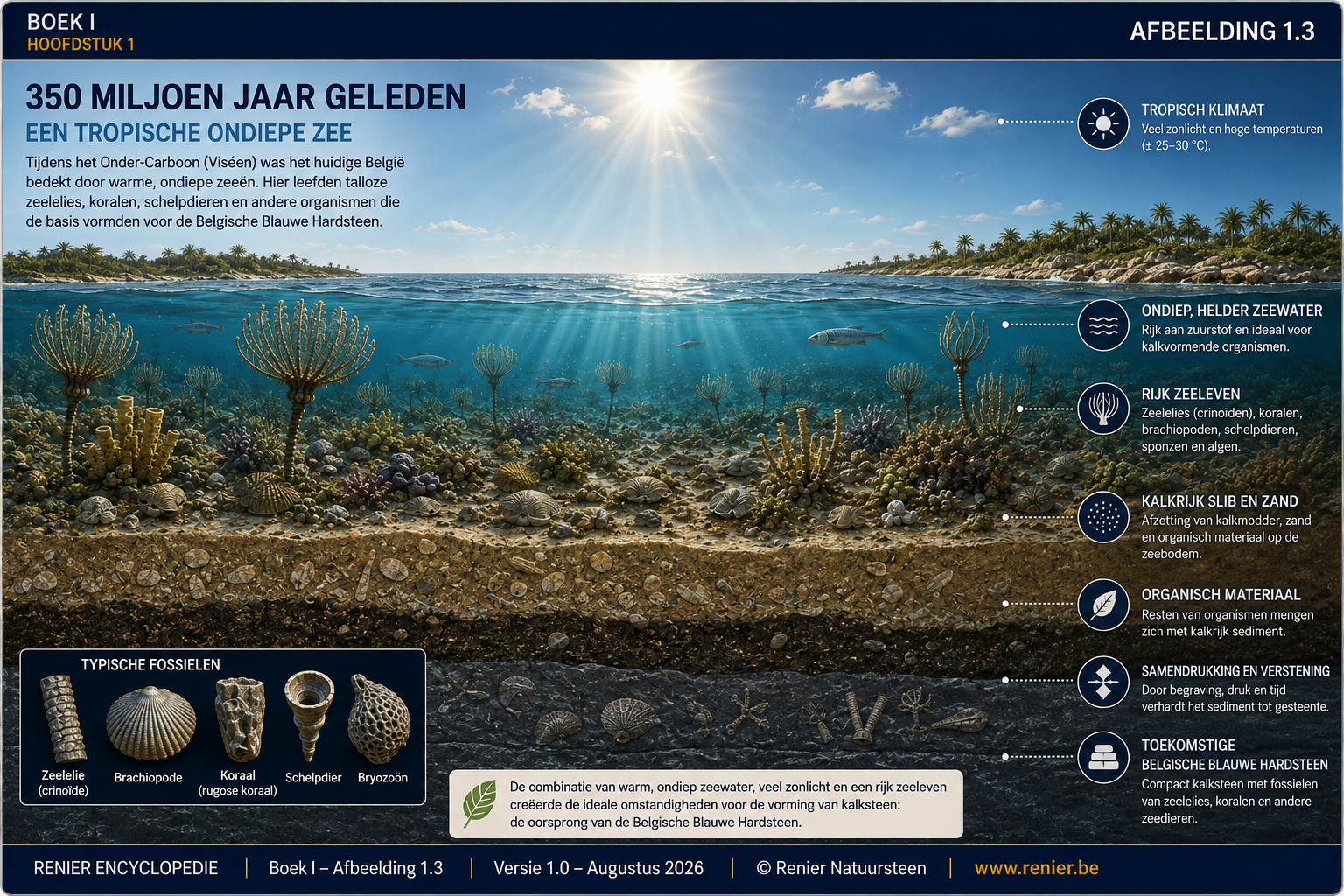
A warm, clear, and relatively shallow sea
The seafloor was not an empty expanse, but a living landscape teeming with organisms.
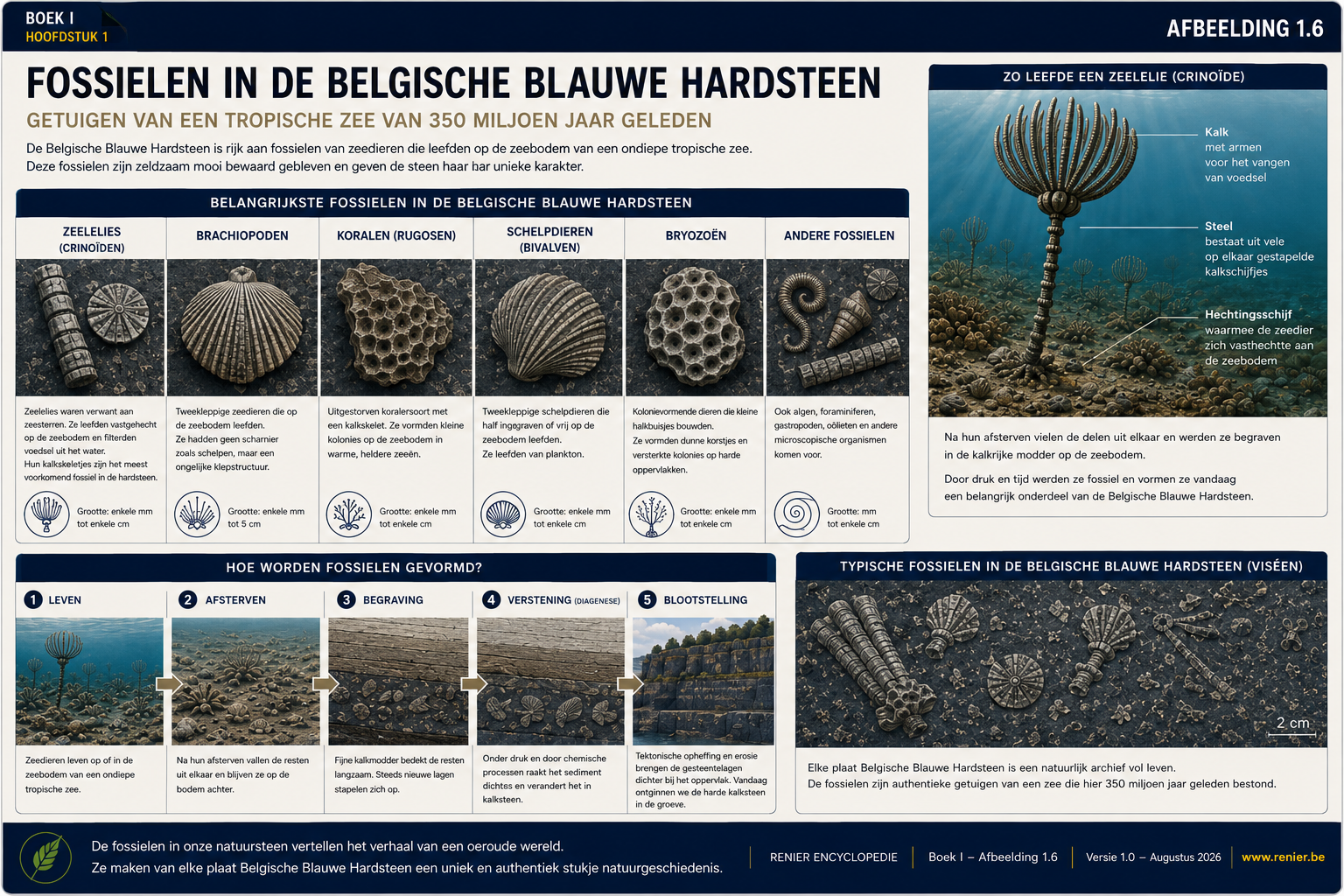
Sea lilies stretched out their arms in the current to filter food particles from the water. Corals formed colonies, brachiopods lay on or in the sediment, and bryozoans built delicate calcareous structures.
The water was clear enough to allow plenty of sunlight to penetrate. At the same time, the influx of clay and sand from the land was limited. As a result, the calcareous deposits were not constantly diluted by large amounts of other sediment.
Conditions remained favorable for long periods of time. As a result, thick layers of calcareous material were able to accumulate on the seafloor.
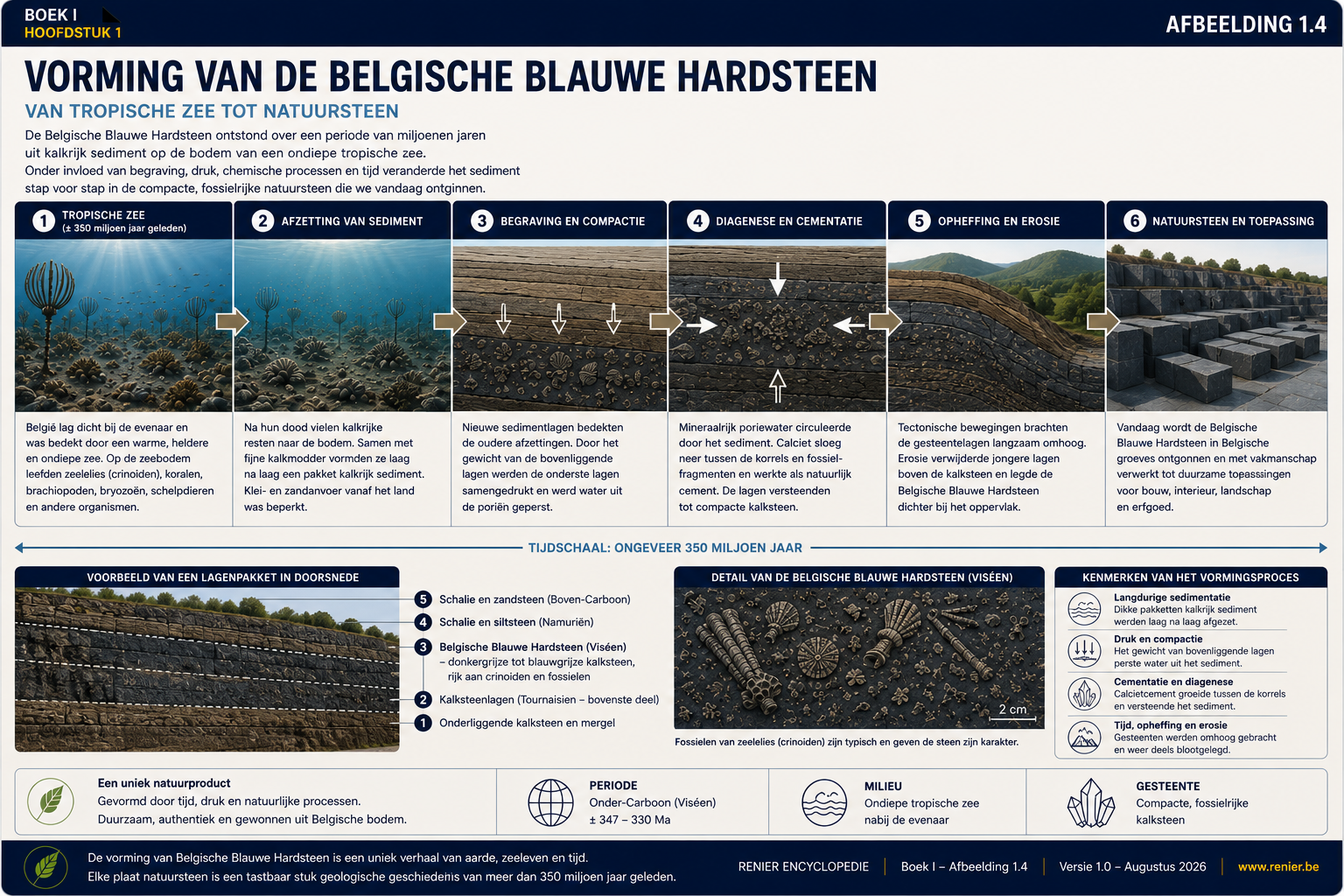
A 350-million-year geological journey
Hundreds of millions of years of natural processes have taken place between the initial deposition on the seafloor and the current mining operations.
After they died, the calcareous remains of marine organisms sank to the seafloor. Together with fine calcareous mud, they formed thick layers of sediment. New layers covered the older deposits, causing pressure and temperature to gradually increase.
Under the influence of compaction and diagenesis, the loose sediment turned into hard limestone. Later, tectonic movements caused the layers to be uplifted. Erosion removed the overlying rocks and brought the limestone closer to the Earth’s surface once again.
Today, Belgian Blue Stone is quarried in Belgian quarries and skillfully crafted into durable products for construction, interior design, landscaping, and heritage preservation.
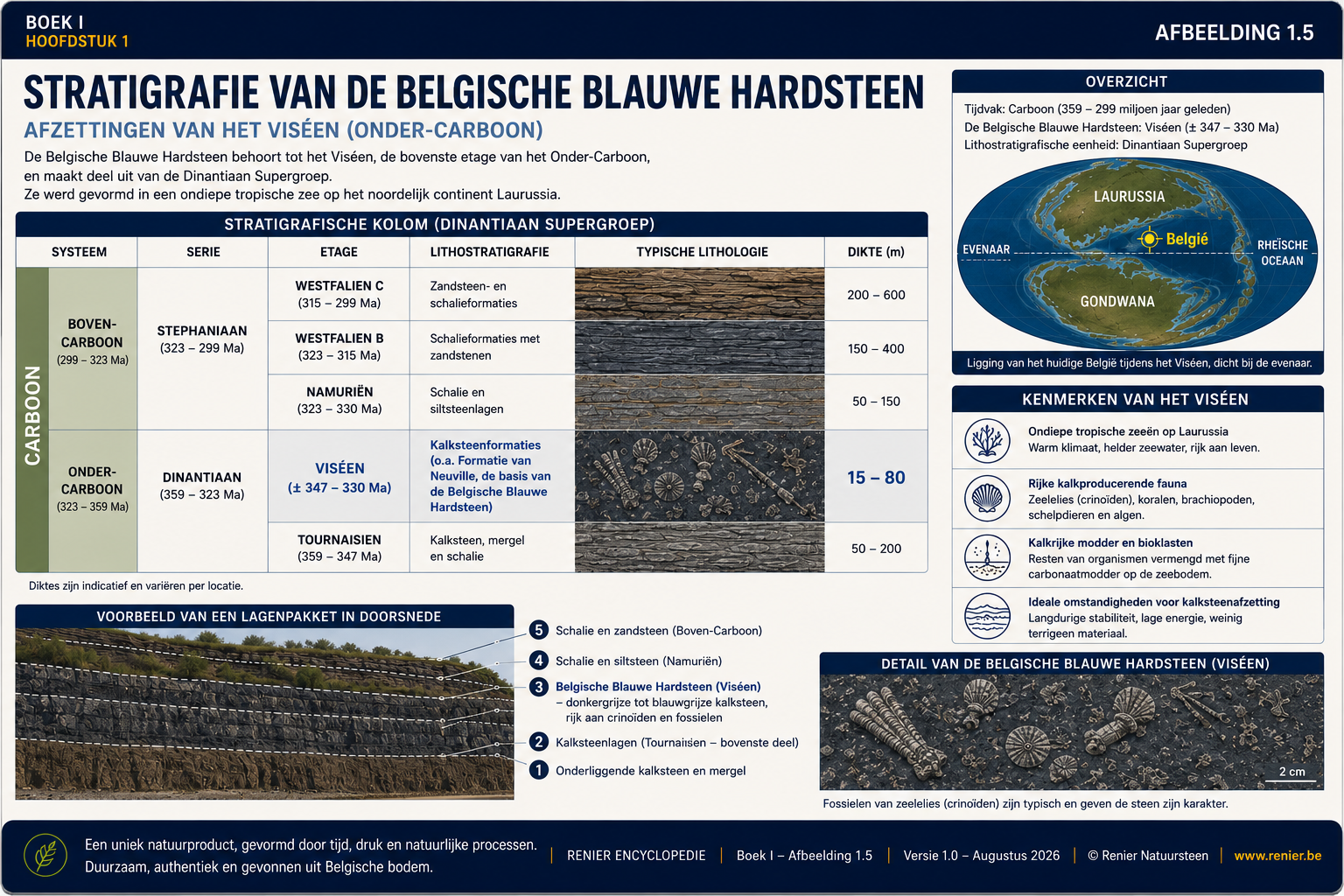
Belgian Blue Stone within the Viséen
Belgian Blue Stone is generally associated with limestone deposits from the Lower Carboniferous. The Viséen stage plays an important role within this period.
Stratigraphy is the science of studying rock layers and arranging them in order of time and space. By comparing fossils, rock types, and the relative positions of layers, geologists can determine when and under what conditions a rock was formed.
Not every Belgian quarry extracts exactly the same layer or rock unit. Local differences in sedimentation, subsequent deformation, and diagenesis can affect color, fossil content, structure, and technical properties.
The exact stratigraphic assignment must always be considered on a quarry-by-quarry and mining layer-by-mining layer basis. The specific geology of the La Préalle quarry is discussed separately below.
The fossils make up the rock itself
The markings in Belgian Blue Stone are not decorations, but the remains of organisms that lived millions of years ago.
Sea lilies, or crinoids, played a particularly important role. Although their name might suggest otherwise, they are not plants. They belong to the phylum Echinodermata and are related to starfish and sea urchins.
Their stems consisted of stacked calcareous discs. After the animal died, these stems disintegrated. The individual fragments ended up on the seafloor in large quantities.
On a polished rock surface, these fragments are visible as small circles, lines, and sometimes star-shaped figures. Other fossils found include brachiopods, corals, bryozoans, and mollusks.
A polished slab of Belgian Blue Stone can reveal thousands of individual fossil fragments. As a result, no two slabs have exactly the same natural pattern.
An exceptional combination of circumstances
A warm ocean alone was not enough. Several factors had to be present simultaneously over a very long period of time.
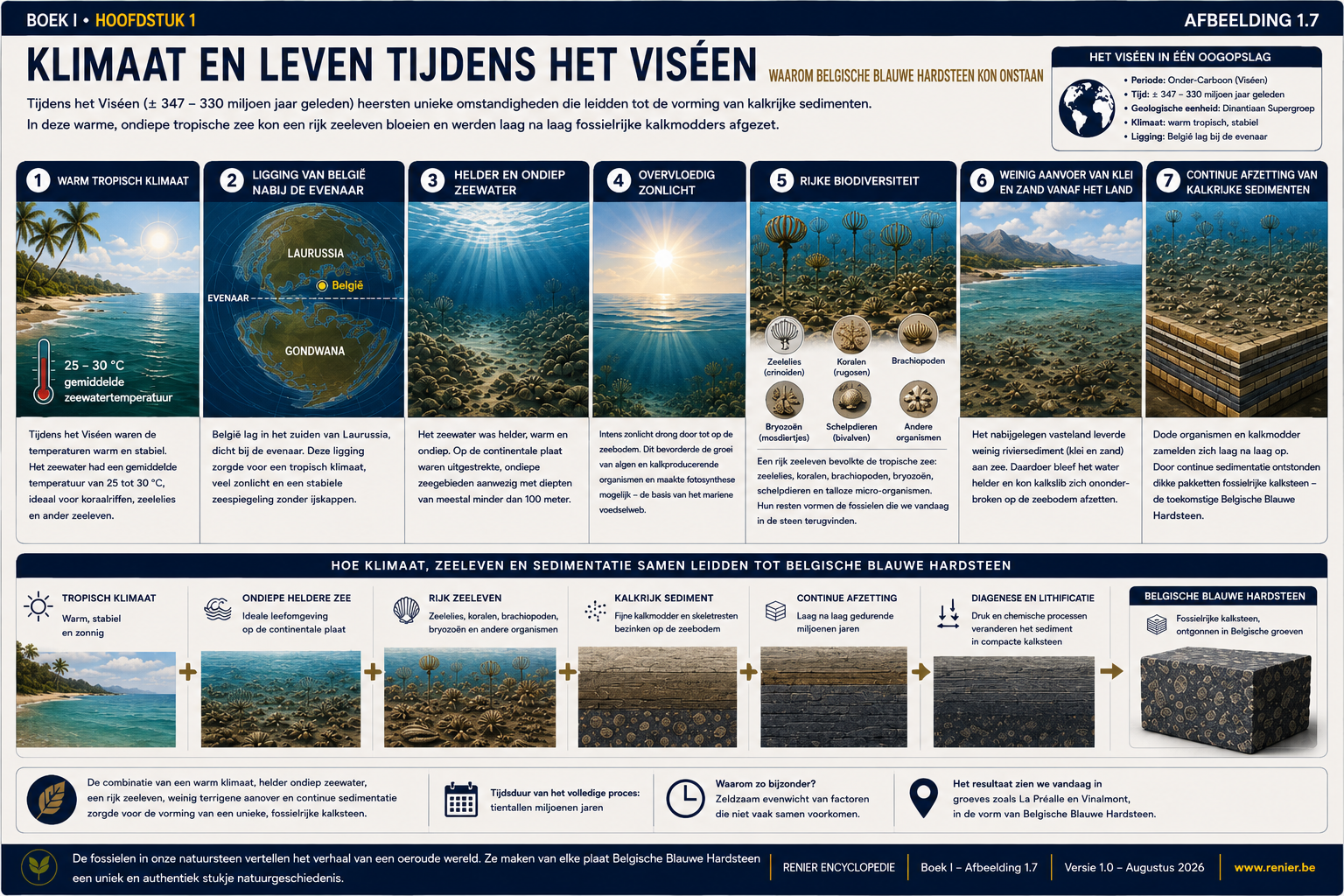
Its location near the equator resulted in a warm climate. The shallow water allowed sunlight to penetrate to the seafloor. The rich marine life continuously produced calcium-rich skeletal fragments.
The limited supply of clay and sand from the land ensured that the deposits remained relatively pure. At the same time, the seafloor subsided slowly enough to continue providing space for new layers of sediment.
This allowed thick layers of fossil-rich calcareous sediment to form without being immediately exposed above water or covered by other material.
The original sediment consisted of a mixture of fine carbonate mud and larger bioclasts: fragments of the calcareous skeletons of marine organisms.
From Sediment to Natural Stone
The sediment on the seafloor was initially soft, porous, and water-rich.
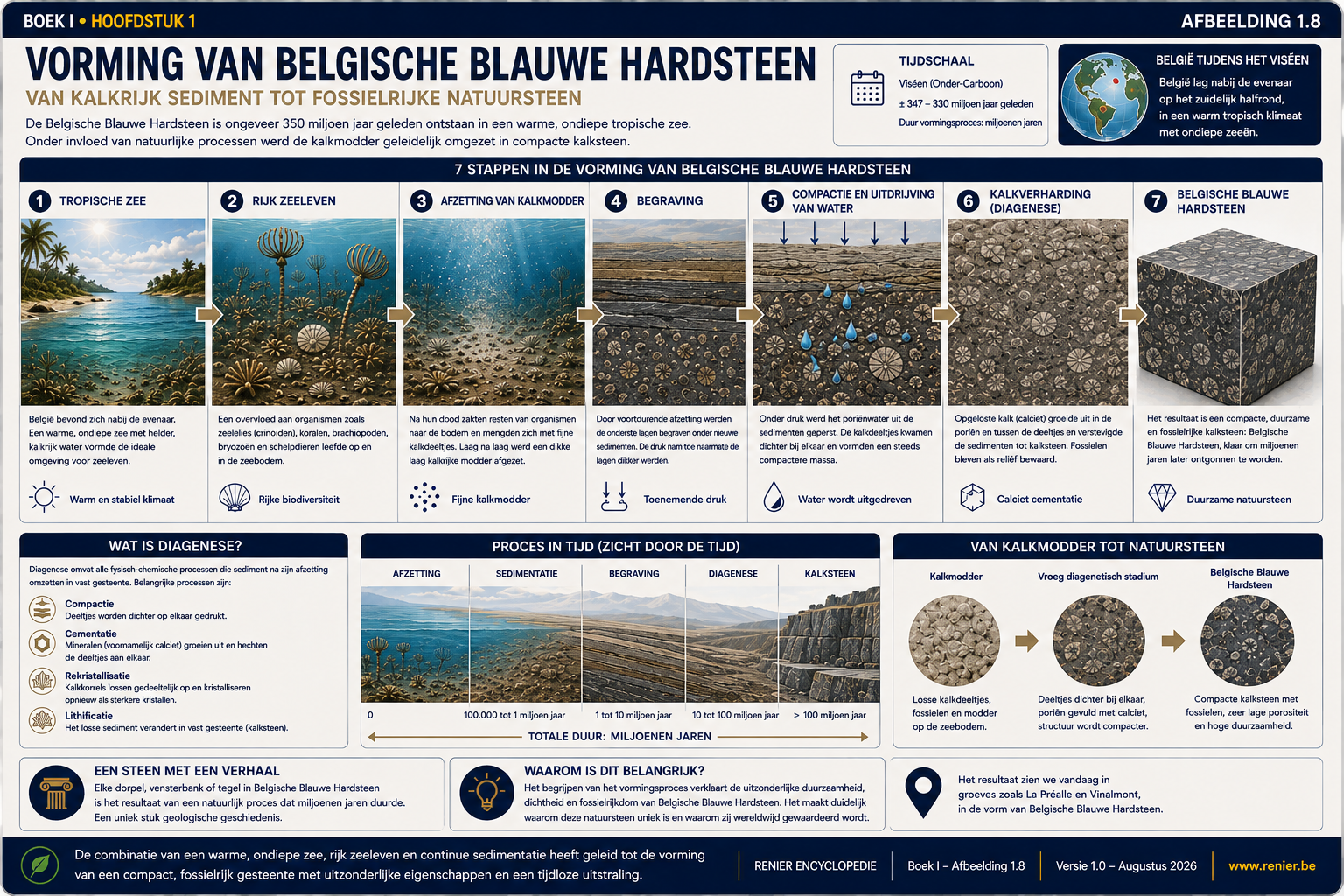
New layers of sediment covered the older deposits. The weight of the overlying layers compressed the lower sediments. Water was forced out of the pores, and the particles moved closer together.
At the same time, mineral-rich pore water circulated through the sediment. Calcite precipitated between the grains and acted as a natural cement. Fossil fragments, calcareous mud, and calcite cement gradually coalesced into a solid mass.
Geologists refer to this set of changes following the deposition as diagenesis. The process involves, among other things, compaction, cementation, recrystallization, and other physicochemical changes.
This process resulted in a dense, compact, and fossil-rich limestone. The original biological structures remained partially visible and give the stone its unique character today.
The Viséen in the History of the Earth
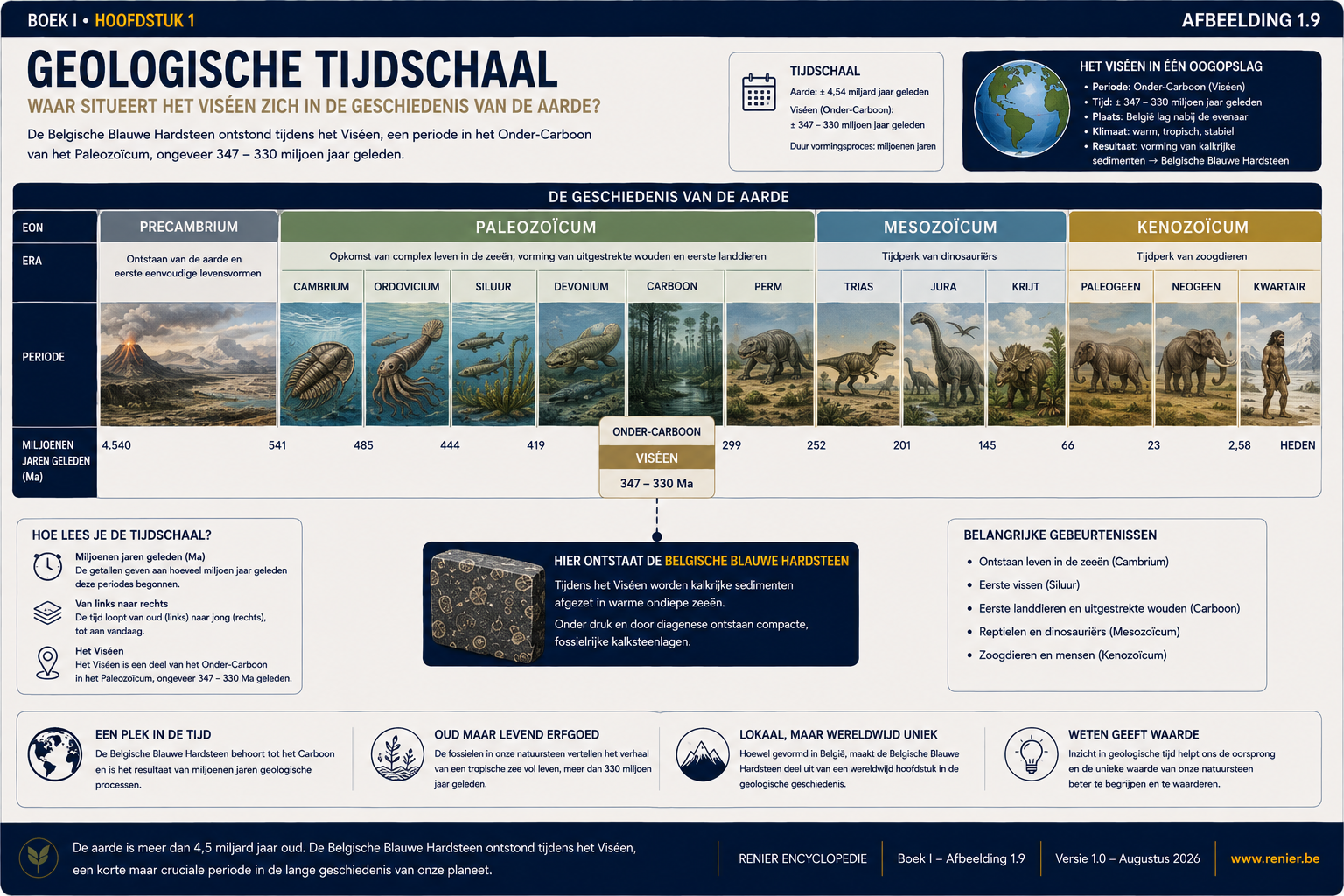
The period during which Belgian Blue Stone was formed represents only a small part of our planet’s history, which spans more than 4.5 billion years.
The Viséen belongs to the Lower Carboniferous, which in turn is part of the Paleozoic Era. During the Paleozoic Era, marine life flourished, and the first extensive terrestrial ecosystems also emerged.
Belgian Blue Stone formed long before the dinosaurs, which did not appear until the Mesozoic Era. Nor did the continents, mountain ranges, and oceans of today exist in their present form at that time.
The rock thus serves as a tangible geological archive of a very ancient chapter in the history of the Earth.
From tropical seabeds to natural stone
- About 350 million years ago, what is now Belgium was located close to the equator.
- A warm, clear, and relatively shallow sea covered large parts of our region.
- Sea lilies, corals, brachiopods, bryozoans, and other organisms produced large quantities of calcareous material.
- Their remains were deposited layer by layer on the seafloor along with calcareous mud.
- Burial, compaction, cementation, and diagenesis transformed the sediment into a solid, fossil-rich limestone.
- The fossils are still visible today and form an integral part of Belgian Blue Stone.
Belgian Blue Stone is, therefore, no ordinary building material. Each slab is a cross-section of a vanished ecosystem and preserves tangible traces of hundreds of millions of years of Earth’s history.
On the Origins of Belgian Blue Stone
How old is Belgian Blue Stone?
The limestone was formed during the Lower Carboniferous period and is approximately 350 million years old. The exact age may vary slightly depending on the geological layer and mining area.
Why does Belgian Blue Stone contain fossils?
The rock formed from calcareous sediments and the remains of organisms that lived on the bottom of a tropical sea. During the fossilization process, many of these remains were preserved within the rock.
Are sea lilies really plants?
No. Sea lilies, or crinoids, are animals and belong to the same major animal group as starfish and sea urchins.
Why was Belgium so close to the equator back then?
Tectonic plates are constantly moving. During the Lower Carboniferous period, the rock formation from which Belgian Blue Stone originated was located much further south than it is today.
What does diagenesis mean?
Diagenesis is the collective term for the processes that transform loose sediment into solid rock after it has been deposited, including compaction, cementation, and recrystallization.