

Natural characteristics, veins, and distinctive features
No two slabs of Belgian Blue Stone are identical. Fossils, calcite veins, stylolites, color variations, and geological structures tell the story of the stone’s natural formation.
The geological signature of the rock
Belgian Blue Stone is a natural product. The stone was formed, compressed, crystallized, and deformed over hundreds of millions of years.
That long geological history leaves its mark. Fossils, faint calcite veins, stylolites, variations in color, layer surfaces, and natural fractures can all be visible in a block or finished slab.
Such characteristics are not necessarily flaws. Many of them are, in fact, part of the stone’s natural character and authenticity.
- No two records are identical
- Fossils as a natural feature
- Calcite Veins and Crystallization
- Stylolites and Pressure Release
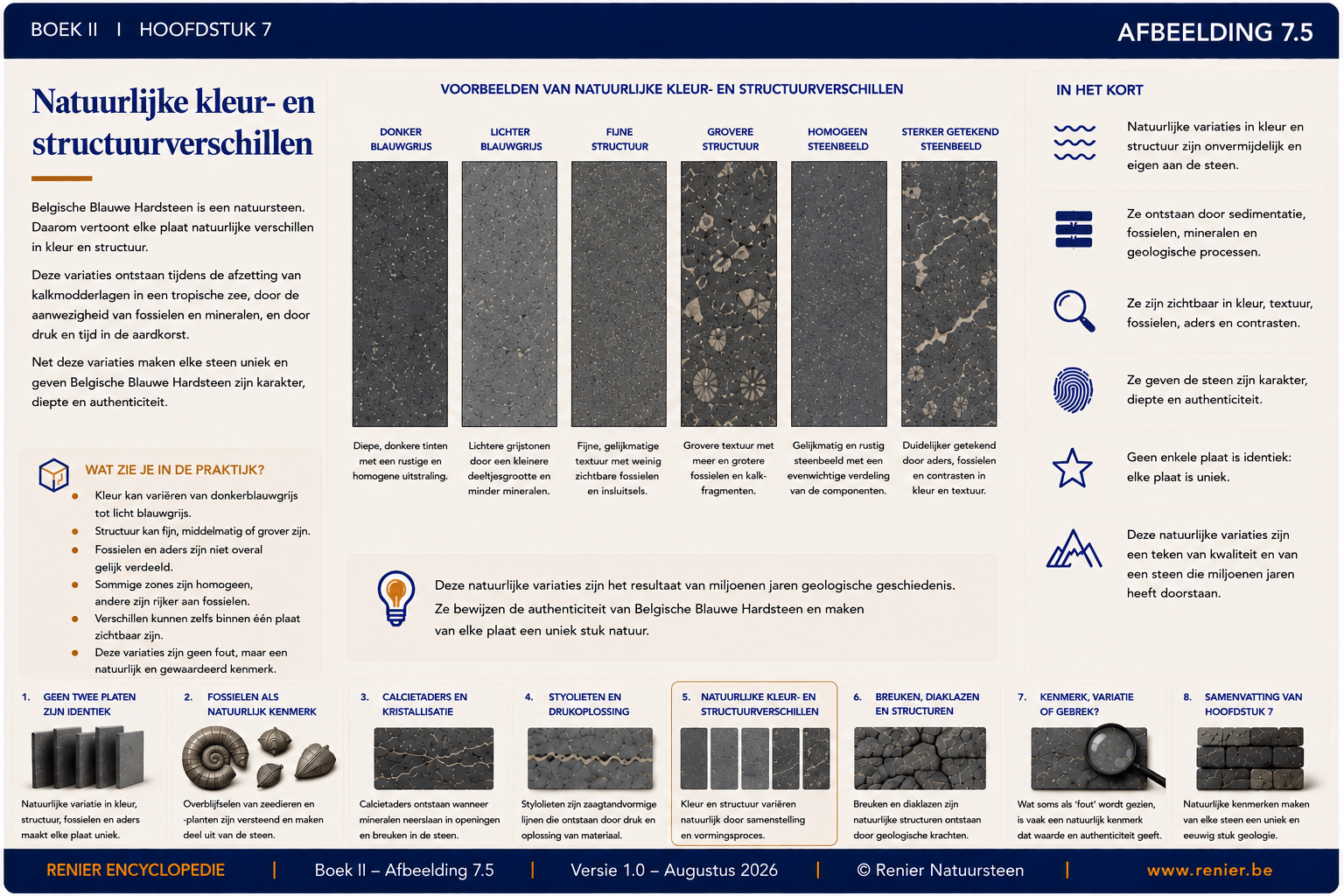
- Natural variations in color and texture
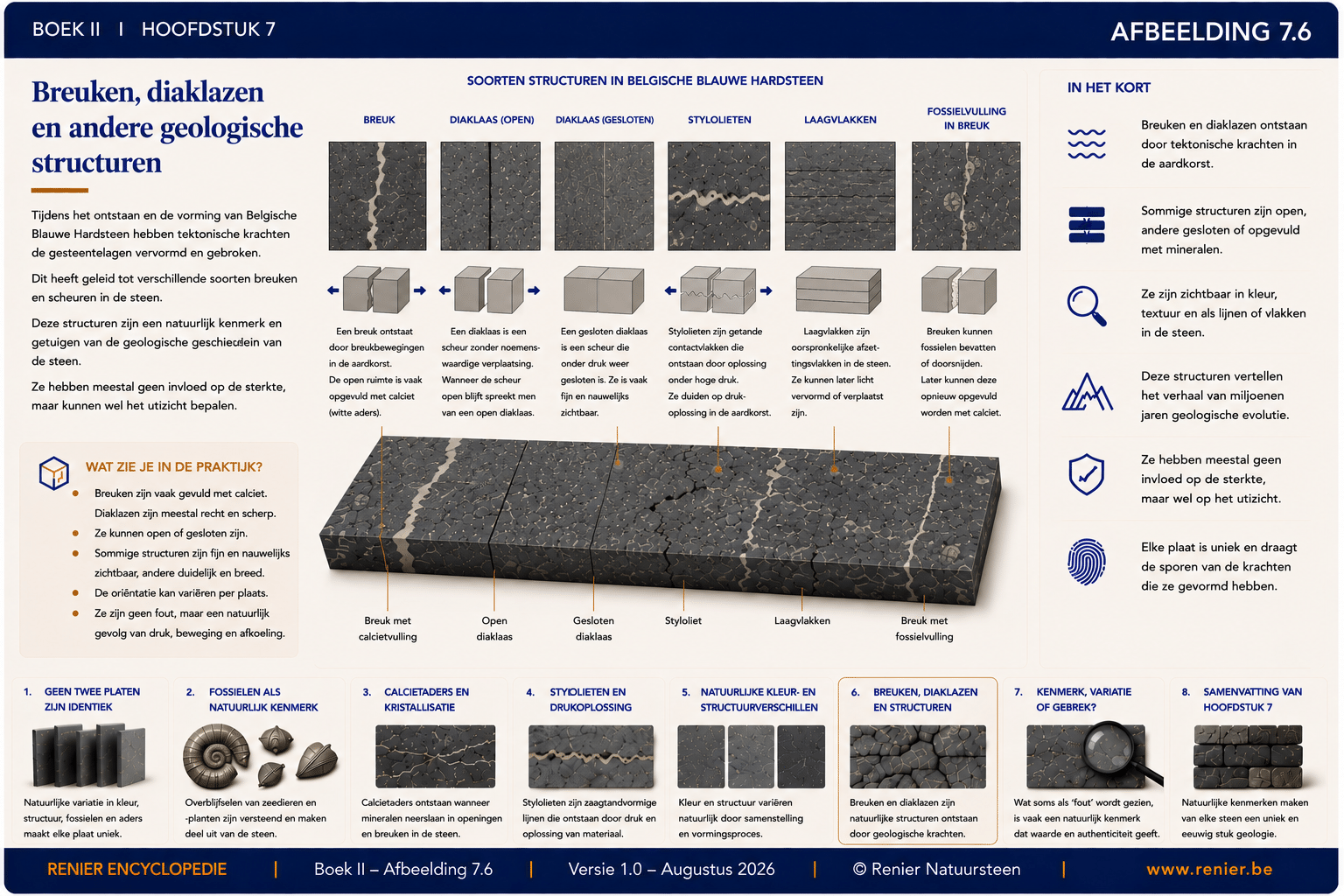
- Fractures, dikes, and other structures
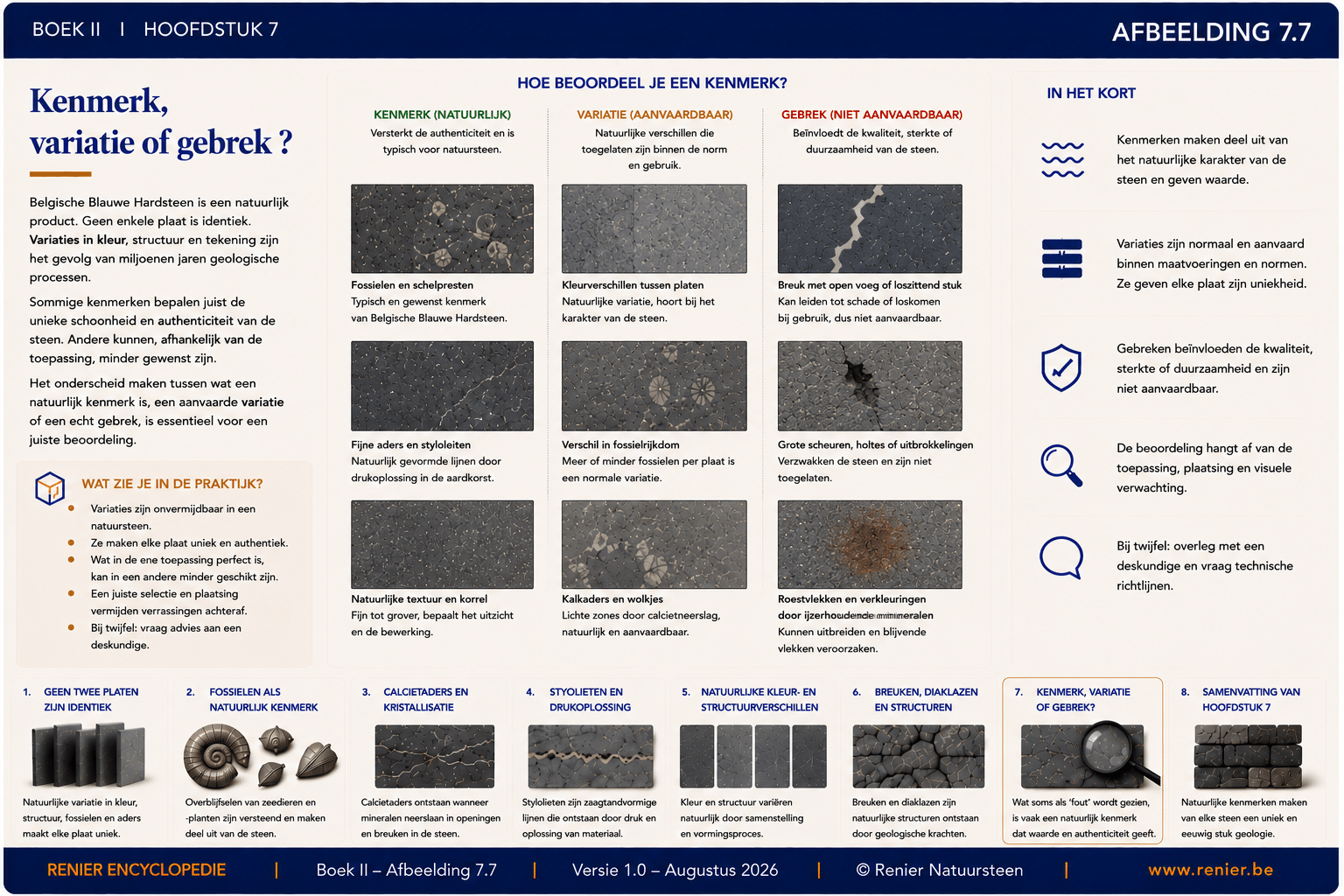
- Characteristic, variation, or defect?
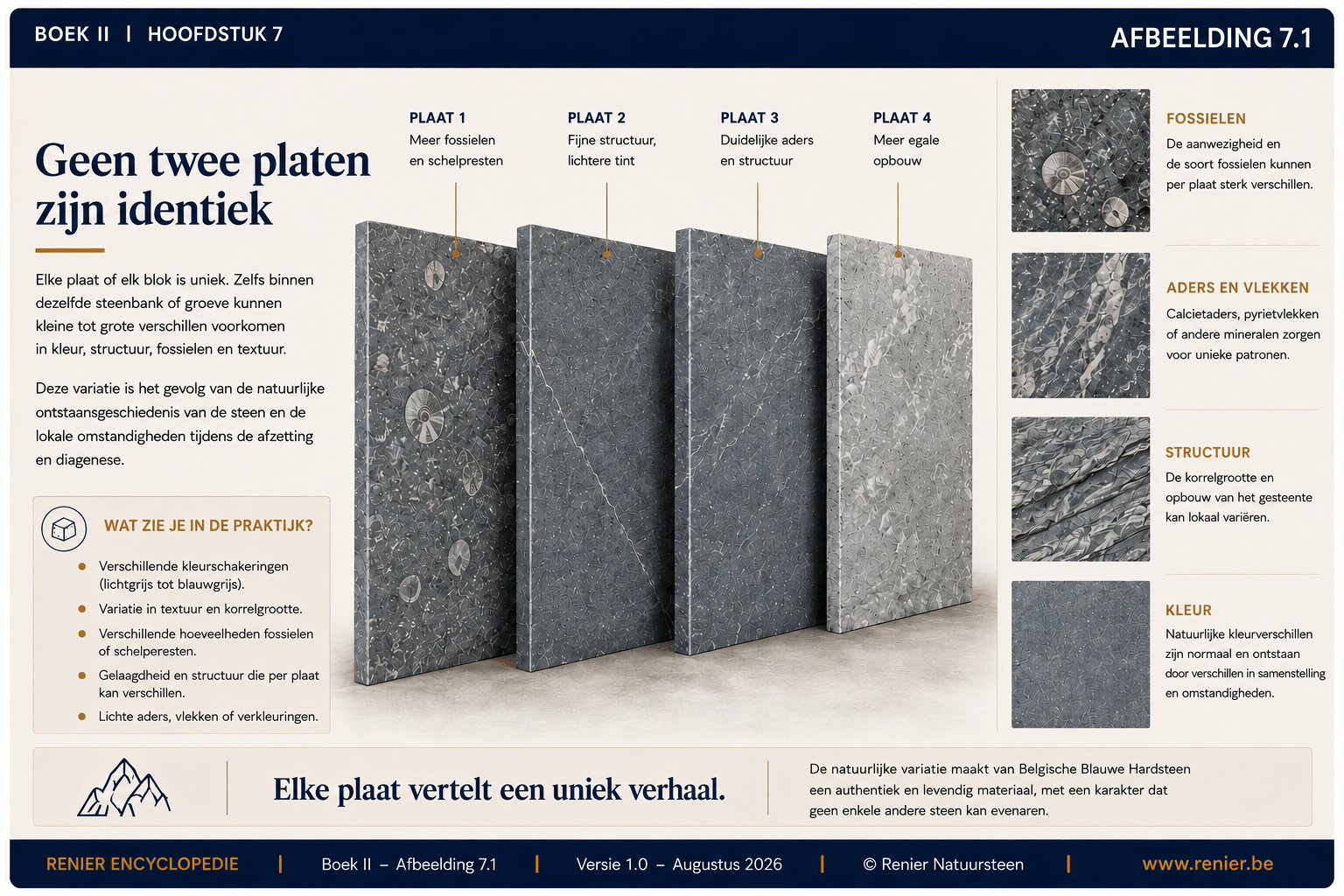
No two records are identical
Natural stone is not produced in a factory. Each slab is the result of natural processes that have taken place over millions of years.
Even within the same stone quarry, there can be variations in color, fossil content, texture, veining, and structure. Local variations during sedimentation and subsequent geological processes result in natural variation.
The way a block is cut also plays a role. The direction of the cut can determine how fossils, stratigraphic features, and veins are revealed.
Fossils as a natural feature
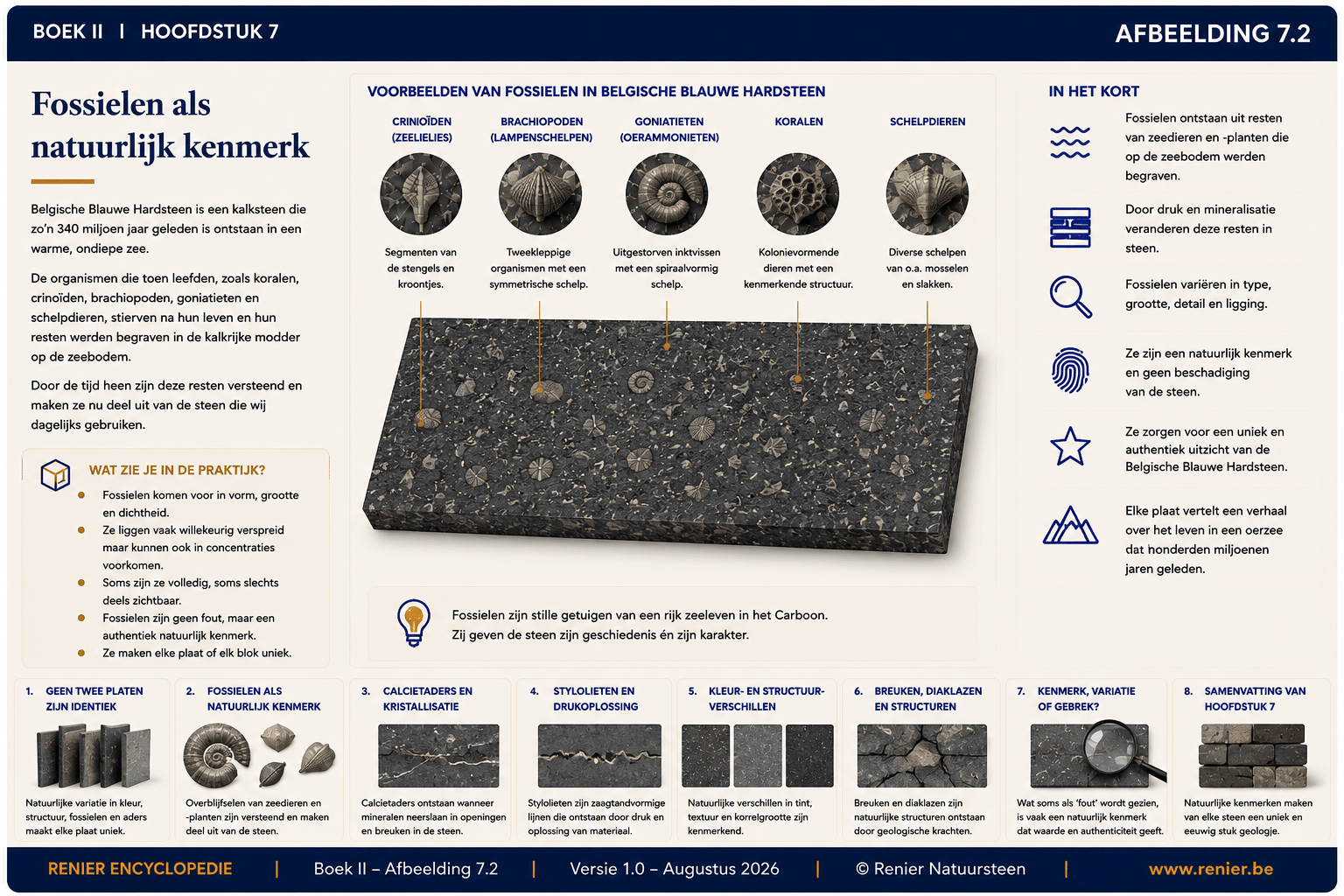
Fossils are among the most recognizable features of Belgian Blue Stone. They are the fossilized remains of organisms that lived in the tropical sea where the rock was formed during the Visean.
Sea lilies, brachiopods, corals, shellfish, and other organisms provided large quantities of calcareous material. After they died, their hard parts ended up in the sediment on the seafloor.
During the formation of the rock, those remains became part of the limestone itself. That is why fossils are not merely superficial decorations, but are literally part of the rock.
The number and visibility of fossils can vary greatly from slab to slab.
Calcite Veins and Crystallization
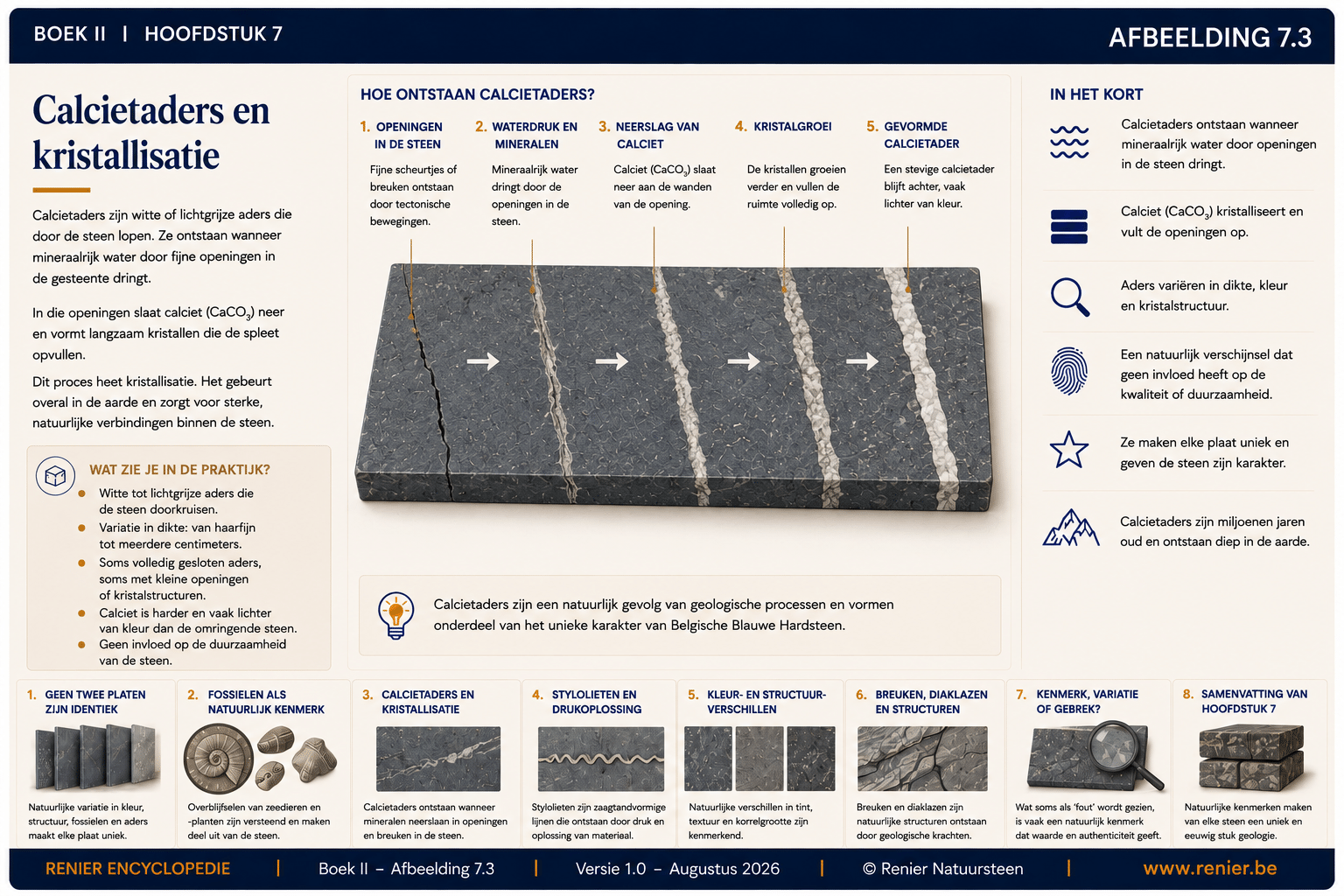
One of the most striking natural features is the light or white veins that run through the blue-gray stone. These veins often consist mainly of calcite.
They form when small openings or cracks in the rock become accessible to mineral-rich water. Calcium carbonate can precipitate from this water and gradually crystallize.
As a result, the original opening is partially or completely filled with calcite. The result can be a hair-thin line, or a wider crystalline vein.
The color of calcite is usually lighter than that of the surrounding rock, making the vein clearly visible on a sawn or polished surface.
Stylolites and Pressure Release
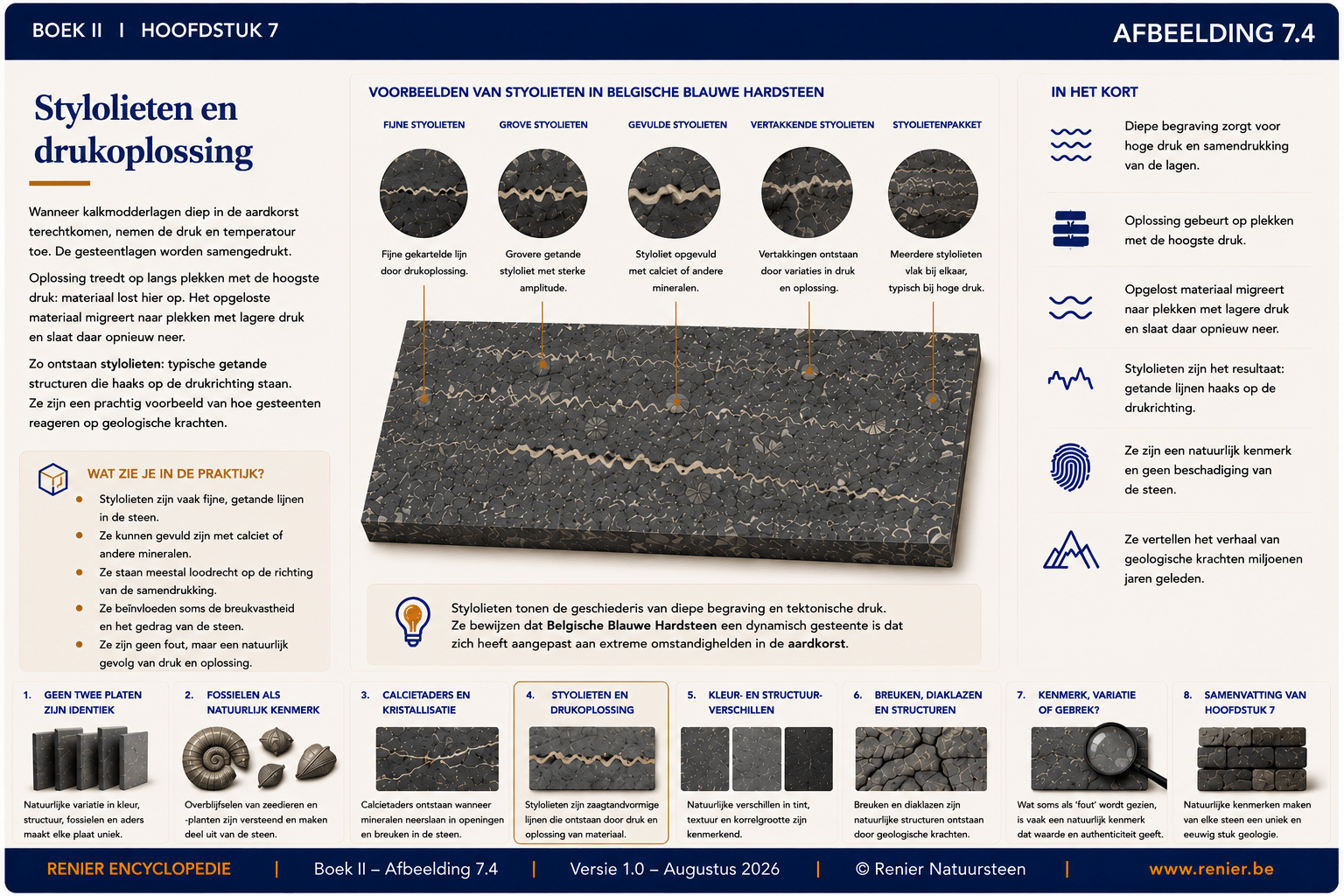
Stylolites are often dark or light-colored, sawtooth-shaped lines in limestone. They form in a very different way than ordinary fractures or calcite veins.
When limestone is buried deep underground, the rock is subjected to great pressure. In places where grains or rock layers press tightly against one another, calcite can slowly dissolve.
Geologists call this process printing solution. Material is removed along the contact surface, while less soluble components remain behind.
This results in an irregular, often jagged line. The direction and shape of a stylolite can provide information about the forces to which the rock was subjected.
Natural variations in color and texture
Although we refer to Belgian Blue Stone as a single type of stone, the material is never completely homogeneous.
The blue-gray color may be slightly lighter or darker. Some areas contain more visible fossils, while others have a more subdued and refined stone texture.
These differences are related to the original sedimentation. The amount of fossil material, the fineness of the calcareous mud, current, local conditions, and subsequent mineralization were not the same everywhere.
Even within a single sheet, there may be subtle variations in color and texture.
Faults, dikes, and other geological structures
After the sediment had turned into hard limestone, the rock continued to be subject to geological forces. Tectonic stresses could deform, split open, or break the layers.
A diaklaas is a natural fissure in the rock in which there has been virtually no displacement of either side .
In the case of a true fracture, movement or displacement along the fracture surface may have occurred. Some of the openings were later completely or partially filled with calcite or other minerals.
In addition, bedding planes, stylolites, and other natural structures may also be visible. Together, they form a geological record of what the rock has undergone since its formation.
Characteristic, variation, or defect?
When it comes to natural stone, it is important to distinguish between one natural characteristic, a acceptable variation and a truly defect.
Fossils, slight variations in color, small natural veins, and certain stylolites are, in principle, part of the natural characteristics of Belgian Blue Stone.
Other characteristics must be evaluated based on the application. For example, a natural material that can be used without any issues in a decorative wall panel may be less suitable in a location where high mechanical stress occurs.
We refer to a defect as a technical defect when a structural issue compromises the product’s necessary strength, durability, dimensional stability, or usability.
Natural Characteristics of Belgian Blue Stone
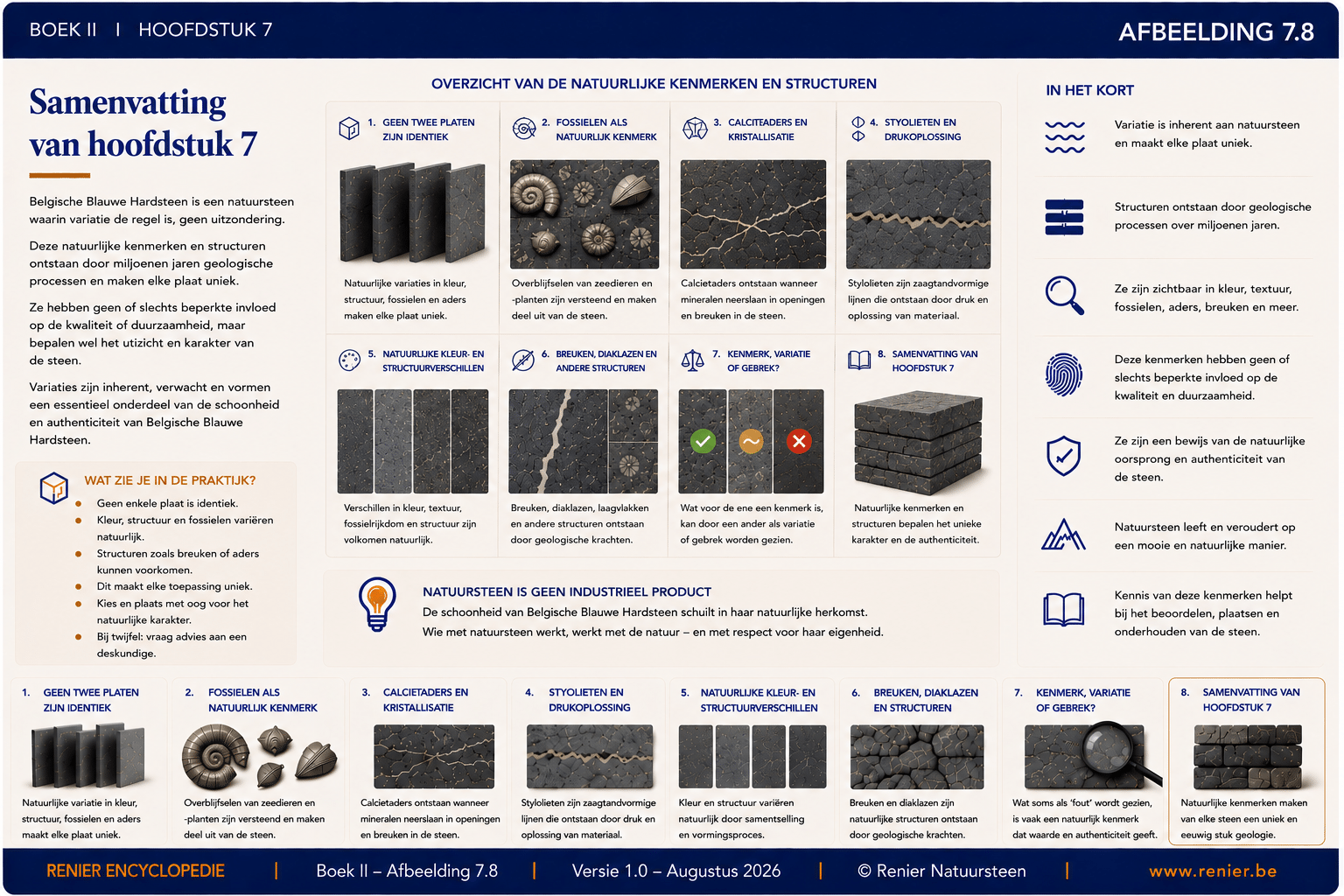
Belgian Blue Stone is not an industrially uniform material. Every quarry, every block, and every slab bears traces of its geological history.
A rock tells its own geological story
When we look at a slab of Belgian Blue Stone, we see more than just its color and surface.
A fossil is evidence of an organism that lived in a tropical sea. A calcite vein indicates that mineral-rich water once flowed through an opening in the rock. A stylolite is evidence of enormous pressure deep within the Earth’s crust, and a fracture may be a trace of later tectonic movement.
Learning to recognize these characteristics helps you correctly evaluate natural stone, select it wisely, and, above all, understand why genuine natural stone can never be completely uniform.