

To install a facade plinth, fully bond it using a flexible natural stone adhesive designed for outdoor use: apply the adhesive to the entire contact surface; never use isolated dots of adhesive. The plinth (usually 10 to 40 cm high) protects the bottom of your facade from splashing water, dirt, and damage. Belgian blue stone is the most commonly chosen material for this purpose, thanks to its low water absorption and frost resistance. Below: the correct procedure, the choice of height and material, and the two mistakes that cause the most damage.
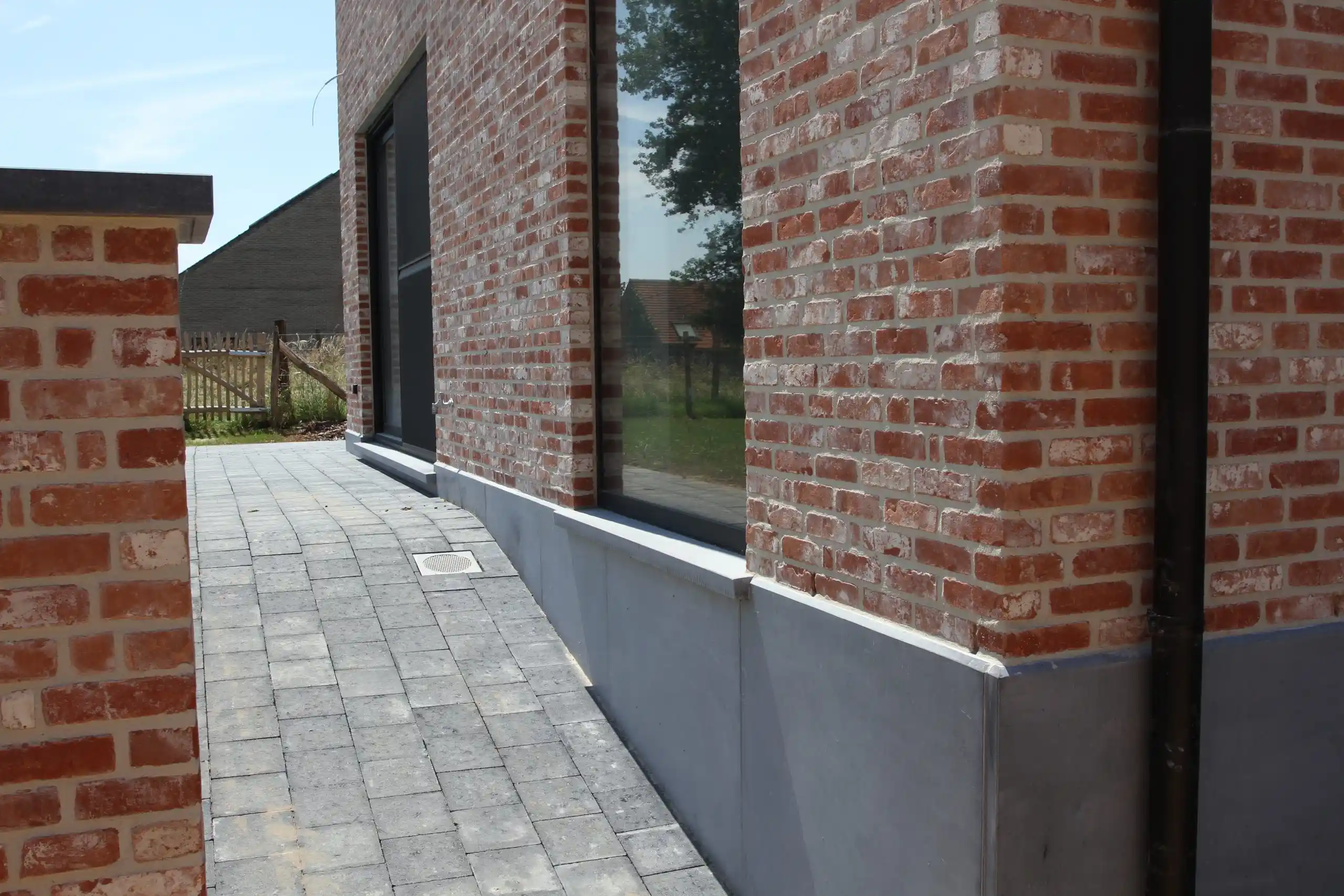
Step 1: Prepare the surface. The wall surface must be dry, smooth, structurally sound, and free of dust. Remove any loose mortar residue and dust the surface.
Step 2: Align. Set up a straight reference line (laser or string) so that the top of the baseboards aligns perfectly, even on a slightly sloping ground level.
Step 3: Apply adhesive thoroughly. Apply the flexible natural stone adhesive evenly over the entire back of the baseboard or the wall surface (or both, covering the entire surface). Press the baseboard firmly into place so that no gaps remain.
Step 4: Grouting. Grout the baseboards with a grout designed for natural stone and outdoor use, and waterproof the top edge so that water cannot seep behind the baseboard.
Step 5: Final cleaning. Remove any glue or grout residue immediately. Removing hardened residue from limestone is difficult; you can find out how to do it in our Maintenance FAQ.
Mistake 1: Applying with glue dots. Behind the baseboard, a cavity remains where moisture condenses; when it freezes, it expands and breaks the bond. This is the most common cause of loose facade baseboards.
Error 2: Staining caused by uneven adhesive application. Where there are dots of adhesive mortar, moisture penetrates the brick unevenly, and the dots show up as stains on the visible surface. Here, too, a full adhesive bed is the solution; read Staining on facade baseboards.
| Situation | Recommended height | Why |
|---|---|---|
| Modern home, sleek design | 10 to 15 cm | Subtle protection, minimalist |
| Classic home | 20 to 30 cm | Classic ratio, more protection |
| A lot of splashing water or dirt | Up to 40 cm | Maximum protection for masonry |
Belgian blue stone is the standard choice of material: it has low water absorption, is frost-resistant, and is low-maintenance, with a blue-sanded finish being the most popular option. As a rough estimate, expect to pay approximately 40 to 120 euros per running meter, depending on height, thickness, and finish. To learn exactly what a facade plinth is and why you might install one, read What is a blue stone base molding?.

How do you install a blue stone foundation plinth? Full-bed installation using a flexible natural stone adhesive for outdoor use: apply adhesive to the entire contact surface, press the baseboard into place without leaving any voids, grout with natural stone grout, and seal the top edge to make it waterproof.
Why shouldn't you install a fascia board using dots of adhesive? Moisture condenses in the cavities behind the baseboard; when it freezes, it expands and causes the bond to break. Glue spots also cause staining on the visible surface.
How high should a building base be? Usually 10 to 30 cm: 10 to 15 cm for modern homes, 20 to 30 cm for traditional homes, and up to 40 cm for facades that require extra protection.
Which stone is best for a foundation plinth? Belgian blue stone: low water absorption, frost-resistant, wear-resistant, and timeless in appearance. The most popular finish is blue-sanded.
How much does a blue stone foundation plinth cost? As a general guideline, expect to pay approximately 40 to 120 euros per running meter, depending on height, thickness, finish, and custom work.
Can I order custom-sized fascia boards? Yes, we cut custom-made facade baseboards in our own workshop in Aarschot. Request a quote with your measurements; contractors place orders at B2B rates through the wholesale.